
Setting Realistic Expectations in Satta Matka: The Reality of Probability & Winning
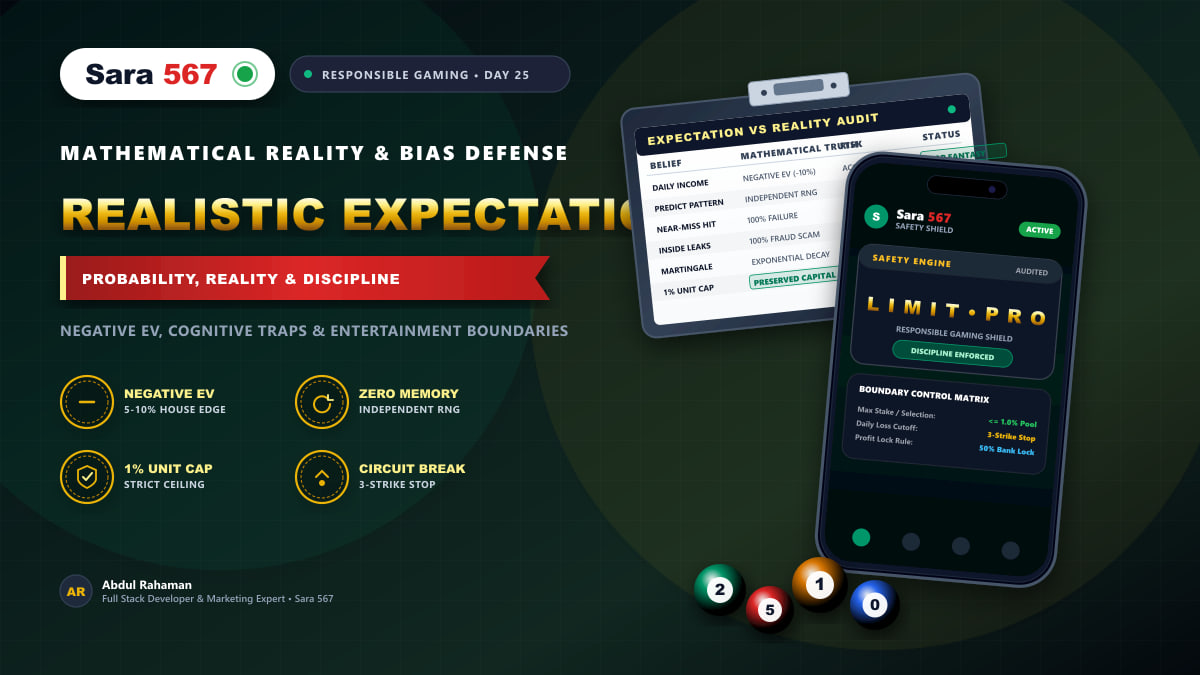
Setting Realistic Expectations in Satta Matka: The Reality of Probability & Winning
Every day, hundreds of thousands of people search Google, Telegram, and YouTube for phrases like "how to win Matka every day", "guaranteed fix jodi", or "make ₹5,000 daily from Satta Matka". The digital space is flooded with deceptive influencers, predatory tipsters, and edited bank screenshots promising financial freedom through numerical guessing.
The allure is obvious. In an era of inflation and economic anxiety, the dream of transforming a humble ₹100 note into ₹9,500 on a Jodi or ₹14,000 on a Single Pana feels like an escape hatch from financial struggle.
However, behind every romanticized story of an overnight winner lies the unyielding wall of combinatorics, negative expected value ($EV$), and statistical variance. When people enter numerical markets with the expectation of generating an income, building wealth, or recovering business debts, disaster is not a possibility—it is a mathematical certainty.
In this educational guide, we strip away the superstition and hype. We examine the psychological, financial, and mathematical realities of Satta Matka, helping you reset your perspective from destructive illusion to grounded, disciplined reality on platforms like Sara 567.
Table of Contents
- The Fundamental Myth: Satta Matka as an "Income Source"
- The Expectation vs. Reality Spectrum
- The Cognitive Biases That Fuel Unrealistic Beliefs
- Shifting Perspective: From "Investment" to "Entertainment Cost"
- The 4 Stages of Player Mindset Evolution
- Actionable Rules for Setting Ironclad Boundaries
- The Self-Diagnostic Safety Audit: Are Your Expectations Unhealthy?
- Frequently Asked Questions (Expectations FAQ)
1. The Fundamental Myth: Satta Matka as an "Income Source"
To understand why treating Matka as an income source is mathematically impossible, one must understand the difference between Positive Expected Value (+EV) activities and Negative Expected Value (-EV) activities.
| Activity Category | Mathematical Expectation | Long-Term Trajectory | Examples |
|---|---|---|---|
| Value Creation (+EV) | Positive Expected Return ($EV > 0$) | Capital grows with time and volume | Skilled labor, equity investing, building a business |
| Zero-Sum Games ($EV = 0$) | Mathematical Parity | Capital transfers based on pure skill edge | Professional poker, competitive arbitrage trading |
| Negative-Sum Games (-EV) | Negative Expected Return ($EV < 0$) | Capital steadily erodes to the operator house edge | Satta Matka, roulette, commercial lotteries |
The Mathematical Inevitability of Negative EV
As proven in our Odds & Payouts Guide, every wager category in Satta Matka incorporates an operator margin:
- Single Anks pay
9:1or9.5:1against true10:1odds (5% to 10% operator edge). - Jodis pay
90:1or95:1against true100:1odds (5% to 10% operator edge). - Single Panas pay
140:1against true220:1odds (36% operator edge).
If an activity has a negative expected value of -5% to -10%, the more frequently you play, the more certain you are to lose.
A salary from employment pays you for your time. An investment in mutual funds compounds value based on economic productivity. In contrast, playing Satta Matka every day is mathematically equivalent to taking a 5% to 10% tax on every single Rupee you cycle through the system. You cannot convert a negative-sum game into a salary through "better chart reading" or "secret formulas."
2. The Expectation vs. Reality Spectrum
Many participants enter the market with romantic illusions cultivated by viral social media posts. Examining these expectations side-by-side with mathematical reality reveals the structural traps:
| Player Expectation (Fantasy) | Mathematical & Practical Reality | Underlying Mechanism | Long-Term Psychological Consequence |
|---|---|---|---|
| "I can make a consistent ₹1,000 profit daily with discipline." | Daily consistent wins are mathematically impossible. Negative EV ensures net capital loss over volume. | Independent Bernoulli trials; previous results have zero physical memory. | Frustration, depression, and loss of confidence when non-hitting streaks occur. |
| "Chart patterns give me a 90% predictive edge on today's Kalyan result." | Historical charts provide organizational data, not predictive destiny. Each draw is an independent random event. | Law of Small Numbers fallacy; finding meaning in random clustering. | Blaming the platform or "bad luck" instead of understanding probability. |
| "If I lose today, I will double my bet tomorrow to recover everything." | Martingale doubling leads to exponential capital exposure and catastrophic total account wipeout. | Geometric stake progression ($2^n$) collides with finite bankroll limits. | Acute financial panic, debt accumulation, and severe psychological distress. |
| "A VIP Telegram channel has inside leak numbers from draw officials." | Inside leaks are 100% fraudulent confidence tricks. Results are generated in secure, sealed physical or RNG environments. | Split-audience scam trickery and advance-fee extortion schemes. | Complete loss of subscription fees on top of failed wager stakes. |
| "I only need one big Full Sangam hit to clear all my lifetime debts." | Full Sangam has a 1-in-48,400 probability with an overwhelming 79.3% operator edge. | Extreme long-shot bias; chasing low-probability outliers. | Steady, rapid erosion of living capital while waiting for an outlier that never arrives. |
3. The Cognitive Biases That Fuel Unrealistic Beliefs
Why do intelligent people hold irrational expectations about numerical games? Cognitive science and behavioral economics show that human brains evolved to recognize patterns in nature, not to compute abstract probability matrices.
| Trap Cycle Phase | Psychological Distortion | Player Internal Reaction | Behavioral Escalation |
|---|---|---|---|
| 1. Pattern Seeking | Apophenia & Clustering Illusion | Perceives a non-existent cycle on the chart | Commits initial capital |
| 2. Near-Miss Trap | Artificial Proximity Effect | Result is 78; bet was 77 ("So close!") | Dopamine surge without payout |
| 3. Outcome Bias | Self-Serving Attribution | Random hit occurs; credits "genius analysis" | Ego inflation & stake increase |
| 4. Chasing Spiral | Acute Tilt & Sunk Cost Fallacy | Drawdown begins; attempts to "recover" | Aggressive Martingale destruction |
| Cognitive Distortion | Common Internal Dialogue | The Cold Mathematical Reality | Antidote Mindset |
|---|---|---|---|
| The Near-Miss Effect | "My Jodi was 77 and the result was 78! I was only one number off, my formula is working!" | In probability, 77 is no closer to 78 than 02 or 94. A loss is a 100% failure; there are no partial credit payouts. | Treat every non-winning outcome identically. Do not assign emotional meaning to numeric proximity. |
| The Gambler's Fallacy | "Ank 5 hasn't appeared on Kalyan Open for 14 days; it is definitely due today!" | The random mechanism has no memory of past draws. The probability of Ank 5 today remains exactly 10% (1 in 10). | Recognize that numbers do not have memory. Independent trials cannot be "due." |
| Outcome Bias | "I won ₹9,500 on Milan Night yesterday, proving my weekly chart reading technique is superior." | In short samples, random luck masquerades as skill. A single win is a statistical outlier within a negative EV baseline. | Attribute wins to short-term variance, not personal analytical genius. Segregate profits immediately. |
| The Sunk Cost Fallacy | "I have already lost ₹15,000 this month. I cannot stop now or that money is gone forever." | Past losses are gone permanently. Continuing to play negative EV games merely increases cumulative losses. | Treat past losses as sunk costs. Closing an account preserves the capital that remains. |
4. Shifting Perspective: From "Investment" to "Entertainment Cost"
The healthiest psychological shift any participant can make is to stop viewing Satta Matka as an investment or financial vehicle, and view it exclusively as an entertainment expense.
When you go to a cinema hall, you pay ₹400 for a movie ticket and popcorn. You do not expect the cinema hall to return your ₹400 at the end of the movie. You willingly spend that money in exchange for two hours of emotional engagement, suspense, and entertainment.
Numerical market observation should be evaluated through the exact same lens:
| Entertainment Activity | Typical Cost per Session | Duration of Engagement | Financial Return Expectation | Tangible Value Delivered |
|---|---|---|---|---|
| Multiplex Movie | ₹350 - ₹600 | 2.5 hours | ₹0.00 (100% Expense) | Escapism, visual storytelling |
| Fine Dining / Restaurant | ₹1,000 - ₹2,500 | 1.5 hours | ₹0.00 (100% Expense) | Culinary pleasure, social connection |
| Amusement Park Visit | ₹1,200 - ₹3,000 | 6 hours | ₹0.00 (100% Expense) | Thrills, sensory excitement |
| Matka Observation (Recreational) | ₹50 - ₹100 (1 Unit) | 2 hours (Open to Close) | Negative EV (-₹5 to -₹10) | Analytical engagement, chart study |
The "Entertainment Budget" Rule
If you choose to track markets on Sara 567, you should establish an Entertainment Budget from discretionary income only:
- Never Stake Survival Capital: Money needed for food, rent, school fees, utilities, or emergency medical funds must never enter a gaming account.
- Consider the Stake Gone Immediately: The moment you place a unit on an Ank or Jodi, assume that money is spent, exactly like paying for a coffee. If you happen to hit, it is a pleasant surprise; if you do not, your financial life is completely unaffected.
- No Credit, No Borrowing: Never borrow from family, friends, credit cards, or instant digital loan apps to fund play. Borrowing money to fund a negative-expectation game is the fast lane to financial insolvency.
5. The 4 Stages of Player Mindset Evolution
Every person who engages with numerical markets travels along a psychological continuum. Recognizing where you stand on this spectrum is critical for maintaining personal sovereignty:
| Stage of Mindset | Emotional State | Financial Behavior | Warning Signs | Required Action |
|---|---|---|---|---|
| Stage 1: Casual Observer | Curiosity & intellectual interest | Small, infrequent stakes (₹20 - ₹50). Wins and losses provoke no strong emotion. | None. Healthy recreational hobbyist. | Maintain current strict unit discipline. |
| Stage 2: The Hopeful Strategist | Excited optimism; belief in "unlocking the secret pattern" | Daily play; begins spending hours reading charts; starts following YouTube "leak" channels. | Feeling minor frustration when predicted numbers fail. Thinking about numbers during work hours. | Step back. Read our Mathematics of Matka Guide to disabuse pattern illusions. |
| Stage 3: The Desperate Chaser | High anxiety, irritability, and guilt | Escalating stake sizes (5x to 10x). Trying to recover cumulative past losses with aggressive Martingale wagers. | Secretive behavior; hiding play from spouse or family; borrowing money to fund bets. | URGENT INTERVENTION REQUIRED. Enforce a 30-day total self-exclusion blackout. |
| Stage 4: Compulsive Spiral | Despair, emotional numbness, tunnel vision | Complete loss of financial control. Borrowing from high-interest loan sharks; using business working capital. | Total disregard for living expenses; panic attacks; suicidal ideation. | IMMEDIATE PROFESSIONAL HELP. Contact national problem gambling helplines and hand over finances to family. |
6. Actionable Rules for Setting Ironclad Boundaries
If you interact with numerical markets, protect yourself by enforcing these five golden boundary protocols:
Rule 1: The 1% Bankroll Unit Limit
Your maximum single wager should never exceed 1% of your total entertainment bankroll. If your allocated entertainment surplus for the month is ₹5,000, your maximum bet size on any single Ank or Jodi is exactly ₹50. This guarantees that even a prolonged streak of 15 non-hitting sessions consumes less than 15% of your entertainment funds.
Rule 2: The Daily 3-Strike Circuit Breaker
Never participate across more than 3 market declaration sessions in a single day. If your selections for the afternoon Time Bazar and evening Kalyan do not hit, the circuit breaker trips. You close your browser, turn off notifications, and do not look at Rajdhani Night or Milan Night for the rest of the calendar day.
Rule 3: The 50% Profit Lock Protocol
Whenever you experience an outlier win (such as hitting a 95:1 Jodi), immediately transfer at least 50% of the net profit into an external, locked bank savings account or mutual fund. Leaving massive winning windfalls inside an active digital wallet inevitably triggers dopamine-fueled stake escalation and rapid give-back.
Rule 4: Zero Exposure to Telegram / WhatsApp "Fixers"
Delete and block every Telegram channel, WhatsApp broadcast, or YouTube guru claiming to provide "100% confirmed leak numbers." As revealed in our Case Studies Analysis, these operations are pure advance-fee confidence rackets designed to extract secondary fees from vulnerable players.
Rule 5: Enforce Mandatory Screen-Free Days
Dedicate at least two days every week (e.g., Saturday and Sunday) where you do not check results, do not visit chart archives, and do not discuss numbers. This resets your brain's dopamine baseline and prevents compulsive behavioral habituation.
7. The Self-Diagnostic Safety Audit: Are Your Expectations Unhealthy?
Take this objective self-assessment to audit your relationship with numerical market tracking:
| Diagnostic Question | Healthy Indicator (Green Flag) | High-Risk Indicator (Red Flag) |
|---|---|---|
| Why are you looking at Matka charts? | For casual pattern curiosity, statistical hobby, or recreational tracking. | To pay rent, clear credit card debt, or replace my day job income. |
| How do you feel when your number doesn't hit? | Mild indifference: "Oh well, that's variance. On to other things." | Intense anger, physical heat in the chest, urge to immediately bet the next market. |
| Where does your stake money come from? | Discretionary entertainment surplus after savings and living expenses. | Borrowed funds, credit card cash advances, business working capital, or grocery funds. |
| Is your market activity transparent? | My partner or close friends know I casually track market results. | I hide my browser history, play in secret, and lie about my finances. |
| Can you step away for a week without anxiety? | Yes, easily. I frequently forget to check results for several days. | No. I feel severe FOMO (Fear Of Missing Out) and compulsive anxiety if I miss a draw. |
[!CAUTION] If you answered with two or more Red Flags, your expectations have crossed into the danger zone. We strongly urge you to step back immediately, enforce a cooling-off period, and seek support from responsible gaming resources.
8. Frequently Asked Questions (Expectations FAQ)
Q1: Can anyone consistently predict Satta Matka numbers using mathematics?
Answer: No. While mathematics can precisely calculate probability spaces, odds, and expected values, it cannot predict individual random outcomes. Each draw is an independent random trial; mathematics proves that long-term prediction of random numbers is an impossibility.
Q2: Why do so many people believe there are "fixed numbers" leaked from Mumbai?
Answer: Confirmation bias and aggressive marketing by scammers. Fraudulent operators send different numbers to thousands of people across split audiences; when one group inevitably wins by pure chance, the scammer uses that screenshot as "proof" of an inside leak to extort advance fees from the victims.
Q3: How much money should a beginner spend on Satta Matka?
Answer: Zero, unless it is treated strictly as an entertainment expense from disposable income that you are 100% prepared to lose without any impact on your living standards. If you choose to participate recreationally, keep unit sizes small (₹10 to ₹50) and never exceed 1% of your entertainment surplus.
Q4: Is tracking charts on Sara 567 safe?
Answer: Yes. Sara 567 is an open informational and historical analytics portal. We provide verified result records, sub-50ms WebSocket updates, and educational guides. We do not operate betting pools, do not take bets, do not sell "leak" tips, and do not solicit user funds.
Conclusion: Real Freedom Lies in Intellectual Clarity
Numerical markets are fascinating mathematical systems, but they are unforgiving to those who bring unrealistic expectations. The house edge, probability decay, and cognitive distortions are structural features designed to favor the operator over time.
True mastery does not mean predicting tomorrow's Jodi; true mastery means understanding the boundaries of mathematics, mastering your own psychology, and ensuring that no game ever threatens your family's financial security or mental peace.
Stay grounded, explore our verified Historical Charts, master the Psychology of Gaming, and track markets responsibly on Sara 567.
Full stack developer and marketing expert specializing in scalable web architecture, SEO optimization, and data-driven analytics for digital platforms.