
Kalyan Matka Complete Guide: Market History, Timings, Charts & Strategies
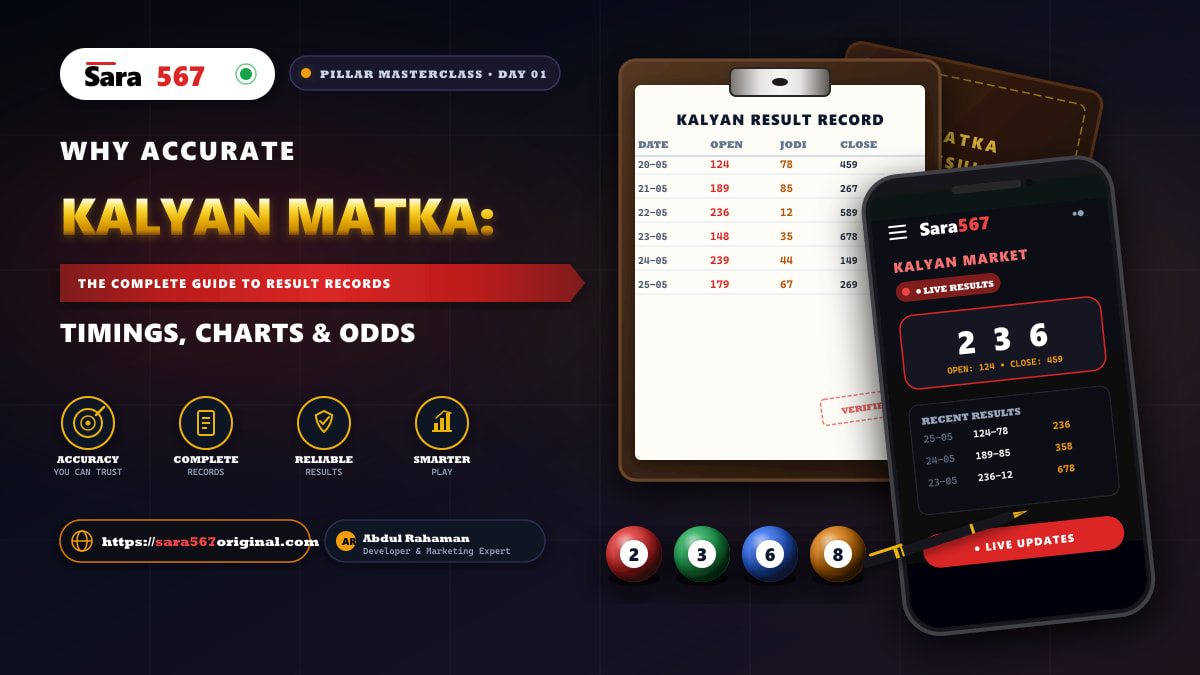
Kalyan Matka Complete Guide: Market History, Timings, Charts & Strategies
Kalyan Matka stands as the most iconic and enduring market in the history of Indian numerical guessing and speculative games. Originating in Mumbai during the early 1960s, Kalyan Matka has evolved from cotton exchange rate wagering into an organized digital numbers framework monitored by millions of enthusiasts daily. Whether you are seeking to understand the historical context of the game, learn how the mathematical draw calculations work, decipher intricate panel records, or implement responsible bankroll strategies, this complete guide provides the definitive informational breakdown.
At Sara 567 (sara567original.com), our mission is to deliver transparent, fast, and verified historical records. This pillar guide breaks down the core elements of Kalyan Matka from an analytical and educational perspective, demystifying the terminology, schedules, and probability models that govern the market.
Table of Contents
- The Origins and History of Kalyan Matka
- Kalyan Market Schedule and Official Timings
- Core Mechanics: How Kalyan Matka Numbers Are Derived
- Understanding the Types of Bets and Formats
- How to Read Kalyan Jodi and Panel Charts Like a Pro
- Analytical Approaches: Pattern Recognition vs. Probability
- Bankroll Management and Strategic Discipline
- Why Sara 567 Is the Preferred Platform for Live Kalyan Results
- Kalyan Matka vs. Other Popular Markets
- Comprehensive Kalyan Matka Terminology Glossary
- Frequently Asked Questions (FAQs)
- Responsible Gaming & Legal Notice
The Origins and History of Kalyan Matka
To comprehend the significance of Kalyan Matka in contemporary culture, one must explore its roots in post-independence Mumbai (then Bombay). In the late 1950s, the bustling neighborhoods of Central Bombay—such as Parel, Byculla, and Kalbadevi—were centers of cotton trading and textile mills. Mill workers, traders, and local residents began placing bets on the opening and closing rates of raw cotton transmitted via teleprinters from the New York Cotton Exchange to the Bombay Cotton Exchange.
The 1961 Turning Point
In 1961, the New York Cotton Exchange permanently outlawed the practice of transmitting speculative opening and closing quotes to foreign trading floors. This sudden regulatory shift threatened to collapse the informal betting ecosystem that thousands had come to rely upon for recreation.
Faced with this vacuum, an enterprising immigrant and grocery merchant named Kalyanji Bhagat (born in Ratadia, Kutch, Gujarat) revolutionized the game in 1962. Kalyanji conceived a system where numbers between 0 and 9 were written on slips of paper and placed inside an earthen pitcher known locally as a Matka.
Three chits were drawn at random to determine the winning numbers for the day. This simple yet effective system gave birth to the name "Matka", which became synonymous with Indian numbers wagering. Kalyanji Bhagat called his market the Worli Matka, operating seven days a week to accommodate the working-class community of Bombay.
The Evolution of Kalyan Matka
A few years later, in 1964, another legendary figure, Ratan Khatri, introduced the "New Worli Matka" (later known as the Main Bazar), introducing five-day trading schedules and stricter drawing rules. Despite competing variations, Kalyanji Bhagat's original market—which came to be universally known as Kalyan Matka—retained unmatched loyalty due to its accessible rules and dependable timing.
Over the decades, as manual chalkboards gave way to telephone syndicates and eventually modern digital architectures, Kalyan Matka transitioned entirely online. Today, platforms such as Sara 567 preserve this historical legacy by offering computerized result tracking, historical archives, and real-time updates accessible worldwide from any mobile browser or desktop device.
Kalyan Market Schedule and Official Timings
Timing is paramount in Kalyan Matka. Unlike twenty-four-hour financial markets, Matka operations adhere to strict daily cycles divided into two distinct sessions: the Open Session and the Close Session.
Daily Operating Hours
Kalyan Matka operates from Monday through Saturday, with selected operators also offering modified Sunday schedules. The recognized operational timings are as follows:
| Session Phase | Scheduled Announcement Time | Significance |
|---|---|---|
| Bidding Closes (Open) | 03:15 PM – 03:30 PM | Cut-off time for placing Open single and panel selections. |
| Kalyan Open Result | 03:45 PM IST | The first 3-digit Pana and single Open Ank are announced. |
| Bidding Closes (Close) | 05:15 PM – 05:30 PM | Cut-off time for placing Close single and Close panel selections. |
| Kalyan Close Result | 05:45 PM IST | The second 3-digit Pana and Close Ank are announced, completing the Jodi. |
Understanding these timings is crucial for anyone analyzing the market. The two-hour gap between 03:45 PM and 05:45 PM allows market participants to evaluate the first half of the sequence before the final combination is locked in.
Core Mechanics: How Kalyan Matka Numbers Are Derived
While newcomers often perceive Matka as bewildering arrays of random digits, the underlying arithmetic is strictly defined, symmetrical, and consistent. Every result is generated through a two-step addition process.
Step 1: The Open Draw Calculation
- Three random numbers between 0 and 9 are generated or drawn. For instance, consider the digits 2, 3, and 6.
- These three digits are always arranged in ascending numerical order:
2, 3, 6. This three-digit triplet is designated as the Open Pana (or Patti). - The three digits are summed together: $$\text{Sum} = 2 + 3 + 6 = 11$$
- The tens digit is discarded, and only the last single digit (the unit digit) is retained. In this example, the unit digit is 1.
- This resulting single digit is known as the Open Ank (or Single Open).
- The Open outcome is represented as:
236 - 1.
Step 2: The Close Draw Calculation
Two hours later, the identical procedure is conducted for the close session:
- Three new numbers between 0 and 9 are drawn, for instance: 3, 6, and 8.
- Arranged in ascending order, the triplet forms the Close Pana:
3, 6, 8. - The digits are added together: $$\text{Sum} = 3 + 6 + 8 = 17$$
- Discarding the tens digit leaves the unit digit 7, which becomes the Close Ank.
- The Close outcome is represented as:
7 - 368.
Step 3: The Complete Kalyan Full Result (Jodi)
When both sessions are concluded, the Open Ank (1) and Close Ank (7) are combined to form a two-digit pair called the Jodi: 17.
The complete result appears on display boards and on Sara 567 as: $$\mathbf{236 - 17 - 368}$$
Where:
- 236 = Open Pana (3 digits)
- 1 = Open Ank (1 digit)
- 7 = Close Ank (1 digit)
- 17 = Full Kalyan Jodi (2 digits)
- 368 = Close Pana (3 digits)
Understanding the Types of Bets and Formats
The mathematical architecture of Kalyan Matka supports multiple wagering formats, varying from straightforward single-digit guesses to intricate combination predictions. Each format carries distinct probabilities and payout ratios:
| Format / Bet Type | Digit Structure | Description & Example | Typical Payout Ratio |
|---|---|---|---|
| 1. Single (Ank) | 1 Digit (0 to 9) | Single unit digit prediction (e.g., 7) | 1 : 9 |
| 2. Jodi | 2 Digits (00 to 99) | Two-digit pair from Open and Close (e.g., 17) | 1 : 90 |
| 3. Single Pana (SP) | 3 Digits (Unique) | Panel of three distinct digits (e.g., 236) | 1 : 140 – 1 : 150 |
| 4. Double Pana (DP) | 3 Digits (Pair) | Panel with two identical digits (e.g., 112) | 1 : 280 – 1 : 300 |
| 5. Triple Pana (TP) | 3 Digits (Triplet) | Panel with three identical digits (e.g., 777) | 1 : 600 – 1 : 800 |
| 6. Half Sangam | 4 Digits | 1 Pana + 1 Opposite Single Ank (e.g., 236 - 7) | 1 : 1,000 |
| 7. Full Sangam | 6 Digits | Complete Open Pana + Close Pana (e.g., 236 - 368) | 1 : 10,000+ |
1. Single (Ank)
- Concept: Predicting the single unit digit (from 0 through 9) for either the Open or Close session.
- Probability: 1 in 10 (10%).
- Standard Ratio: 1 : 9.
2. Jodi
- Concept: Predicting the exact two-digit combination (from 00 through 99) formed by the Open and Close Anks.
- Probability: 1 in 100 (1%).
- Standard Ratio: 1 : 90.
3. Single Pana (SP)
- Concept: Predicting a 3-digit panel where all three digits are distinct (e.g., 147, 258, 369). There are 120 possible Single Pana combinations.
- Standard Ratio: 1 : 140 to 1 : 150.
4. Double Pana (DP)
- Concept: Predicting a 3-digit panel containing two identical digits (e.g., 112, 335, 889). There are 90 possible Double Pana combinations.
- Standard Ratio: 1 : 280 to 1 : 300.
5. Triple Pana (TP)
- Concept: Predicting a 3-digit panel where all three digits are identical (e.g., 000, 111, 222 ... 999). There are only 10 possible Triple Pana combinations in the entire game.
- Standard Ratio: 1 : 600 to 1 : 800.
6. Half Sangam & Full Sangam
- Half Sangam: Combining an Open Pana with a Close Single Ank, or a Close Pana with an Open Single Ank.
- Full Sangam: Accurately predicting both the Open Pana (3 digits) and the Close Pana (3 digits) simultaneously. This represents the pinnacle of Matka complexity, with odds exceeding 1 in 100,000.
How to Read Kalyan Jodi and Panel Charts Like a Pro
Historical result tracking is central to the Matka community. Serious analysts do not guess blindly; they study historical records maintained in structured tables. On Sara 567, these records are categorized into two primary presentations: Jodi Charts and Panel (Pana) Charts.
1. The Kalyan Jodi Chart
The Kalyan Jodi Chart displays the two-digit outcomes organized weekly from Monday to Saturday across historical months and years:
| Week Range | Mon | Tue | Wed | Thu | Fri | Sat |
|---|---|---|---|---|---|---|
| Oct 06 – 11 | 17 | 42 | 28 | 05 | 89 | 63 |
| Sep 29 – 04 | 35 | 91 | 60 | 74 | 12 | 55 |
| Sep 22 – 27 | 82 | 07 | 49 | 33 | 26 | 98 |
- Red Jodis (Cut Jodis): When the two digits of a Jodi are identical (e.g., 11, 22, 55) or when they sum to 5 or 10 (e.g., 16, 27, 38, 49, 05), they are often printed in red color on traditional charts. In Matka parlance, these are known as "Red Jodis" or "Family Numbers."
2. The Kalyan Panel (Pana) Chart
The Kalyan Panel Chart is the comprehensive record. Instead of showing merely the two-digit Jodi, each cell contains all eight digits of the day's result arranged in three stacked elements:
| Component Position | Example Value | Description & Timing |
|---|---|---|
| Open Pana (Top) | 236 | 3-digit ascending panel announced at 03:45 PM |
| Full Jodi (Middle) | 17 | 2-digit combination (1 Open Ank + 7 Close Ank) |
| Close Pana (Bottom) | 368 | 3-digit ascending panel announced at 05:45 PM |
By reviewing continuous weeks of panel charts, analysts evaluate:
- Repetition of Pansi: Whether specific 3-digit combinations (such as 149 or 345) recur across bi-weekly cycles.
- Cross-Line Patterns: How diagonal entries from Tuesday Open correlate with Thursday Close figures.
- Cut Digit Distribution: If an Open Ank is 3, checking whether its complementary "Cut Ank" (8) appears in subsequent days.
Analytical Approaches: Pattern Recognition vs. Probability
Over six decades, Matka veterans have formulated various analytical approaches designed to forecast potential outcomes. It is vital to examine these methodologies through both an empirical and mathematical lens.
1. The "Cut Ank" Theory (Complementary Digits)
In Matka arithmetic, every single digit from 0 to 9 has an assigned "Cut" counterpart, determined by adding 5 to the digit:
| Base Digit | Cut Digit | Base Digit | Cut Digit |
|---|---|---|---|
| 0 | 5 | 5 | 0 |
| 1 | 6 | 6 | 1 |
| 2 | 7 | 7 | 2 |
| 3 | 8 | 8 | 3 |
| 4 | 9 | 9 | 4 |
Many forecasting strategies suggest that when a certain digit fails to appear for several sessions, its Cut counterpart is mathematically overdue.
2. Panel Frequency & Summing Analysis
Another common technique involves tracking the arithmetic sum of the previous three days' Jodis. For example:
- Monday Jodi: 17 (Sum = 8)
- Tuesday Jodi: 42 (Sum = 6)
- Wednesday Target: Looking for Anks that align with the differential
8 - 6 = 2or8 + 6 = 14 -> 4.
3. The Reality of Independent Probability
From an objective mathematical perspective, each Kalyan Matka draw is an independent random event. Just like rolling a die or flipping a coin, the outcome of Wednesday's draw is not dictated by Monday's numbers. While historical pattern charts provide invaluable historical context and data visualization, no formula or software can guarantee future outcomes with certainty.
Bankroll Management and Strategic Discipline
Because Satta Matka is governed by statistical variance, participating without strict bankroll discipline inevitably leads to financial loss. Professional analysts emphasize that risk management is far more crucial than number guessing.
Core Principles of Responsible Play
- The 1% Rule: Never allocate more than 1% to 2% of your disposable entertainment budget on any single Kalyan session. If your monthly entertainment fund is ₹5,000, your maximum exposure per day should not exceed ₹50 to ₹100.
- Never Chase Losses: The "Martingale" strategy (doubling your stake after a loss to recover capital) is catastrophic in numbers games. Successive losses can wipe out capital within a handful of iterations.
- Fixed Profit & Stop-Loss Limits: Establish hard boundaries before a session begins. For example, if you reach a pre-set gain of ₹500 or a loss limit of ₹200, conclude your activity for the day immediately.
- Separate Funds: Never utilize funds reserved for household necessities, rent, education, or emergency savings for speculative activities.
- Acknowledge the House Edge: Understand that the mathematical payout ratios in any commercial numbers game incorporate an intrinsic margin for the market operator.
Why Sara 567 Is the Preferred Platform for Live Kalyan Results
In the fast-moving world of Indian Matka, the accuracy and latency of information delivery make all the difference. Users tracking Kalyan results choose Sara 567 (sara567original.com) for several distinct advantages:
- Lightning-Fast Live Publishing: As soon as Kalyan Open (03:45 PM) and Close (05:45 PM) results are verified, our automated systems update the homepage within seconds.
- Error-Free Historical Archives: Our database hosts clean, verified Kalyan Jodi and Panel charts spanning months and years, allowing researchers to study patterns without transcription errors.
- Mobile-First Responsive Interface: Built with modern web frameworks, the Sara 567 portal loads instantaneously on 4G and 5G smartphones, even in areas with low bandwidth.
- Zero Distracting Pop-Ups: Unlike legacy Matka portals cluttered with deceptive advertisements, Sara 567 provides a clean, user-centric interface focused strictly on readable data tables.
- Multi-Language Accessibility: Readers across India can access navigational aids, explanations, and guides in English, Hindi, and regional languages.
Kalyan Matka vs. Other Popular Markets
While Kalyan Matka remains the undisputed king of Indian market games, several other markets operate throughout the day and evening. Understanding the distinction helps users organize their viewing schedules:
| Feature / Metric | Kalyan Matka | Milan Day | Rajdhani Day | Time Bazar |
|---|---|---|---|---|
| Open Time | 03:45 PM | 03:00 PM | 03:15 PM | 01:00 PM |
| Close Time | 05:45 PM | 05:00 PM | 05:15 PM | 02:00 PM |
| Operating Days | Mon – Sat | Mon – Sun | Mon – Fri | Mon – Sat |
| Market Origin | Central Bombay (1962) | Milan Syndicates | Northern/Delhi Hubs | Old Cotton Mill Hub |
| Volatility / Volume | Highest in India | Moderate-High | High | Moderate |
| Primary Draw Format | 3-digit Pana + Single Ank | 3-digit Pana + Single Ank | 3-digit Pana + Single Ank | 3-digit Pana + Single Ank |
Kalyan's afternoon window (3:45 PM to 5:45 PM) positions it perfectly between the early noon markets like Time Bazar and the late evening sessions like Milan Night and Rajdhani Night.
Comprehensive Kalyan Matka Terminology Glossary
To communicate effectively within the community and navigate result portals, you should master this essential vocabulary:
- Ank (Single): Any single numeral ranging from 0 to 9.
- Jodi (Pair): Any two-digit number ranging from 00 to 99 formed by joining Open and Close Anks.
- Pana / Patti (Panel): A three-digit combination arranged strictly in ascending order (e.g., 125, 458).
- Single Pana (SP): A Pana comprising three entirely distinct digits (e.g., 137).
- Double Pana (DP): A Pana comprising two identical digits and one distinct digit (e.g., 225).
- Triple Pana (TP): A Pana comprising three identical digits (e.g., 444).
- Open Result: The outcome of the first session announced at 03:45 PM.
- Close Result: The outcome of the second session announced at 05:45 PM.
- Matka: The historical earthen pot once used to draw random lots.
- Family / Cut Jodi: A pair of numbers that share identical mathematical roots or reciprocal cut digits (e.g., 14 and 69).
- Sangam: The simultaneous alignment of Open and Close panel configurations.
Frequently Asked Questions (FAQs)
Q1: What are the exact result timings for Kalyan Matka?
Answer: The official Kalyan Matka Open result is declared at 03:45 PM IST, and the Kalyan Close result is declared at 05:45 PM IST, operating from Monday through Saturday.
Q2: Who was Kalyanji Bhagat, and why is the market named after him?
Answer: Kalyanji Bhagat was an Indian farmer and merchant from Kutch, Gujarat, who pioneered the Worli Matka in Mumbai in 1962. Because of his foundational role and fair operating standards, the market was permanently named Kalyan Matka in his honor.
Q3: What is the difference between a Jodi Chart and a Panel Chart?
Answer: A Jodi Chart displays only the two-digit winning numbers (Open Ank + Close Ank) organized in calendar grids. A Panel (Pana) Chart displays the full eight-digit breakdown, including the 3-digit Open Pana, the 2-digit Jodi, and the 3-digit Close Pana.
Q4: Is there any mathematical formula to predict Kalyan Matka results with 100% accuracy?
Answer: No. Every draw in Kalyan Matka is an independent random event governed by probability. While historical charts reveal frequencies and statistical trends, anyone claiming to possess "fixed" or "guaranteed" winning numbers is engaging in deceptive behavior.
Q5: What is a "Red Jodi" in the Kalyan chart?
Answer: A "Red Jodi" (also called a Cut Jodi or Family Jodi) occurs when both digits are identical (such as 00, 11, 22) or when the two digits are complementary cuts of each other (such as 16, 27, 38, 49, 05). On traditional physical display charts, these combinations were marked in red ink.
Q6: Where can I check verified live Kalyan Matka results online?
Answer: You can access live, instant, and verified updates on Sara 567 and review historical panel records on our dedicated Kalyan Charts archive page.
Responsible Gaming & Legal Notice
[!CAUTION] Important Legal & Financial Disclaimer:
Real-money wagering and gambling activities in India are governed by the Public Gambling Act of 1867 and state-specific legislations. Laws vary significantly between jurisdictions: while some states allow licensed lotteries and skill-based activities, traditional speculative wagering is prohibited in numerous territories.
All information published on Sara 567 (
sara567original.com) is provided strictly for informational, educational, and historical research purposes. Sara 567 does not operate wagering services, accept financial deposits, or guarantee commercial outcomes. Users are strongly advised to adhere to their local state laws, maintain rigorous personal financial discipline, and avoid real-money gambling if it poses risks to personal or financial well-being.
Full stack developer and marketing expert specializing in scalable web architecture, SEO optimization, and data-driven analytics for digital platforms.