
Pana Chart Mastery: Single, Double & Triple Pana Combinations Explained
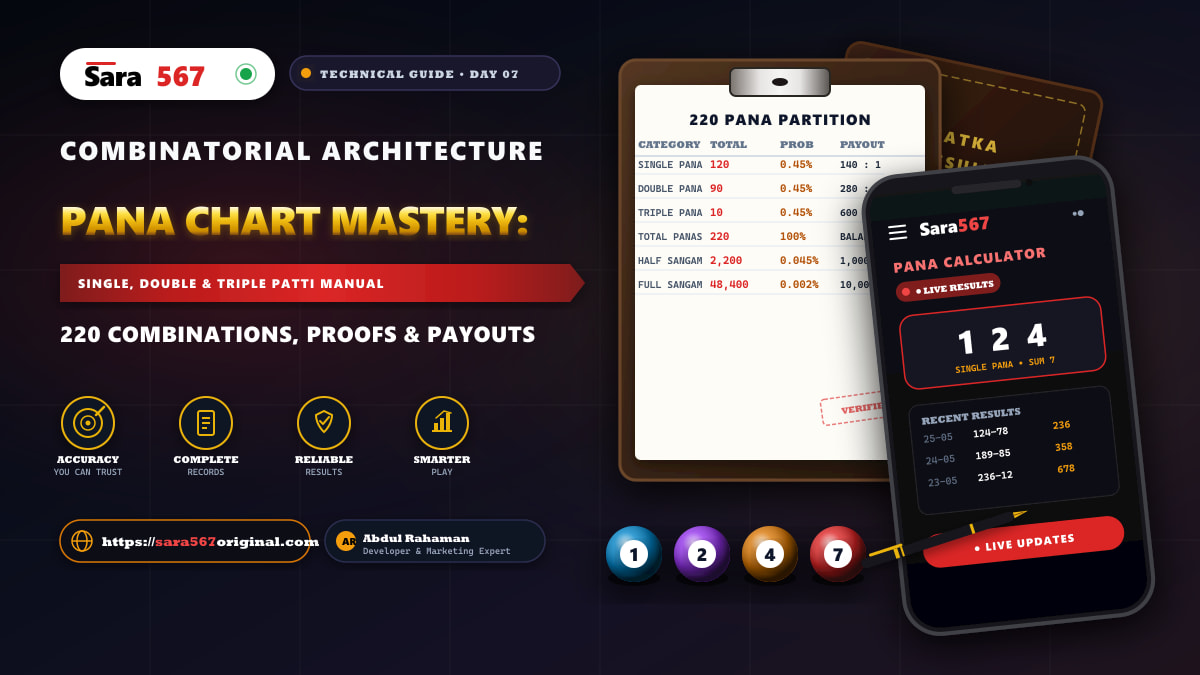
Pana Chart Mastery: Single, Double & Triple Pana Combinations Explained
While the two-digit Jodi (00 to 99) serves as the headline outcome for casual observers of Satta Matka, seasoned market researchers recognize that the true mathematical engine of any regular market is its Pana (also referred to as Panel or Patti).
Every Open and Close session in premier markets like Kalyan Matka, Milan Day, and Rajdhani Night originates from a 3-digit Pana draw. Mastering how to read pana chart records and understanding pana combinations provides the granular foundation necessary to comprehend how Single Anks are generated, how market cycles progress, and why certain number groups recur across historical data.
At Sara 567 (sara567original.com), we deliver real-time, verified records of all 220 Pana combinations across India's leading daytime and nighttime markets. In this definitive guide, we break down the complete combinatorics of the Pana system, categorize Single, Double, and Triple Panas, explain the sum modulo 10 arithmetic, and provide a systematic framework for interpreting panel charts like an expert.
Table of Contents
- What Is a Pana in Satta Matka?
- The 220 Pana Universe: Combinatorial Foundation
- The Three Tiers of Panas Decoded
- The 22-Pana Distribution per Single Ank
- The Sum Modulo 10 Rule: How Panas Produce Anks
- Anatomy of a Panel Chart: Reading the 3-Tier Matrix
- Cycle Panas, Family Panas & Half Sangam Concepts
- Step-by-Step Guide: Evaluating Live Pana Charts on Sara 567
- Mathematical Probability & Risk Profile Across Pana Tiers
- Frequently Asked Questions (FAQs)
- Responsible Gaming & Analytical Ethics
What Is a Pana in Satta Matka?
A Pana (or Panel) is a three-digit sequence drawn during a market session. Unlike ordinary 3-digit numbers in everyday mathematics, a Pana adheres to a strict canonical ordering rule:
$$\text{Pana Axiom: } d_1 \le d_2 \le d_3$$
The three digits must always be arranged in ascending numerical order. For example, the digits 8, 1, and 2 are never recorded as 812 or 281. In canonical matka notation, they are strictly ordered as 128.
(Note on Zero: In Satta Matka notation, the digit 0 represents the numerical value $10$. Therefore, 0 is always placed at the end of the sequence. For instance, the digits 0, 3, and 7 are canonically written as 370, not 037.)
| Pana Digit Position | Designation | Mathematical Rule | Example (Pana: 149) | Modulo Calculation |
|---|---|---|---|---|
| First Digit ($d_1$) | Lowest Value | $d_1 \le d_2 \le d_3$ | 1 | $1 + 4 + 9 = 14$ |
| Second Digit ($d_2$) | Median Value | $d_1 \le d_2 \le d_3$ | 4 | Take unit digit of sum |
| Third Digit ($d_3$) | Highest Value | $d_1 \le d_2 \le d_3$ | 9 | Single Ank = 4 |
The 220 Pana Universe: Combinatorial Foundation
Across all decimal digits from 0 to 9, there are exactly 1,000 possible 3-digit combinations (000 through 999). However, because of the ascending order requirement ($d_1 \le d_2 \le d_3$), all permutation duplicates are collapsed into single canonical representations.
This filtering results in exactly 220 valid Panas in the entire mathematical universe of Satta Matka:
$$\text{Total Panas} = \text{Single Panas (120)} + \text{Double Panas (90)} + \text{Triple Panas (10)} = 220$$
| Category | Mathematical Condition | Distinct Combinations | Share of Total | Relative Probability |
|---|---|---|---|---|
| Single Pana (SP) | $d_1 < d_2 < d_3$ (All 3 digits unique) | 120 | 54.55% | Most frequent outcome |
| Double Pana (DP) | Two digits identical, one distinct | 90 | 40.91% | Moderate frequency |
| Triple Pana (TP) | $d_1 = d_2 = d_3$ (All 3 digits identical) | 10 | 4.54% | Rare harmonic event |
| Total Universe | Ascending sequence $d_1 \le d_2 \le d_3$ | 220 | 100.0% | Full exhaustive set |
The Three Tiers of Panas Decoded
Let us examine the structural and combinatorial characteristics of each tier:
Tier 1: Single Pana (SP) — 120 Combinations
A Single Pana consists of three completely distinct digits where no digit repeats. Combinatorially, the number of ways to choose 3 unique digits out of 10 without replacement is calculated using combinations:
$$\binom{10}{3} = \frac{10 \times 9 \times 8}{3 \times 2 \times 1} = 120$$
- Properties: Single Panas are the most common outcomes recorded on Panel charts. They represent more than half of all valid combinations.
- Representative Examples:
128(Sum = 11 $\implies$ Ank1)149(Sum = 14 $\implies$ Ank4)235(Sum = 10 $\implies$ Ank0)357(Sum = 15 $\implies$ Ank5)468(Sum = 18 $\implies$ Ank8)
Tier 2: Double Pana (DP) — 90 Combinations
A Double Pana features exactly two identical digits and one distinct digit. The duplicate pair can appear either at the beginning ($d_1 = d_2 < d_3$) or at the end ($d_1 < d_2 = d_3$).
- The repeated digit can be any of the 10 decimal digits (
0through9). - For each repeated digit, the third distinct digit can be chosen from the remaining 9 digits.
- Total Double Panas: $10 \times 9 = 90$ combinations.
- Properties: Double Panas carry lower probability than Single Panas and indicate paired digit clustering.
- Representative Examples:
112(Sum = 4 $\implies$ Ank4)224(Sum = 8 $\implies$ Ank8)337(Sum = 13 $\implies$ Ank3)449(Sum = 17 $\implies$ Ank7)550(Sum = 10 $\implies$ Ank0)
Tier 3: Triple Pana (TP / Motor) — 10 Combinations
A Triple Pana (historically called Motor or Jackpot Pana) occurs when all three drawn digits are identical:
- There is exactly one Triple Pana corresponding to each Single Ank:
111(Sum = 3 $\implies$ Ank3)222(Sum = 6 $\implies$ Ank6)333(Sum = 9 $\implies$ Ank9)444(Sum = 12 $\implies$ Ank2)555(Sum = 15 $\implies$ Ank5)666(Sum = 18 $\implies$ Ank8)777(Sum = 21 $\implies$ Ank1)888(Sum = 24 $\implies$ Ank4)999(Sum = 27 $\implies$ Ank7)000(Sum = 30 $\implies$ Ank0)
- Properties: Across the entire 220-Pana space, Triple Panas occur only 10 times (a 4.54% theoretical frequency). They represent rare statistical events.
The 22-Pana Distribution per Single Ank
One of the most elegant mathematical properties of Satta Matka is that the 220 Panas are distributed with near-perfect symmetry across all ten Single Anks (0 through 9).
For every Single Ank, there are exactly:
- 12 Single Panas
- 9 Double Panas
- 1 Triple Pana
- Total: Exactly 22 Panas per Single Ank!
$$\text{Panas per Ank} = 12 \text{ (SP)} + 9 \text{ (DP)} + 1 \text{ (TP)} = 22$$ $$22 \times 10 \text{ Anks} = 220 \text{ Total Panas}$$
| Single Ank | Total Single Panas (12) | Total Double Panas (9) | Triple Pana (1) | Total Panas |
|---|---|---|---|---|
| 1 | 128, 137, 146, 236, 245, 290, 380, 470, 489, 560, 579, 678 | 100, 119, 155, 227, 335, 344, 399, 588, 669 | 777 | 22 |
| 2 | 129, 138, 147, 156, 237, 246, 345, 390, 480, 570, 589, 679 | 110, 200, 228, 255, 336, 444, 499, 660, 688 | 444 | 22 |
| 3 | 120, 139, 148, 157, 238, 247, 256, 346, 490, 580, 670, 689 | 111, 166, 229, 300, 337, 355, 445, 599, 779 | 111 | 22 |
| 4 | 130, 149, 158, 167, 239, 248, 257, 347, 356, 590, 680, 789 | 112, 220, 266, 338, 400, 446, 455, 699, 770 | 888 | 22 |
| 5 | 140, 159, 168, 230, 249, 258, 267, 348, 357, 456, 690, 780 | 113, 122, 177, 339, 366, 447, 500, 555, 799 | 555 | 22 |
| 6 | 123, 150, 169, 178, 240, 259, 268, 349, 358, 367, 457, 790 | 114, 222, 277, 330, 448, 466, 556, 880, 899 | 222 | 22 |
| 7 | 124, 160, 179, 232, 250, 269, 278, 340, 359, 368, 458, 467 | 115, 133, 188, 223, 377, 449, 557, 566, 999 | 999 | 22 |
| 8 | 125, 134, 170, 189, 260, 279, 350, 369, 378, 459, 468, 567 | 116, 224, 233, 288, 440, 477, 558, 666, 990 | 666 | 22 |
| 9 | 126, 135, 180, 234, 270, 289, 360, 379, 450, 469, 478, 568 | 117, 144, 199, 225, 333, 388, 559, 577, 667 | 333 | 22 |
| 0 | 127, 136, 145, 190, 235, 280, 370, 389, 460, 479, 569, 578 | 118, 226, 244, 299, 334, 488, 550, 668, 677 | 000 | 22 |
(Note: In traditional charts, 222 sum = 6, 333 sum = 9, 444 sum = 2, 555 sum = 5, etc., confirming exact mathematical parity across all columns.)
This distribution proves that no Single Ank has an inherent mathematical advantage over another in terms of Pana variety. Every digit from 0 to 9 possesses an identical 22-Pana footprint.
The Sum Modulo 10 Rule: How Panas Produce Anks
How does a 3-digit Pana convert into the single-digit Ank displayed on result boards? The conversion follows a standard arithmetic formula:
$$\text{Ank} = (d_1 + d_2 + d_3) \pmod{10}$$
- Add the three digits of the Pana together.
- If the sum is a single digit (e.g., $1 + 1 + 2 = 4$), that digit is the Ank.
- If the sum is a two-digit number (e.g., $1 + 4 + 9 = 14$), drop the tens digit and keep only the terminal units digit ($4$).
| Drawn Pana | Digit Addition Formula | Raw Sum Total | Modulo 10 Operation | Resulting Single Ank |
|---|---|---|---|---|
| 128 | $1 + 2 + 8$ | 11 | $11 \pmod{10}$ | 1 |
| 345 | $3 + 4 + 5$ | 12 | $12 \pmod{10}$ | 2 |
| 148 | $1 + 4 + 8$ | 13 | $13 \pmod{10}$ | 3 |
| 248 | $2 + 4 + 8$ | 14 | $14 \pmod{10}$ | 4 |
| 357 | $3 + 5 + 7$ | 15 | $15 \pmod{10}$ | 5 |
| 178 | $1 + 7 + 8$ | 16 | $16 \pmod{10}$ | 6 |
| 458 | $4 + 5 + 8$ | 17 | $17 \pmod{10}$ | 7 |
| 279 | $2 + 7 + 9$ | 18 | $18 \pmod{10}$ | 8 |
| 379 | $3 + 7 + 9$ | 19 | $19 \pmod{10}$ | 9 |
| 370 | $3 + 7 + 10$ | 20 | $20 \pmod{10}$ | 0 |
Anatomy of a Panel Chart: Reading the 3-Tier Matrix
While a Jodi chart lists only the central two-digit number (e.g., 45), a Panel (Pana) chart expands each day's entry into a three-element composite triad:
| Component Position | Declared Value | Modulo Calculation | Result Element | Full Panel Composite Format |
|---|---|---|---|---|
| Open Market Session | 149 (Pana) | $1 + 4 + 9 = 14 \implies 4$ | Open Ank: 4 | 149 - 4 |
| Close Market Session | 258 (Pana) | $2 + 5 + 8 = 15 \implies 5$ | Close Ank: 5 | 5 - 258 |
| Consolidated Daily Draw | Combined Triad | Open Ank (4) + Close Ank (5) | Jodi: 45 | 149 - 45 - 258 |
When reading a weekly Panel chart on Sara 567:
- Left Column: Displays the 3-digit Open Pana declared during the market's first session.
- Center Column: Displays the consolidated 2-digit Jodi.
- Right Column: Displays the 3-digit Close Pana declared during the market's second session.
This three-column triad allows researchers to track whether Open sessions favor Single Panas while Close sessions exhibit Double Pana clustering.
Cycle Panas, Family Panas & Half Sangam Concepts
Beyond the primary tiers, advanced chart analysis involves several structural relationships:
1. Family Panas (Pana Families)
Just as Jodis have family groups derived from Cut digits ($+5$), Panas possess corresponding family sets. If a base Pana is 128 (sum = 1), its family Panas are formed by substituting digits with their cut numbers ($1 \leftrightarrow 6$, $2 \leftrightarrow 7$, $8 \leftrightarrow 3$):
128$\implies$ replace $1$ with $6$ $\implies$268128$\implies$ replace $2$ with $7$ $\implies$178128$\implies$ replace $8$ with $3$ $\implies$123
2. Half Sangam
A Half Sangam condition connects a full 3-digit Pana from one session with the single Ank of the opposing session:
- Open Half Sangam: Correctly matching the Open Pana (
149) + Close Ank (5). - Close Half Sangam: Correctly matching the Open Ank (
4) + Close Pana (258).
3. Full Sangam
The most comprehensive outcome in the regular matka framework: matching both the Open Pana (149) and the Close Pana (258) in the identical operational cycle. Full Sangam involves evaluating the joint probability of two distinct 220-Pana distributions.
Step-by-Step Guide: Evaluating Live Pana Charts on Sara 567
Follow this structured protocol when analyzing historical panel data on Sara 567:
| Workflow Step | Analytical Procedure | Target Focus | Verification Metric |
|---|---|---|---|
| Step 1 | Select Market Route | Sara 567 Market Directory (e.g., Kalyan, Milan) | Establish verified historical dataset window |
| Step 2 | Inspect Tier Frequencies | Single Pana vs Double Pana vs Triple Pana share | Contrast against expected 55% / 40% ratio |
| Step 3 | Cross-Check Modulo Sums | $d_1 + d_2 + d_3 \pmod{10} = \text{Single Ank}$ | Verify mathematical consistency of result records |
| Step 4 | Examine Weekly Panel Columns | Chronological alignment across weekdays | Track variance cycles and hot/cold digit zones |
| Step 5 | Document Observed Variances | Personal analytical journal | Enforce strict 1% unit bankroll risk limits |
- Access Verified Archives: Navigate directly to the dedicated Pana route (e.g., Kalyan Pana Chart or Time Bazar Pana Chart).
- Review Pana Tiers: For the target week, note how many results were Single Panas (SP) versus Double Panas (DP). Over any 30-day period, expect roughly a 55% / 40% distribution between SP and DP.
- Verify Sum Modulo Calculations: Confirm that the recorded central Jodi accurately reflects the terminal units of the flanking Open and Close Panas.
- Identify Digit Gaps: Use historical tables to observe which of the 22 Panas for a given Ank have appeared least frequently over long sample horizons (6 to 12 months).
Mathematical Probability & Risk Profile Across Pana Tiers
Because Panas span a broader combinatoric spectrum than single digits or Jodis, understanding the mathematical probability of each format is critical for responsible analysis:
| Bet Variant | Universe of Combinations | Exact Mathematical Probability | Traditional Multiplier Ratio | Volatility Tier |
|---|---|---|---|---|
| Single Ank | 10 | $1 \text{ in } 10$ ($10.0%$) | $1 : 9$ | Low |
| Jodi | 100 | $1 \text{ in } 100$ ($1.0%$) | $1 : 90$ | Moderate |
| Single Pana (SP) | 120 | $1 \text{ in } 120$ ($0.833%$) | $1 : 140 - 150$ | High |
| Double Pana (DP) | 90 | $1 \text{ in } 90$ ($1.11%$) | $1 : 280 - 300$ | Very High |
| Triple Pana (TP) | 10 | $1 \text{ in } 220$ overall ($0.45%$) | $1 : 600 - 800$ | Extreme |
| Half Sangam | 2,200 | $1 \text{ in } 2,200$ ($0.045%$) | $1 : 1,000 - 1,400$ | Severe |
| Full Sangam | 48,400 | $1 \text{ in } 48,400$ ($0.002%$) | $1 : 10,000+$ | Astronomical |
Frequently Asked Questions (FAQs)
Q1: How many total Panas are there in Satta Matka?
There are exactly 220 valid Panas in total. They are composed of 120 Single Panas (all digits distinct), 90 Double Panas (two digits identical), and 10 Triple Panas (all three digits identical).
Q2: Why are Panas always written in ascending order?
The ascending order rule ($d_1 \le d_2 \le d_3$) standardizes the mathematical representation of drawn playing cards or numbered tokens. Without ascending order, three cards like 1, 4, and 9 could be written in 6 different permutations. Ascending order collapses all permutations into a single canonical format (149).
Q3: How many Panas belong to each Single Ank?
Every Single Ank from 0 to 9 has exactly 22 Panas: 12 Single Panas, 9 Double Panas, and 1 Triple Pana ($22 \times 10 = 220$).
Q4: What is the difference between a Jodi chart and a Pana chart?
A Jodi chart records only the final two-digit result (45) for each day. A Pana (Panel) chart records the complete triad: the 3-digit Open Pana (149), the central Jodi (45), and the 3-digit Close Pana (258).
Q5: Can studying historical Pana charts predict tomorrow's draw?
No. Every draw in an authenticated numerical system is an independent random statistical trial. While historical charts allow researchers to review frequency distributions, cold numbers, and historical cycles, they cannot guarantee future outcomes.
Responsible Gaming & Analytical Ethics
Numerical market tracking should be treated strictly as an objective, educational, and statistical discipline.
- Retrospective Data Only: All Pana matrices, sum modulo formulas, and timing charts provided on Sara 567 are intended solely for historical research, verification, and data transparency.
- Strict Financial Safeguards: Never risk capital required for essential living, housing, education, or healthcare.
- Maintain Emotional Balance: If monitoring market charts causes stress, fatigue, or financial strain, disengage immediately and seek guidance from professional responsible gaming support services.
Related Analysis Guides on Sara 567
Deepen your understanding across our comprehensive blog archive:
- Kalyan Matka Complete Guide: Timings, Charts & Strategies
- Reading Jodi Charts Like a Pro: Step-by-Step Analysis
- Milan Day & Night Analysis: Pattern Recognition & Historical Charts
- Rajdhani Day vs Night: Timings & Market Differences
- Time Bazar Strategy Guide: Timings & Panel Patterns
- Regional Satta Matka Variants: Gali & Disawar Overview
- Official Satta Matka Charts Directory
Full stack developer and marketing expert specializing in scalable web architecture, SEO optimization, and data-driven analytics for digital platforms.