
The Psychology of Gambling: Understanding the Mindset Behind Satta Matka
The Psychology of Gambling: Understanding the Mindset Behind Satta Matka
In the study of numerical wagering markets like Satta Matka, discussions almost universally focus on mechanical and statistical elements: Pana combinations, Jodi frequency distributions, and mathematical probability frameworks. Yet, empirical research in behavioral economics and neurobiology reveals a counterintuitive reality: mathematical literacy alone rarely protects a participant from financial drawdown.
The primary point of failure for participants is almost never an inability to perform arithmetic; rather, it is the inability to govern the neuro-cognitive mechanisms that hijack human decision-making under uncertainty. When capital is placed at risk and numbers flash across live declaration feeds on platforms like Sara 567, ancient biological survival circuits overpower the logical prefrontal cortex.
Cognitive phenomena such as the Gambler’s Fallacy, the Illusion of Control, the Near-Miss Effect, and the catastrophic emotional tailspin known as Tilt are not accidental character flaws. They are hardwired evolutionary shortcuts (heuristics) that evolved to spot predators and forage food in nature, but malfunction spectacularly when exposed to synthetic, stochastic number games.
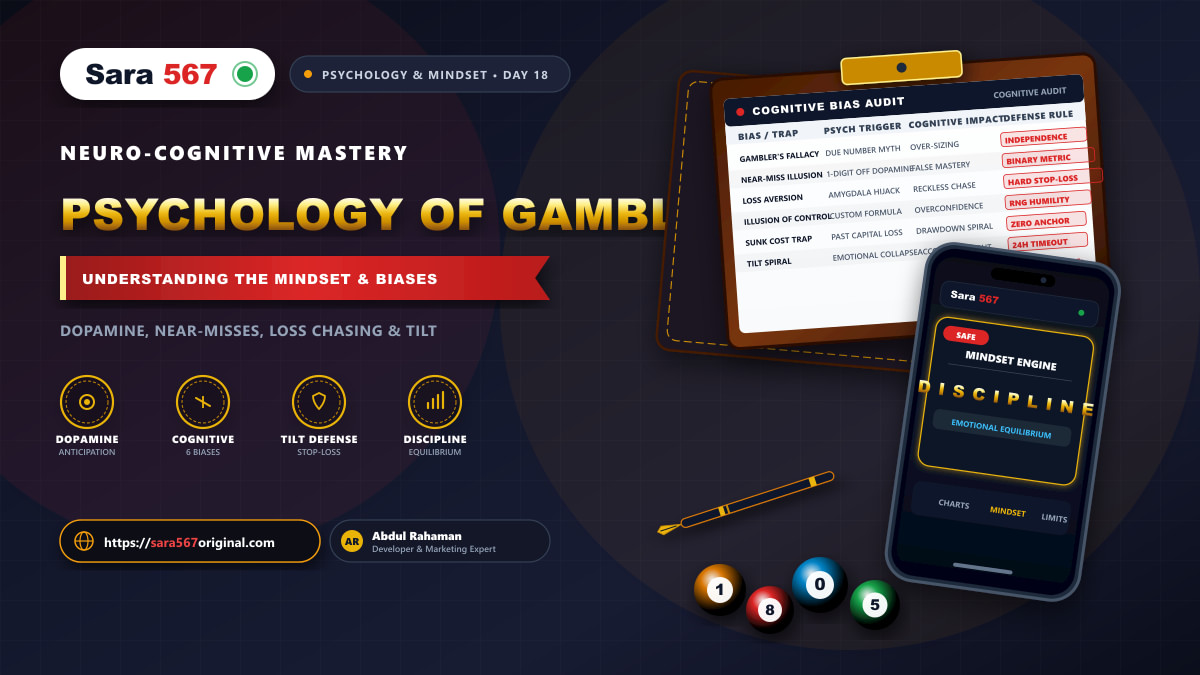
In this comprehensive educational masterclass, we dissect the neuropsychology of gambling through the lens of Satta Matka. We analyze why the brain falls into irrational cognitive traps, map out the neurochemical cascades behind "near-misses," identify the six fatal biases governing speculative behavior, and deliver an actionable cognitive defense framework to safeguard mental equilibrium and financial capital.
Table of Contents
- The Neurological Engine: Dopamine, Variable Rewards & The Near-Miss
- The 6 Major Cognitive Biases Dominating Satta Matka
- The Neurobiology of "Tilt": Anatomy of Emotional Collapse
- The Illusion of Control & Pattern Pareidolia
- The Psychology of Social Exploitation: Why Smart People Fall for "Fix Leaks"
- The Cognitive Defense Framework: Systematic Rules for Emotional Equilibrium
- How Sara 567 Promotes Analytical Objectivity
- Self-Diagnostic Mindset Audit: Healthy Observer vs. Compromised Player
- Frequently Asked Questions (FAQs)
- Responsible Gaming Ethics & Psychological Support Resources
The Neurological Engine: Dopamine, Variable Rewards & The Near-Miss
To understand why participants exhibit persistent, often compulsive engagement with Satta Matka markets, one must look beneath conscious thought into the brain's mesolimbic dopamine pathway—the neurological reward engine.
The Dopamine Loop:
- Anticipation Window: Countdown to market declaration triggers heightened neurological arousal.
- Dopamine Spike: Neurochemical surge peaks during the moment of uncertainty, not after the result.
- Outcome Event: Binary declaration occurs (Win, Loss, or Near-Miss).
- Reinforced Habit Loop: Unpredictable payout cadence prevents habituation, cementing compulsive repetition.
1. Anticipation Over Outcome
Contrary to popular belief, dopamine is not the neurochemical of satisfaction or pleasure; it is the neurochemical of anticipation, craving, and pursuit.
Pioneering neuroscientist Wolfram Schultz demonstrated that dopamine neurons fire at their highest frequency not when a subject receives a reward, but during the window of uncertainty leading up to the reward. When an individual wagers on an Open Ank in Kalyan Matka and watches the countdown clock tick toward 4:10 PM, dopamine concentrations in the nucleus accumbens surge dramatically. The brain becomes hyper-focused, treating the pending announcement as a high-stakes survival event.
2. Variable Ratio Reinforcement Schedules
In the 1950s, behavioral psychologist B.F. Skinner discovered that animals conditioned with fixed rewards (a food pellet every 5th lever press) quickly became bored and ceased pressing once satiated. However, when animals were placed on a Variable Ratio Reinforcement Schedule—where the reward was delivered unpredictably after an unknown number of presses—their behavior became obsessive and resistant to extinction.
Satta Matka embodies the ultimate variable reinforcement mechanism. A player might experience a 1:9 payout on Single Ank today, lose for three days, strike a 1:90 Jodi next week, and lose again. This structural unpredictability prevents dopamine habituation, permanently keeping the player’s motivational circuitry in a state of hyper-arousal.
3. The "Near-Miss" Paradox
Perhaps the most destructive neurological phenomenon in numbers markets is the Near-Miss Effect. Consider this real-world scenario:
- An individual analyzes historical charts and wagers on Single Pana
124(sum = $7$). - The official market declaration announces Pana
125(sum = $8$).
To a computer or an objective mathematician, Pana 125 is a total loss, identical in financial consequence to Pana 789. Both return exactly zero. However, functional Magnetic Resonance Imaging (fMRI) studies conducted by neuroscientist Dr. Luke Clark reveal that the human brain does not process a near-miss as a loss.
Instead, the brain's insula and striatum register the near-miss with a neurochemical signature almost indistinguishable from a win. The brain interprets the event as an almost-win or a skill indicator ("My formula was only off by one digit! I'm closing in!"). This false signal induces an urgent dopamine surge, compelling the player to place an immediate follow-up wager to "correct the minor variance."
| Neurological Trigger | Biological Mechanism | Subjective Psychological Perception | Behavioral Consequence |
|---|---|---|---|
| Declaration Countdown | Mesolimbic dopamine surge prior to outcome | Intense thrill, tunnel vision, heightened pulse | Heightened emotional attachment to random numbers |
| Variable Payout Cadence | Unpredictable intermittent reward schedule | "My turn to hit could be on the very next draw" | Compulsive, habitual repetition of wagers |
The Near-Miss (124 vs 125) | Insula activation mirroring a genuine monetary win | "My reading was right, luck was just slightly off" | Escalated wager sizing and immediate re-entry |
| Big Win Early on | Super-normal stimulus resetting reward threshold | "I have natural intuition and an edge in this market" | Overconfidence, unrealistic risk tolerance |
| Consecutive Losses | Amygdala activation triggering fight-or-flight | Severe panic, wounded ego, visceral injustice | Aggressive loss chasing (Tilt) |
The 6 Major Cognitive Biases Dominating Satta Matka
Human cognitive architecture relies on cognitive shortcuts (heuristics) to make rapid judgments. In statistical environments with independent events, however, these shortcuts transform into catastrophic cognitive biases.
| Step | Cognitive Bias | Erroneous Internal Monologue | Mathematical Reality |
|---|---|---|---|
| 1. Trigger | Gambler's Fallacy | "Digit 4 is overdue; it must appear today." | Independent probability ($P = 0.10$ on every draw). |
| 2. Selection | Illusion of Control | "My custom birthdate formula beats raw chance." | Calculations organize historical data, not future outcomes. |
| 3. Memory | Confirmation Bias | "I predicted that win! (Erases 20 prior losses)" | Selective recall filters out painful drawdowns. |
| 4. Drawdown | Loss Aversion | "I must double my wager to recover immediately." | Pain of loss ($2.5\times$) overrides rational sizing. |
| 5. Escalation | Sunk Cost Fallacy | "I have spent ₹20,000 tracing this line; I can't stop now." | Past losses cannot be retrieved by taking further risk. |
| 6. Collapse | Catastrophic Tilt | "All-in on the next draw to reset the ledger." | Amygdala hijack causes total capital liquidation. |
1. The Gambler's Fallacy (The Monte Carlo Illusion)
The Gambler's Fallacy is the mistaken conviction that past independent events influence future probabilities. In Satta Matka, this manifests as the "Due Number" belief:
"Digit 3 hasn't appeared as Kalyan Open for 18 consecutive sessions. The law of averages guarantees it must drop within the next two days!"
The Mathematical Reality: As proven in our Mathematical Aspects of Satta Matka Guide, physical lottery draws and certified Random Number Generators possess no memory. On Day 19, the probability of Single Ank 3 appearing remains precisely:
$$P(\text{Ank } 3) = \frac{1}{10} = 10.0%$$
The universe does not "balance" short-term historical deviations. The coin, the urn, and the RNG do not know they have produced 18 non-threes. Assuming an outcome is "due" leads players to dangerously increase their stake sizes on a flat, unchanging 10% chance.
2. The Illusion of Control
Harvard psychologist Ellen Langer established that people behave as though chance events are subject to their personal skill if elements of choice, familiarization, or competition are introduced.
In Satta Matka, players experience the Illusion of Control when they:
- Select numbers derived from personal dates, numerology, or mystical dreams.
- Manually calculate elaborate "Cut Ank" formulas ($+5 \pmod{10}$) or "Berij" equations.
- Physically place their own selections rather than accepting random assignments.
Because the player spent 45 minutes cross-referencing historical Jodi charts, their brain attributes predictive power to their effort. When the selection fails, they don't conclude that the market is stochastic; they conclude their formula was merely "missing one factor."
3. Confirmation Bias & The Selective Memory Archive
Confirmation bias causes individuals to aggressively search for, interpret, and recall information that confirms preexisting beliefs while systematically discounting contradictory evidence.
- The Victory: When a player hits a 1:90 Jodi after tracking a "Family Bracket" for three weeks, they celebrate loudly, screenshot the winning receipt, and share it on social media. The event is permanently branded into their memory as evidence of analytical genius.
- The Losses: The 24 consecutive failed wagers that preceded the win are mentally dismissed as "bad luck," "operator manipulation," or "market anomalies."
Over a year, the player's subjective recollection is that they are "roughly break-even or slightly ahead," when an objective bankroll audit would reveal an unrecoverable 35% negative return.
4. Loss Aversion (Prospect Theory)
Nobel laureates Daniel Kahneman and Amos Tversky demonstrated in Prospect Theory that the psychological pain of losing money is approximately 2 to 2.5 times more intense than the psychological joy of winning the exact same amount.
Prospect Theory Impact (Kahneman & Tversky):
- Pleasure from Winning ₹10,000: $+1.0\times$ baseline psychological utility.
- Pain from Losing ₹10,000: $-2.5\times$ psychological distress (250% more intense).
- Behavioral Outcome: Fear of realizing a loss drives desperate, exponential wager escalation (the Martingale instinct).
Because losing ₹10,000 hurts far more than winning ₹10,000 satisfies, people become violently risk-seeking when confronted with losses. While a rational investor would accept a small loss to preserve capital, a loss-averse gambler will double or quadruple their position on the subsequent session (the Martingale instinct) in a desperate attempt to reset their ledger to zero.
5. The Sunk Cost Fallacy
The Sunk Cost Fallacy occurs when an individual continues an endeavor solely as a result of previously invested resources (money, time, or emotional energy).
In Matka culture, this is known as "Tracing a Line" (Line Pakadna). A player decides that Jodi 48 is primed to strike. They back it with ₹500 on Monday. It misses. On Tuesday, they wager ₹1,000. It misses. By Friday, they have sunk ₹15,000 into this single idea.
Even if the player's rational mind recognizes that continuing is catastrophic, the emotional brain screams: "If I stop now and it drops tomorrow, all my ₹15,000 was wasted!" The player wagers again, captive to money that is already gone forever.
6. Clustering Illusion (Pareidolia)
The human brain is an aggressive, overactive pattern-recognition engine. In prehistoric times, mistaking a shadow for a predator kept our ancestors alive; failing to spot a predator was fatal. Consequently, evolution biased us toward Type I errors (false positives)—seeing patterns where none exist.
When examining multi-year panel records on Sara 567, players observe clusters: three consecutive red Jodis, alternating odd-even Anks, or diagonal step patterns across weeks. The brain automatically attributes deliberate intent or structural cycles to these clusters, ignoring the fundamental statistical truth that truly random sequences naturally exhibit clumps and streaks.
| Cognitive Bias | Psychological Mechanism | Matka Community Manifestation | Rational Countermeasure |
|---|---|---|---|
| Gambler's Fallacy | Belief that independent probabilities self-correct | "Ank 8 is missing for 20 draws; it's 100% due today" | Recognize that every draw has zero memory ($P = 0.10$ always) |
| Illusion of Control | Confusing effort/custom calculation with predictive edge | "My secret mathematical chart formula unlocked the Jodi" | Accept that calculations organize history, not future outcomes |
| Confirmation Bias | Remembering wins, erasing losses from memory | "I hit Jodi 78 last week! My strategy is clearly working" | Maintain an immutable, written financial P&L ledger |
| Loss Aversion | Pain of loss is $2.5\times$ greater than joy of gain | Panic-doubling wagers after a losing Open session | Enforce rigid, automated stop-loss thresholds |
| Sunk Cost Fallacy | Throwing new capital after past unrecoverable losses | "I've spent ₹10,000 chasing this line; I cannot abandon it" | Treat every session as an entirely independent capital decision |
| Clustering Illusion | Imposing patterns onto random stochastic data | "Look at this diagonal stair-step pattern across 3 weeks" | Apply binomial distribution tests to confirm statistical noise |
The Neurobiology of "Tilt": Anatomy of Emotional Collapse
In competitive games and financial markets, Tilt describes a state of mental or emotional confusion and frustration in which a participant adopts an optimal strategy no longer, resulting in reckless, irrational behavior.
In Satta Matka, Tilt is the primary vehicle of rapid account liquidation. It is not a gradual drift; it is an acute neurobiological crisis.
The Neuro-Cognitive Tilt Cascade:
- Unexpected Loss Event: A perceived "sure-shot" wager fails or narrowly misses by a single digit.
- Amygdala Hijack: The emotional brain perceives monetary loss as an acute survival threat.
- Prefrontal Cortex Downregulation: Adrenaline and cortisol bypass executive logic and risk evaluation.
- Compulsive Multi-Wagering: Inversion of risk tolerance; placing oversized wagers across unvetted markets.
- Account Liquidation: Complete emotional burnout and severe capital exhaustion.
The Amygdala Hijack
Under normal conditions, incoming sensory data is processed by the Prefrontal Cortex (PFC)—the executive brain region responsible for logical reasoning, risk evaluation, and long-term planning.
However, when a player experiences an unexpected, painful loss (especially on a "sure-shot" wager or a near-miss), the Amygdala—the brain's emotional panic and fear center—interprets the monetary loss as a direct existential threat. The amygdala triggers a flood of cortisol and adrenaline, effectively bypassing and down-regulating the Prefrontal Cortex.
During an Amygdala Hijack:
- Time Horizon Collapses: The brain cannot conceptualize tomorrow or next week; it demands instant resolution of pain right now.
- Risk Inversion: Wagers that the player would have considered completely insane thirty minutes prior (e.g., wagering an entire month's rent on a single Close Pana) suddenly feel rational and urgent.
- Physical Symptoms: Elevated heart rate, shallow breathing, facial flushing, and trembling hands.
| Stage of Tilt | Neuro-Cognitive State | Internal Dialogue | Behavioral Reaction |
|---|---|---|---|
| Stage 1: Denial & Irritation | Minor cortisol release; prefrontal cortex active but stressed | "How did that Open Pana drop? That was completely rigged." | Discards established unit sizes; doubles next bet |
| Stage 2: Panic & Urgency | Amygdala activation begins; logical inhibition weakened | "I cannot go to bed with a ₹5,000 red ledger today." | Enters secondary unfamiliar markets to recover faster |
| Stage 3: Full Amygdala Hijack | Complete executive shutdown; extreme adrenaline surge | "All in on Close Ank 4 and its cut 9. Win it all back now." | Wagers total bankroll across high-variance Panas |
| Stage 4: Post-Mortem Despair | Severe dopamine depletion, exhaustion, acute shame | "What have I done? How could I have lost control like that?" | Complete psychological burnout; promises to quit |
Understanding Tilt is the foundation of professional capital preservation. Once an Amygdala Hijack occurs, no amount of willpower can restore logic; the only viable strategy is physical, environmental separation from the market. Learn more about structured risk prevention in our Bankroll Management for Satta Matka Guide.
The Illusion of Control & Pattern Pareidolia
Why do humans persist in seeking secret formulas within numbers markets? The answer lies in evolutionary psychology and the concept of Pattern Pareidolia.
The Superstition Architecture
In the 1940s, B.F. Skinner conducted a famous experiment titled "Superstition in the Pigeon". He placed hungry pigeons in a cage equipped with an automated dispenser that dropped food pellets at strictly random intervals, regardless of what the birds were doing.
Instead of resting, the pigeons developed bizarre, complex rituals:
- One bird repeatedly turned counter-clockwise two or three times.
- Another thrust its head into a specific upper corner.
- A third developed a rhythmic nodding motion.
Because a pigeon happened to be bobbing its head precisely when a random pellet dropped, its brain constructed a false causal link: "My head bobbing created the food."
The Matka Analogy: Dream Numbers & Chart Astrology
Matka culture is filled with human equivalents of head-bobbing pigeons:
- Dream interpretation books claiming seeing an elephant correlates to Ank
8. - Numerology charts matching vehicle numbers or dates to Kalyan Open.
- "Golden Chart Formulas" claiming that adding the Monday Close to Wednesday Open predicts Thursday's Pana.
When a dream number or chart formula coincides with a winning outcome, the participant experiences an intoxicating burst of self-validation. The thousands of times that dreams or mathematical formulas failed to produce a result are discarded by the brain's filtering mechanisms.
| Perspective | Analytical Workflow | Causal Presumption | Objective Reality |
|---|---|---|---|
| Statistical Reality | Independent Stochastic Draw | No memory or external causation | Pure probability distribution |
| Psychological Trap | Historical Chart $\rightarrow$ Superstitious Formula $\rightarrow$ Ego | Formula "causes" the winning result | Illusion of control & overconfidence |
True analytical maturity begins when a participant accepts that historical charts are records of what occurred, not blueprints of what must occur.
The Psychology of Social Exploitation: Why Smart People Fall for "Fix Leaks"
Across Telegram, WhatsApp, and YouTube, hundreds of fraudulent channels advertise "100% Fixed Kalyan Open", "Direct Head Office Leak", or "Guaranteed Full Sangam".
Intelligent individuals—engineers, accountants, small business owners—routinely fall victim to these scams, transferring thousands of rupees in advance fees. Why? The explanation is rooted in psychological manipulation techniques weaponizing cognitive vulnerability.
Predator Psychological Exploitation Vectors:
- Authority Bias: Presenting fabricated government certificates, bogus operator seals, or "Chief Director" titles.
- Desperation Trap: Targeting individuals during severe drawdowns when stress suppresses cognitive bandwidth by 13–14 IQ points.
- Manufactured Social Proof: Circulating photoshopped screenshots of bank transfers and counterfeit winning betting slips.
1. Authority & Exclusivity Bias
Scammers construct elaborate facades of institutional authority. They fabricate government ministry certificates, adopt titles like "Chief Market Director," and claim proprietary access to private draw rooms. Human beings are socially conditioned from childhood to defer to authority, especially when seeking certainty in chaos.
2. Desperation & Reduced Cognitive Bandwidth
Research from Princeton University demonstrates that individuals experiencing acute financial distress or severe gambling losses suffer a temporary drop of 13 to 14 IQ points in cognitive bandwidth.
When a player is deep in a financial hole, their brain is desperate for a savior. A scammer promising a "guaranteed debt recovery leak" bypasses the player's critical skepticism because their emotional survival circuits desperately want the promise to be true.
3. Counterfeit Social Proof & The Split-Audience Trick
Scammers often employ the classic "Confidence Split" method:
- The operator acquires 800 phone numbers from public groups.
- They send Single Ank
0to 80 users, Ank1to 80 users, and so on through9. - Whichever digit drops, exactly 80 users receive a "miraculously accurate" prediction.
- The scammer repeats this with the 80 surviving users for the Close session.
- Eight individuals witness two consecutive 100% accurate predictions. To those 8 victims, the scammer seems omniscient; they eagerly pay ₹25,000 for the next "VIP Leak."
| Exploitation Tactic | Psychological Vulnerability Weaponized | Deceptive Slogan / Tactic | Critical Mental Defense |
|---|---|---|---|
| Counterfeit VIP Status | Need for belonging and privileged insider edge | "Join our VIP Diamond Group for direct operator leaks" | No private leaks exist; draws are cryptographically independent |
| Manufactured Scarcity | Fear of Missing Out (FOMO) & urgency | "Only 3 slots remaining for today's Kalyan Special" | Artificial urgency is the universal hallmark of a confidence scam |
| Fabricated Social Proof | Herd mentality & conformity bias | Continuous barrage of photoshopped bank credit alerts | Screenshots are trivial to forge via browser inspect tools |
| Advance-Fee Escalation | Sunk Cost Fallacy & commitment traps | "Your Jodi is ready; send ₹5,000 more for clearance OTP" | Cease contact immediately upon any demand for advance funds |
For an exhaustive breakdown of predatory schemes, read our dedicated guide on Common Satta Matka Mistakes to Avoid.
The Cognitive Defense Framework: Systematic Rules for Emotional Equilibrium
If the human brain is naturally ill-equipped for stochastic numbers markets, how can a participant protect their mental and financial health? The answer is Systematic External Constraints.
You cannot rely on willpower in the heat of a draw; you must construct rules that prevent your emotional brain from accessing capital when compromised.
The 4-Pillar Cognitive Defense Architecture:
- Pre-Commitment (The Ulysses Pact): Hard capital boundaries established and enforced before markets open.
- Cool-Off Protocol: Mandatory 24-hour physical market exit the moment emotional frustration surfaces.
- Immutable Ledger: Every single rupee logged in a timestamped journal to strip away confirmation bias.
- Decoupled Ego: Internalizing that stochastic numbers reflect random chance, never personal intelligence.
1. Pre-Commitment Contracts (The Ulysses Pact)
In Greek mythology, Ulysses instructed his sailors to tie him securely to the mast of his ship and plug their own ears with beeswax so he could hear the enchanting song of the Sirens without steering his vessel into the rocks.
A Pre-Commitment Contract is a financial Ulysses Pact:
- Set Capital Limits in Advance: Decide your exact total outlay for the day before any market opens.
- Segregate Funds: Keep gaming capital in a dedicated digital wallet completely disconnected from primary savings, credit lines, or household expense accounts.
- Zero In-Session Top-Ups: Establish an immutable rule: Once the wallet balance reaches zero for the day, no additional deposits are permitted under any circumstances until the following calendar day.
2. The 24-Hour Mandatory Cool-Off Protocol
The moment an individual detects the earliest physiological signs of Tilt (flushed face, accelerated breathing, anger at a result, desire to instantly recover capital), they must execute the 24-Hour Disconnect:
- Close all market tracking websites and mobile applications.
- Place the phone in another room or go for a brisk 30-minute walk outdoors.
- Physical exercise accelerates the metabolization of cortisol and adrenaline, allowing the Prefrontal Cortex to regain operational control.
3. The Immutable Audit Journal
Never rely on memory to assess your performance. Maintain a strict, timestamped spreadsheet recording:
- Date and market session.
- Specific selection and wager type (Ank, Jodi, Pana).
- Capital staked.
- Objective result (Win / Loss).
- Emotional state before the wager (Bored, Excited, Frustrated, Calm).
Reviewing this journal weekly strips away confirmation bias and exposes the true cost of emotional decision-making.
| Operational Principle | Tactical Implementation | Behavioral Goal |
|---|---|---|
| Strict Unit Sizing | Cap any single wager at $1%\text{--}2%$ of total allocated entertainment bankroll | Eliminates the existential threat of consecutive losing streaks |
| Session Drawdown Cap | Terminate all activity immediately if 3 consecutive wagers fail | Prevents the onset of acute Tilt and emotional spirals |
| Decoupling Ego from Numbers | View results as random draws rather than reflections of intelligence | Eliminates the wounded-pride reaction that fuels loss chasing |
| Reality-Check Anchors | Convert potential wagers into tangible goods (meals, utility bills, books) | Restores perspective on the real-world value of money |
| Scheduled Complete Breaks | Designate 2 mandatory "Dark Days" each week with zero market tracking | Resets dopamine receptors and breaks compulsive checking loops |
How Sara 567 Promotes Analytical Objectivity
Modern digital platforms frequently design their interfaces to maximize behavioral addiction: flashing neon banners, ringing bells on wins, social feeds celebrating big scores, and countdown timers engineered to create frantic urgency.
Sara 567 takes a radically different, data-first approach designed to support calm, objective analytical study:
- Clean, Uncluttered Interface: No casino-style flashing animations, psychological sound effects, or gamified reward badges that trigger artificial dopamine spikes.
- Transparent Historical Archives: Complete, uninterrupted panel charts spanning decades (including Kalyan Panel Charts, Milan Day Charts, and Time Bazar). Users can inspect long-term data distributions objectively rather than viewing isolated sessions.
- Sub-100ms Neutral Declarations: Results are synchronized directly from verified market sources with zero editorial sensationalism, hype, or misleading "hot tips."
- Educational Commitment: By publishing comprehensive guides on Bankroll Management, Statistical Realities, and Gaming Law, Sara 567 empowers readers with facts, not fantasy.
Self-Diagnostic Mindset Audit: Healthy Observer vs. Compromised Player
Use this ten-point diagnostic matrix to honestly audit your psychological relationship with numerical markets:
| Diagnostic Question | Healthy Data Observer / Recreational Participant | Emotionally Compromised / High-Risk Participant |
|---|---|---|
| 1. Reaction to a Loss | Mild shrug; treats the cost as an entertainment expense | Acute anger, frustration, or obsessive desire to recover capital |
| 2. Selection Method | Understands numbers are independent random events | Believes their secret formula, dream, or paid tip has guaranteed accuracy |
| 3. Reaction to a Near-Miss | Recognizes it as a 100% loss with zero monetary value | Celebrates the near-miss as "proof" that a big win is imminent |
| 4. Record Keeping | Keeps an accurate, written log of every rupee in and out | Relies on memory; conceals or rationalizes losses |
| 5. Stake Sizing | Consistently bets small, fixed percentages ($1%\text{--}2%$) | Drastically fluctuates bet sizes based on "gut feeling" or losses |
| 6. Capital Source | Strictly excess, discretionary entertainment funds | Wagers with money earmarked for rent, bills, groceries, or loans |
| 7. Emotional State | Calm, curious, dispassionate observer | High anxiety, rapid heartbeat, mood swings tied to results |
| 8. Market Tracking | Checks results casually during free time | Constantly refreshes feeds, interrupts work, checks during social meals |
| 9. Post-Session Mindset | Walks away effortlessly when budget is reached | Cannot stop; seeks out night or regional markets to keep playing |
| 10. Response to Scams | Instantly identifies and laughs off "Fix Game" peddlers | Tempted to pay fees in hopes of recovering past financial drawdowns |
[!IMPORTANT] If your behavior aligns with three or more indicators in the Compromised Participant column, you are actively vulnerable to severe financial and psychological harm. Cease all market participation immediately and implement a mandatory 30-day digital sabbatical.
Frequently Asked Questions (FAQs)
1. Why is it so difficult to stop playing after a big win?
A big win triggers a massive, super-normal flood of dopamine in the brain's reward centers, far exceeding the neurochemical rewards produced by everyday achievements. The brain immediately tags the activity as an extraordinarily efficient survival behavior. Furthermore, early wins foster an acute Illusion of Control, convincing the player that their personal instincts can reliably conquer mathematical odds.
2. How does the "Near-Miss" effect deceive the human brain?
Neuroimaging shows that when an outcome is close to a winning target (e.g., wagering on 124 and 125 is declared), the brain activates the striatum and anterior insula—the same regions activated by an actual financial win. The brain interprets the near-miss as a skill-building cue, falsely signaling that practice and repetition are improving accuracy, even in a completely random game.
3. Can psychological discipline turn Satta Matka into a guaranteed income stream?
No. No amount of psychological discipline, emotional stability, or mental fortitude can alter the underlying mathematical probabilities of an independent numbers game. The house edge and stochastic nature of 220 Panas and 100 Jodis ensure that the mathematical expectation remains negative over large sample sizes. Discipline protects your mental health and prevents catastrophic ruin; it does not change mathematical laws.
4. What should I do the moment I feel myself going on "Tilt"?
Immediately close all browser windows, silence your mobile device, and physically remove yourself from your desk or room. Engage in physical activity (such as walking or light exercise) and drink water. Do not attempt to "reason" yourself out of Tilt while still looking at the charts; the physical separation is mandatory to allow your Prefrontal Cortex to regain control from the amygdala.
5. Why do players continue to trust Telegram and WhatsApp tipsters after being scammed?
This is driven by a combination of the Sunk Cost Fallacy and Desperation-Induced Cognitive Tunneling. When a victim has lost substantial capital, admitting that all tipsters are frauds requires confronting the full, painful reality of their losses. Believing that the next tipster might be the genuine one provides temporary emotional relief, allowing the victim to maintain hope of complete financial recovery.
6. How does keeping a written betting journal improve psychological outcomes?
A written journal acts as an objective mirror that strips away Confirmation Bias and Selective Memory. When a player is forced to record every loss alongside every win, their brain can no longer maintain the comforting delusion that they are "almost even." Seeing cold, factual numbers forces rational accountability and acts as a powerful brake against reckless wagering.
Responsible Gaming Ethics & Psychological Support Resources
Satta Matka and historical numbers markets must be viewed strictly through an academic, historical, and mathematical lens. Participating in speculative numbers games carries profound financial and psychological risks.
True maturity lies in recognizing that the human mind was built for biology, not statistics. Preserving your family's financial security, your mental peace, and your emotional equilibrium must always take absolute precedence over any game.
Recognizing Warning Signs of Compulsive Behavior:
- Preoccupation with calculating numbers to the detriment of professional responsibilities.
- Concealing wagering habits, losses, or debts from spouses and family members.
- Borrowing money or liquidating physical assets to fund wagers.
- Experiencing profound guilt, anxiety, or depression following market sessions.
Where to Seek Help:
If you or someone you know is struggling with emotional distress, compulsive wagering, or financial harm resulting from gambling, free, confidential assistance is available:
- NIMHANS Behavioral Addictions Clinic: National Institute of Mental Health and Neuro Sciences, India. Consultation and professional psychological support for behavioral dependencies.
- KIRAN Mental Health Helpline:
1800-599-0019(Government of India 24/7 Toll-Free National Helpline). - Gamblers Anonymous International: Support groups and peer fellowship recovery programs (gamblersanonymous.org).
Educational disclaimer: This publication is provided for informational, historical, and psychological education purposes only. Sara 567 does not promote, facilitate, or operate gambling. Maintain strict personal limits, understand your psychological vulnerabilities, and prioritize financial safety at all times.
Full stack developer and marketing expert specializing in scalable web architecture, SEO optimization, and data-driven analytics for digital platforms.