
Time Bazar Strategy Guide: Timings, Panel Patterns & Playing Techniques
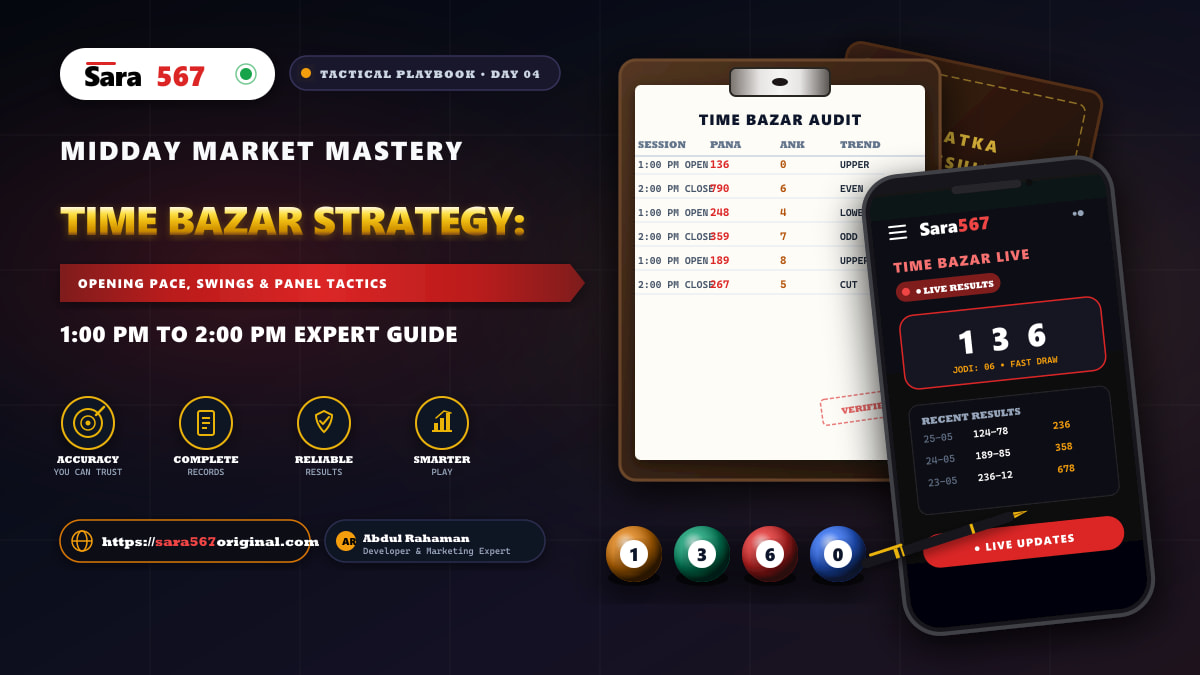
Time Bazar Strategy Guide: Timings, Panel Patterns & Playing Techniques
Within the vibrant landscape of Indian numerical markets, Time Bazar occupies a premier operational position. Known universally as the opening bell of the daytime market cycle, formulating a disciplined time bazar strategy requires an understanding of its unique afternoon schedule, condensed session turnaround, and historical chart patterns. Whether you are tracking time bazar timing, analyzing opening panel matrices, or structuring personal bankroll guidelines, this strategic manual breaks down the market's mathematical mechanics.
At Sara 567 (sara567original.com), we provide verified, millisecond-precise updates for all daytime sessions. Below, we examine the structural nuances of Time Bazar, offering data-driven insights into how the market operates, how its charts are structured, and how analytical discipline separates structured study from haphazard guesswork.
Table of Contents
- The Role and Heritage of Time Bazar
- Time Bazar Schedule and Official Market Timings
- The 60-Minute Window: Understanding Rapid Session Dynamics
- How to Read Time Bazar Jodi and Panel Charts
- Analytical Approaches: Pattern Tracking in Noon Draws
- Comparative Framework: Time Bazar vs. Milan Day vs. Kalyan
- Midday Bankroll Management & Risk Controls
- Why Sara 567 Is the Authoritative Portal for Time Bazar
- Frequently Asked Questions (FAQs)
- Responsible Gaming & Legal Disclaimer
The Role and Heritage of Time Bazar
Time Bazar emerged in Mumbai's commercial textile districts during the late 1960s. Historically, textile workers and independent merchants took their midday lunch breaks between 01:00 PM and 02:00 PM. Local syndicate organizers recognized this routine and created a market calibrated specifically around this midday window.
Unlike other markets where the Open and Close draws are separated by two or even three hours, Time Bazar operates on a compact schedule: the Open is declared at 01:00 PM IST, and the Close follows promptly at 02:00 PM IST. Because it declares outcomes before any other major market, Time Bazar is widely regarded as the daytime catalyst, setting the statistical tone for Milan Day (03:00 PM) and Kalyan Matka (03:45 PM).
Operating from Monday through Saturday, Time Bazar delivers six days of continuous numerical records, making its historical charts a valuable resource for statistical analysis.
Time Bazar Schedule and Official Market Timings
Punctuality is the hallmark of Time Bazar. Because the operational window between Open and Close is just 60 minutes, participants must adhere strictly to entry cutoffs:
| Session Phase | Bidding Cut-Off Window | Official Declaration Time | Strategic Importance |
|---|---|---|---|
| Open Session Entry | 12:40 PM – 12:50 PM IST | Before Draw Announcement | Entry deadline for Open single and panel predictions. |
| Time Bazar Open | Draw Execution Window | 01:00 PM IST | Announces 3-digit Open Pana and single Open Ank. |
| Close Session Entry | 01:40 PM – 01:50 PM IST | Intermediate Trading Period | Entry deadline for Close single and panel predictions. |
| Time Bazar Close | Final Announcement | 02:00 PM IST | Announces 3-digit Close Pana, locking the full Jodi. |
Understanding this compact 60-minute schedule is vital. In larger markets like Kalyan or Rajdhani, participants enjoy a generous two-hour deliberation buffer; in Time Bazar, the transition from Open to Close requires rapid evaluation of historical data on Sara 567.
The 60-Minute Window: Understanding Rapid Session Dynamics
The condensed one-hour gap between 01:00 PM and 02:00 PM introduces distinct market behaviors that differentiate Time Bazar from evening or late-afternoon markets:
| Feature / Trait | Time Bazar (60-Minute Gap) | Standard Markets (120-Minute Gap) |
|---|---|---|
| Session Spacing | 1 Hour (01:00 PM to 02:00 PM) | 2 Hours (e.g., 03:45 PM to 05:45 PM) |
| Intermediate Analysis | Rapid 40-minute evaluation window | Extended 90-minute deliberation window |
| Participant Mindset | Fast-paced, lunchtime focus | Methodical, end-of-workday focus |
| Market Role | Opening benchmark of the daytime cycle | Midday anchor or prime-time conclusion |
| Volatility Clustering | High panel turnover across weekly cycles | Broad distribution over monthly archives |
Because decisions must be made swiftly, participants who lack pre-established statistical systems often fall into the trap of emotional, hurried guessing. Developing a structured strategy prior to the 01:00 PM Open draw is essential for disciplined participation.
How to Read Time Bazar Jodi and Panel Charts
Accurate strategic assessment requires a clear understanding of historical table formats. On Sara 567, records are organized into Time Bazar Jodi Charts and Time Bazar Panel Charts:
1. The Panel Matrix Structure
In the panel chart, every draw is documented in an eight-digit, three-tier format:
| Panel Position | Sample Value | Arithmetic Derivation & Significance |
|---|---|---|
| Open Pana (Top) | 248 | 3-digit panel declared at 01:00 PM ($2+4+8 = 14 \implies$ Open Ank 4) |
| Full Jodi (Center) | 49 | Combined 2-digit winning pair (4 Open Ank + 9 Close Ank) |
| Close Pana (Bottom) | 135 | 3-digit panel declared at 02:00 PM ($1+3+5 = 9 \implies$ Close Ank 9) |
The complete result appears as: $$\mathbf{248 - 49 - 135}$$
2. Weekly Jodi Calendar View
The Jodi chart organizes daily outcomes across six columns from Monday to Saturday:
| Week Dates | Monday | Tuesday | Wednesday | Thursday | Friday | Saturday |
|---|---|---|---|---|---|---|
| Oct 05 – 10 | 49 | 91 | 63 | 95 | 28 | 70 |
| Sep 28 – 03 | 12 | 87 | 34 | 06 | 55 | 41 |
| Sep 21 – 26 | 73 | 50 | 98 | 24 | 16 | 89 |
- Red Jodis (Cut Pairs): Combinations with identical numbers (e.g., 55) or numbers whose digits sum to cut complements (e.g., 49, where 4+5=9) are traditionally highlighted in red ink to assist in visual pattern analysis.
Analytical Approaches: Pattern Tracking in Noon Draws
Over decades of observation, quantitative researchers have identified several analytical concepts frequently applied to Time Bazar charts:
1. The Single Ank Complement Rule (Cut Ank)
Every numeral between 0 and 9 has an assigned Cut Digit, calculated by adding 5 (modulo 10):
| Base Digit | Cut Counterpart | Base Digit | Cut Counterpart |
|---|---|---|---|
| 0 | 5 | 5 | 0 |
| 1 | 6 | 6 | 1 |
| 2 | 7 | 7 | 2 |
| 3 | 8 | 8 | 3 |
| 4 | 9 | 9 | 4 |
Many analysts monitor weekly charts to check whether a prolonged absence of a base digit (e.g., 2) increases the historical frequency of its Cut counterpart (7) appearing in the Open draw.
2. The Monday Momentum Indicator
Because Time Bazar resumes operations on Monday afternoon after the Sunday pause, Monday's 01:00 PM draw is examined closely. Analysts observe whether Monday Open numbers align with the closing figures from the preceding Saturday.
3. The Reality of Statistical Independence
While pattern recognition provides enjoyable historical structure, it is critical to emphasize that every draw is an independent random event. The probability of any single digit appearing as an Ank remains strictly 1 in 10 (10%), and any Jodi remains 1 in 100 (1%). No pattern guarantees future outcomes.
Comparative Framework: Time Bazar vs. Milan Day vs. Kalyan
To appreciate Time Bazar's unique timing within the broader daytime schedule, consider how it compares to subsequent afternoon markets:
| Metric / Parameter | Time Bazar | Milan Day | Kalyan Matka |
|---|---|---|---|
| Open Announcement | 01:00 PM IST | 03:00 PM IST | 03:45 PM IST |
| Close Announcement | 02:00 PM IST | 05:00 PM IST | 05:45 PM IST |
| Session Buffer | 1 Hour | 2 Hours | 2 Hours |
| Operating Days | Mon – Sat | Mon – Sun | Mon – Sat |
| Market Character | Fast noon starter | Afternoon bridge | India's flagship market |
| Historical Origin | Mumbai Mill lunch hour | Northern syndicates | Worli cotton exchange |
Time Bazar completes its entire daily cycle before Milan Day even begins its Open session, allowing analysts to review noon data cleanly before shifting focus to the late-afternoon markets.
Midday Bankroll Management & Risk Controls
Because Time Bazar occurs early in the day, poor risk management can negatively impact an individual’s entire day. Adhering to strict personal guidelines is paramount:
- Never Chase a Midday Deficit: If an outcome does not align with your prediction at 02:00 PM, never double your budget on Milan Day or Kalyan to "recover." Each market must have an isolated, non-negotiable budget.
- The 1% Rule: Allocate no more than 1% to 2% of your monthly disposable entertainment budget to any single Time Bazar session.
- Pre-Set Limits: Define your entry threshold before 12:30 PM. Once the 02:00 PM Close result is announced, conclude your participation for the afternoon regardless of the result.
- Emotional Detachment: Approach number analysis strictly as an intellectual and historical study of probability, never as a financial livelihood or income mechanism.
Why Sara 567 Is the Authoritative Portal for Time Bazar
Tracking Time Bazar online requires speed, precision, and reliable data delivery. Sara 567 (sara567original.com) stands out as the trusted choice for thousands of daily users:
- Instantaneous Real-Time Results: Our servers publish the 01:00 PM Open and 02:00 PM Close declarations within seconds of official confirmation.
- Accurate Historical Archives: Browse years of verified Time Bazar Jodi and Panel charts without missing dates, transcription errors, or broken tables.
- Optimized Mobile Experience: Access clean charts effortlessly on any Android or iOS device, even over 3G and 4G connections.
- Clean, Ad-Free Layout: Enjoy an uncluttered interface focused purely on data readability without annoying pop-ups or spam redirects.
Frequently Asked Questions (FAQs)
Q1: What are the exact timings for Time Bazar?
Answer: The Time Bazar Open result is declared at 01:00 PM IST, and the Close result is declared at 02:00 PM IST, operating six days a week from Monday through Saturday.
Q2: Why is the gap between Open and Close only one hour in Time Bazar?
Answer: Historically, Time Bazar was created around the one-hour lunch break of Mumbai's textile mill workers in the late 1960s, establishing a condensed 60-minute window that has remained a tradition ever since.
Q3: What days does Time Bazar operate?
Answer: Time Bazar operates from Monday to Saturday and is officially closed on Sundays.
Q4: Can historical chart patterns guarantee winning numbers in Time Bazar?
Answer: No. Every draw is governed by independent mathematical probability. While charts help analyze frequency and historical trends, no formula or service can guarantee winning numbers.
Q5: Where can I check live, verified Time Bazar results online?
Answer: You can track live updates on the Sara 567 Homepage and review complete historical records on the Time Bazar Panel Chart page.
Responsible Gaming & Legal Disclaimer
[!CAUTION] Important Legal & Financial Notice:
In India, speculative numbers games and real-money wagering are subject to the Public Gambling Act of 1867 and state-specific laws. Legal frameworks vary widely across different states, and users are responsible for complying with the regulations applicable in their jurisdiction.
All commentary, analytical strategies, and historical chart tables published on Sara 567 (
sara567original.com) are provided strictly for educational, historical, and informational purposes. Sara 567 does not host gambling operations, accept financial deposits, or guarantee commercial returns. Users are urged to exercise strict personal financial discipline and avoid speculative activities if they cause financial hardship.
Full stack developer and marketing expert specializing in scalable web architecture, SEO optimization, and data-driven analytics for digital platforms.