
Rajdhani Day vs Night: Timings, Market Differences & Chart Comparison
Rajdhani Day vs Night: Timings, Market Differences & Chart Comparison
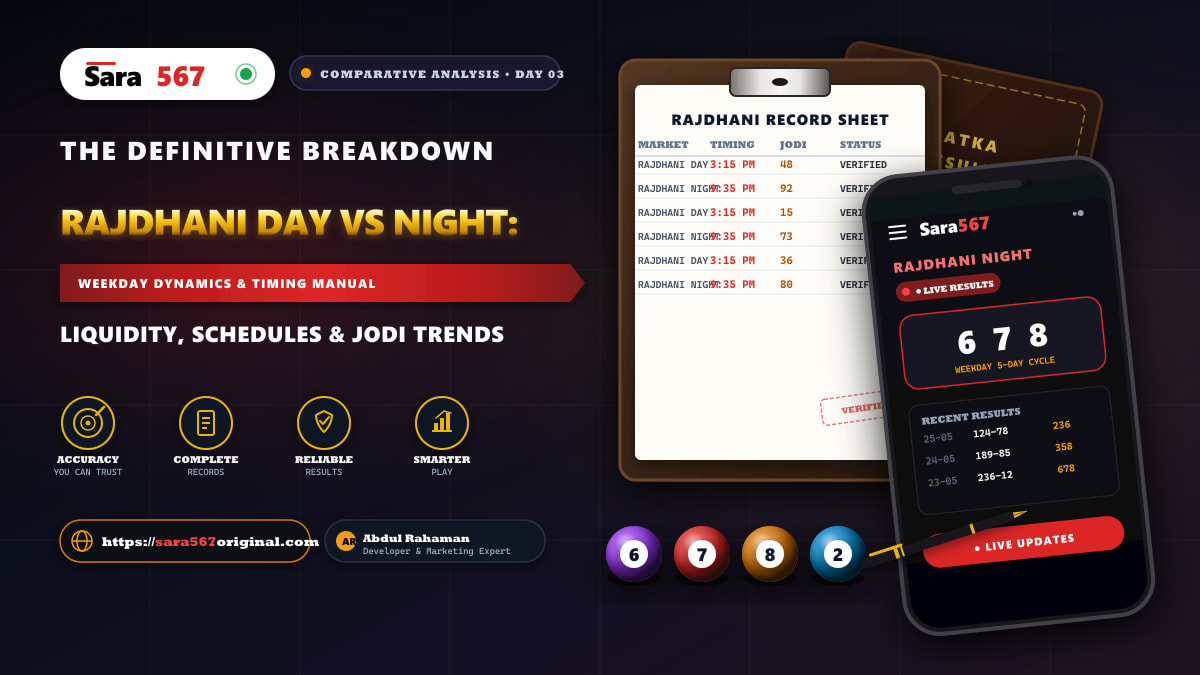
For enthusiasts and analysts navigating the Indian Matka landscape, understanding the core rajdhani day night difference is essential. Named after the prestigious express train network connecting India’s capital with major metropolitan hubs, the Rajdhani market network has maintained a formidable reputation for consistency, structured rules, and immense participant volume. Whether you are seeking precise details regarding rajdhani timing, comparing daytime versus late-night chart behaviors, or seeking to interpret panel histories, this comprehensive comparative guide breaks down every aspect.
At Sara 567 (sara567original.com), we track and verify daily market declarations with real-time speed. Below, we provide an objective, data-driven analysis contrasting Rajdhani Day and Rajdhani Night across operational schedules, mathematical volatility, historical chart trends, and bankroll discipline.
Table of Contents
- The Origins and Prestige of the Rajdhani Network
- Rajdhani Day vs. Night Timing Breakdown
- Key Market Differences: Pace, Volume & Volatility
- How to Read Rajdhani Jodi and Panel Charts
- Comparative Analysis of Historical Draw Behaviors
- Betting Formats and Standard Payout Structure
- Bankroll Management for Rajdhani Participants
- Why Sara 567 Is the Definitive Source for Rajdhani Results
- Frequently Asked Questions (FAQs)
- Responsible Gaming & Legal Disclaimer
The Origins and Prestige of the Rajdhani Network
Established during the 1980s as numerical wagering matured across Northern, Western, and Central India, the Rajdhani syndicate was designed to provide an organized, high-reliability alternative to regional lotteries. The name "Rajdhani" evokes punctuality, speed, and premium service—attributes that the market operators strived to reflect through dependable daily announcement schedules.
Unlike seven-day open markets, the standard Rajdhani market adheres strictly to a five-day operating week, running from Monday through Friday. This scheduled weekend closure gives analysts and enthusiasts a 48-hour analytical pause to compile weekly logs, calculate digit frequency distributions, and evaluate chart cycles on Sara 567 without the pressure of live daily announcements.
Rajdhani Day vs. Night Timing Breakdown
Timing represents the most crucial operational distinction between the two markets. Both markets provide a structured two-hour gap between Open and Close announcements, enabling participants to evaluate intermediate single Anks before final combinations are concluded.
| Market Category | Session Phase | Bidding Cut-Off | Official Declaration Time | Market Significance |
|---|---|---|---|---|
| Rajdhani Day | Open Session | 02:55 PM IST | 03:15 PM IST | Announces daytime 3-digit Open Pana & single Open Ank. |
| Rajdhani Day | Close Session | 04:55 PM IST | 05:15 PM IST | Declares Close Pana, finalizing daytime 2-digit Jodi. |
| Rajdhani Night | Open Session | 09:15 PM IST | 09:35 PM IST | Declares evening 3-digit Open Pana & night Open Ank. |
| Rajdhani Night | Close Session | 11:25 PM IST | 11:45 PM IST | Declares Close Pana, locking the midnight final outcome. |
The scheduling of Rajdhani Day (03:15 PM – 05:15 PM) aligns with the late afternoon business rush, closely paralleling the timing of Kalyan Matka. In contrast, Rajdhani Night (09:35 PM – 11:45 PM) serves as the high-stakes evening capstone, operating after all daytime markets have completed their cycles.
Key Market Differences: Pace, Volume & Volatility
While both markets utilize the identical mathematical framework (drawing three digits, summing them, and modulo 10 extraction), their trading dynamics exhibit distinctive traits:
| Feature / Metric | Rajdhani Day | Rajdhani Night |
|---|---|---|
| Operating Time Window | 03:15 PM to 05:15 PM IST | 09:35 PM to 11:45 PM IST |
| Operating Days | Monday – Friday (5 Days) | Monday – Friday (5 Days) |
| Participant Demographics | Daytime merchants & traders | Evening mobile users & post-work participants |
| Market Atmosphere | Analytical, deliberate | Energetic, prime-time intensity |
| Preceding Anchor Market | Time Bazar (02:00 PM) | Milan Night Open (09:00 PM) |
| Subsequent Market | Kalyan Close (05:45 PM) | Closes late-night national schedule |
| Perceived Volatility | Moderate, steady panel spread | Higher Jodi variance in closing draws |
1. Afternoon Deliberation vs. Evening Speed
Participants in Rajdhani Day frequently cross-examine numbers with Time Bazar outcomes announced earlier at 02:00 PM. Rajdhani Night, on the other hand, is followed heavily on mobile smartphones in relaxed home settings, creating higher concurrent live traffic on Sara 567 servers between 09:30 PM and midnight.
2. Friday Closing Dynamics
Because both markets conclude operations on Friday evening and remain closed on Saturday and Sunday, the Friday sessions exhibit distinct psychological behavior. Many participants call Friday's draws the "Weekend Lock," paying heightened attention to repetitive family numbers and Cut Anks.
How to Read Rajdhani Jodi and Panel Charts
To analyze either market with proficiency, users must understand the difference between Jodi Charts and Panel (Pana) Charts. Sara 567 preserves comprehensive archives for both:
1. The Rajdhani Panel Layout
In the Rajdhani Day Panel Chart and Rajdhani Night Panel Chart, every day's record is displayed as a stacked three-part unit:
| Panel Position | Sample Value | Mathematical Significance |
|---|---|---|
| Open Pana (Top) | 149 | 3-digit panel declared at Open ($1+4+9=14 \implies$ Open Ank 4) |
| Jodi (Center) | 43 | Combined 2-digit winning pair (4 Open + 3 Close) |
| Close Pana (Bottom) | 148 | 3-digit panel declared at Close ($1+4+8=13 \implies$ Close Ank 3) |
The full representation appears as: $$\mathbf{149 - 43 - 148}$$
2. The Weekly Jodi Calendar Grid
The Rajdhani Day Jodi Chart condenses these records into a five-column weekly format:
| Week Dates | Monday | Tuesday | Wednesday | Thursday | Friday |
|---|---|---|---|---|---|
| Oct 06 – 10 | 43 | 82 | 19 | 60 | 75 |
| Sep 29 – 03 | 21 | 94 | 33 | 58 | 07 |
| Sep 22 – 26 | 68 | 15 | 40 | 87 | 92 |
Red Jodis—combinations with identical digits (e.g., 33) or cut-family sums (e.g., 16, 27, 49)—are highlighted visually to help observers identify weekly symmetry.
Comparative Analysis of Historical Draw Behaviors
Experienced chart researchers frequently study long-term frequencies across both sessions:
| Analytical Parameter | Rajdhani Day Patterns | Rajdhani Night Patterns |
|---|---|---|
| Double Pana Frequency | Averages 1 to 2 times every 10 sessions | Averages 1 to 2 times every 10 sessions |
| Single Ank Distribution | Even dispersion across digits 0–9 | Slight clustering in prime numbers (3, 5, 7) |
| Cut Ank Recurrence | Often mirrors Wednesday afternoon values | Often mirrors previous night’s Close values |
| Draw Independence | 100% Mathematically Independent | 100% Mathematically Independent |
The Myth of Cross-Market Dependency
A frequent misconception among new participants is believing that if Rajdhani Day closes with an Ank of 3, Rajdhani Night is "guaranteed" to open with its Cut Ank (8). From a mathematical standpoint, every draw is an independent event with identical odds (1 in 10 for Single Ank, 1 in 100 for Jodi). Apparent patterns are historical observations, not future predictions.
Betting Formats and Standard Payout Structure
Both Rajdhani Day and Rajdhani Night support identical play types and payout ratios:
| Play Format | Number Structure | Probability | Standard Market Payout |
|---|---|---|---|
| Single (Ank) | 1 Digit (0 to 9) | 1 in 10 (10%) | 1 : 9 (₹10 pays ₹90) |
| Jodi | 2 Digits (00 to 99) | 1 in 100 (1%) | 1 : 90 (₹10 pays ₹900) |
| Single Pana (SP) | 3 Distinct Digits (e.g., 149) | 120 combinations | 1 : 140 to 1 : 150 |
| Double Pana (DP) | 2 Identical Digits (e.g., 114) | 90 combinations | 1 : 280 to 1 : 300 |
| Triple Pana (TP) | 3 Identical Digits (e.g., 444) | 10 combinations | 1 : 600 to 1 : 800 |
| Half Sangam | 1 Pana + 1 Opposite Ank | High difficulty | 1 : 1,000 |
| Full Sangam | Open Pana + Close Pana | Extreme difficulty | 1 : 10,000+ |
Bankroll Management for Rajdhani Participants
Because Rajdhani offers both afternoon and late-evening sessions, participants face potential psychological pitfalls if they do not manage their budgets effectively:
- Partition Day and Night Budgets: Allocate fixed, separate budgets for Rajdhani Day and Rajdhani Night. Never transfer funds or double stakes in the night session to recoup an afternoon deficit.
- The 2% Rule: Never risk more than 1% to 2% of your monthly disposable entertainment capital in any single session.
- Respect the Five-Day Week: Use Saturday and Sunday to step away completely from numerical tracking. Weekend downtime resets emotional perspective and supports financial well-being.
- Enforce Hard Limits: Determine both a profit goal and a stop-loss threshold before 03:00 PM. Once either boundary is crossed, conclude your activity immediately.
Why Sara 567 Is the Definitive Source for Rajdhani Results
Finding clean, timely, and verified numbers online can be difficult due to cluttered portals and inaccurate scrapers. Sara 567 (sara567original.com) provides clear advantages:
- Sub-Second Live Updates: Declarations for Rajdhani Day (03:15 PM / 05:15 PM) and Rajdhani Night (09:35 PM / 11:45 PM) are updated live on our homepage.
- Complete Historical Records: Our database contains years of verified Jodi and Pana records for both sessions without missing dates or corrupted figures.
- Mobile-Responsive Speed: Built with clean modern web standards, Sara 567 loads effortlessly on low-bandwidth mobile connections.
- Ad-Free Clean Tables: Focus strictly on the data you need without intrusive popups, spam redirects, or deceptive banner ads.
Frequently Asked Questions (FAQs)
Q1: What are the exact timings for Rajdhani Day and Rajdhani Night?
Answer: Rajdhani Day opens at 03:15 PM IST and closes at 05:15 PM IST. Rajdhani Night opens at 09:35 PM IST and closes at 11:45 PM IST. Both markets operate Monday through Friday.
Q2: Does Rajdhani operate on Saturday and Sunday?
Answer: No. Standard Rajdhani Day and Rajdhani Night operate strictly five days a week from Monday through Friday, remaining closed on weekends.
Q3: What is the main difference between Rajdhani Day and Rajdhani Night?
Answer: The primary differences lie in the operating hours, session atmosphere, and volume. Day operates during afternoon trading hours (03:15 PM – 05:15 PM), while Night serves as the evening anchor market (09:35 PM – 11:45 PM) with high mobile participation.
Q4: Are numbers drawn in Rajdhani Day linked to Rajdhani Night?
Answer: No. Each draw is completely independent. Probability resets to baseline odds for every session, meaning daytime results have no causal influence on nighttime numbers.
Q5: Where can I review historical Rajdhani charts?
Answer: You can access complete, date-indexed archives on Sara 567’s dedicated Rajdhani Day Charts and Rajdhani Night Charts pages.
Responsible Gaming & Legal Disclaimer
[!CAUTION] Important Legal & Financial Disclaimer:
In India, speculative gaming and real-money lotteries are governed by the Public Gambling Act of 1867 as well as individual state legislations. Laws differ substantially across regions, and participants must ensure full compliance with their local legal frameworks.
All commentary, comparison charts, and statistics published on Sara 567 (
sara567original.com) are provided solely for educational, historical, and informational purposes. Sara 567 does not organize betting, process payments, or promise financial returns. Users are strongly urged to exercise strict personal discipline and refrain from speculative activity if it creates financial or emotional stress.
Full stack developer and marketing expert specializing in scalable web architecture, SEO optimization, and data-driven analytics for digital platforms.