
Common Satta Matka Mistakes to Avoid: The Essential Guide to Sidestepping Beginner Errors & Analytical Traps
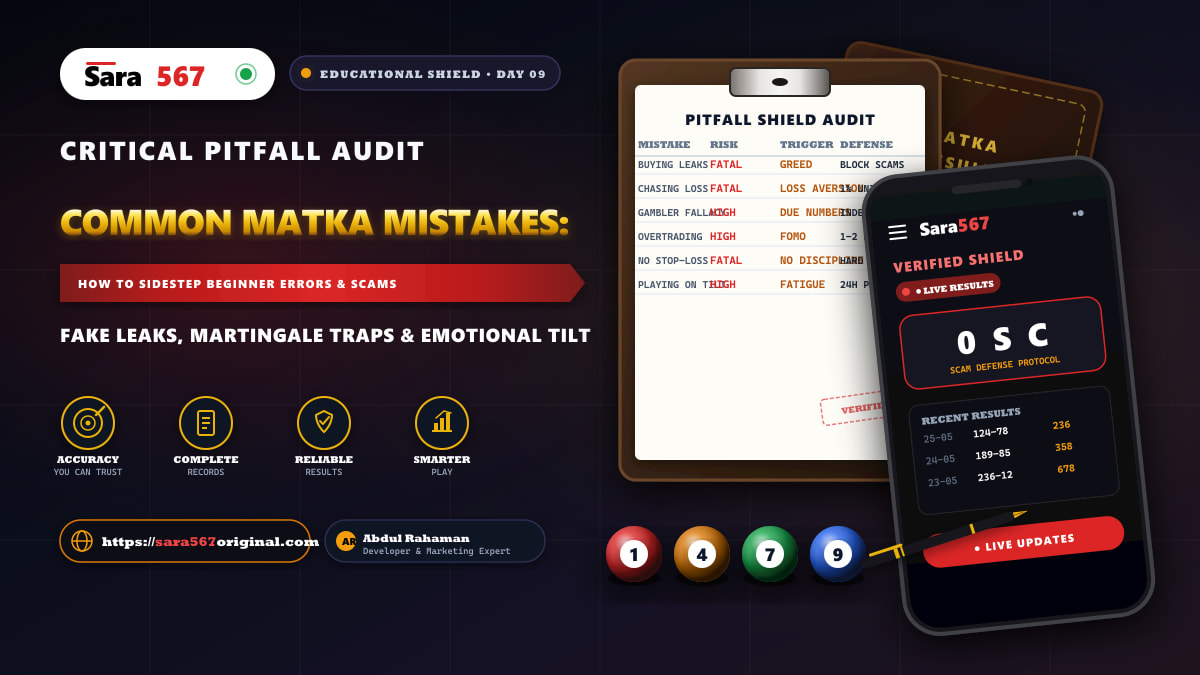
Common Satta Matka Mistakes to Avoid: The Essential Guide to Sidestepping Beginner Errors & Analytical Traps
In any mathematical or probability-based discipline, winning is rarely about discovering a magical secret formula. More often than not, sustainable success and long-term capital preservation come down to one fundamental principle: eliminating unforced errors. In the world of numerical tracking, card games, and market chart study, understanding the most common satta matka mistakes to avoid is far more critical to your longevity than hunting for elusive "guaranteed tips."
Every week, thousands of newcomers enter the ecosystem and succumb to classic beginner errors—from falling victim to fraudulent Telegram "leak" groups and doubling down on losing streaks, to falling prey to the Gambler's Fallacy and ignoring basic bankroll rules. Because numerical markets like Kalyan Matka, Milan Day, and Time Bazar operate on strict mathematical probability and random independent events, errors in judgment multiply rapidly into severe financial and emotional distress.
At Sara 567 (sara567original.com), we prioritize complete transparency, educational empowerment, and responsible gaming. As part of our 33-day master curriculum, this guide dissects the top eight critical pitfalls that trap both novice and experienced participants. By recognizing these psychological, financial, and analytical traps beforehand, you can protect your capital, cultivate disciplined habits, and view numerical data through a rational, objective lens.
Table of Contents
- The Anatomy of Beginner Pitfalls in Numerical Games
- Mistake 1: Believing in "100% Guaranteed Leaks" & Scam Groups
- Mistake 2: The Chasing Losses & Martingale Double-Down Trap
- Mistake 3: Falling for the Gambler's Fallacy ("Due Numbers")
- Mistake 4: Overtrading Across Too Many Simultaneous Markets
- Mistake 5: Trading Without Hard Daily Stop-Loss and Profit Ceilings
- Mistake 6: Misreading Jodi & Pana Charts Without Matrix Verification
- Mistake 7: Emotional Tilt, Fatigue, and Playing Under Stress
- Mistake 8: Relying on Unverified Websites with Delayed or Manipulated Archives
- Comprehensive Pitfall Matrix: Amateur Habits vs. Disciplined Protocols
- The Mathematical Reality: Martingale vs. Disciplined Unit Allocation
- A 5-Step Recovery Protocol After Experiencing a Drawdown
- Frequently Asked Questions (FAQs)
- Responsible Gaming & Analytical Transparency
The Anatomy of Beginner Pitfalls in Numerical Games
Why do participants consistently repeat the same costly blunders across decades of market history? The answer lies at the intersection of human cognitive wiring and mathematical misunderstanding. The human brain is an organic pattern-recognition machine; it evolved to detect order even in completely chaotic or independent random environments. When exposed to numerical sequences, charts, and fluctuating results, inexperienced minds instinctively construct illusory narratives.
In numerical markets, beginner errors typically manifest across three distinct domains:
- Information Bias: Blindly trusting malicious actors, unverified historical records, or self-proclaimed "matka gurus" who sell fabricated results.
- Financial Mismanagement: Treating discretionary funds as an open checkbook, risking core living expenses, and neglecting fractional unit sizing.
- Cognitive Distortion: Believing that past non-occurrences somehow increase the statistical probability of a specific future digit (the classic Monte Carlo error).
Recognizing that every draw is governed by fixed statistical parameters is the first step toward self-correction. Let us systematically examine the top eight pitfalls and explore how disciplined analysts insulate themselves against each one.
Mistake 1: Believing in "100% Guaranteed Leaks" & Scam Groups
Without question, the single most destructive trap awaiting any beginner is the predatory industry of fake leak channels, fraudulent WhatsApp admins, and paid VIP Telegram groups promising "100% Fix Open-Close Jodi leaks straight from the Kalyan or Milan head office."
| Scam Stage | Fraudster Manipulation Tactic | Mathematical Reality & Mechanism |
|---|---|---|
| Phase 1: Mass Outreach | Contacts 100 vulnerable players in private groups | Arbitrarily divides users into 4 groups of 25 players each |
| Phase 2: Segmented Tips | Group A gets digit 1; Group B gets 4; Group C gets 7; Group D gets 9 | One digit is guaranteed to hit purely by mathematical probability |
| Phase 3: The "Proof" | Groups A, B, and D are immediately blocked and erased | Group C falsely believes the scammer has "genuine insider leaks" |
| Phase 4: The Extortion | Demands ₹10,000 to ₹50,000 upfront for the "next VIP Jodi" | Inevitable loss on the next draw, after which scammer disappears |
The Mechanism of the Scam
Scammers exploit the survivorship illusion. They distribute different numbers to dozens of segmented subgroups. Whichever subset inevitably matches the random outcome is hailed as "proof" of an insider connection. The fraudster then charges exorbitant fees to those convinced victims before vanishing or giving them a random sequence on the next round.
The Objective Reality
- There is no such thing as an insider leak. Modern results for verified markets like Kalyan Matka, Milan Night, and Rajdhani Day are generated at scheduled declaration times through randomized draws or structured algorithmic mechanisms.
- Anyone possessing a guaranteed predictive method with a 100% strike rate would have zero financial incentive to sell it on social media for ₹500 or ₹5,000.
- The Golden Rule: The moment anyone solicits money in exchange for "guaranteed fixed results," you are dealing with an outright scam. Never transfer money to tipsters, agents, or unofficial channels.
Mistake 2: The Chasing Losses & Martingale Double-Down Trap
When an analyst or player incurs an unexpected loss, a powerful physiological impulse takes over: the desire to erase the deficit immediately. This phenomenon, known in behavioral economics as loss aversion, frequently drives beginners into the fatal Martingale system—doubling their stake after every loss in the naive hope that a single eventual win will recover all prior deficits plus a minuscule profit.
Why Martingale Fails Mathematically
While the Martingale system sounds logically sound to an amateur, it suffers from an exponential growth rate that collides head-on with table limits and personal financial ruin.
$$\text{Required Stake at Step } n = \text{Base Unit} \times 2^{(n-1)}$$
If your initial stake is ₹100, look at how rapidly capital requirements escalate during an ordinary streak of variance:
- Step 1: ₹100
- Step 2: ₹200 (Cumulative: ₹300)
- Step 3: ₹400 (Cumulative: ₹700)
- Step 4: ₹800 (Cumulative: ₹1,500)
- Step 5: ₹1,600 (Cumulative: ₹3,100)
- Step 6: ₹3,200 (Cumulative: ₹6,300)
- Step 7: ₹6,400 (Cumulative: ₹12,700)
- Step 8: ₹12,800 (Cumulative: ₹25,500)
By Step 8, you are risking an astonishing ₹25,500 of accumulated capital simply to recover a petty ₹100 original base profit. In probability games, adverse streaks of 6 to 10 consecutive misses are mathematically normal occurrences over large sample sizes. Attempting to chase losses through geometric escalation is the fastest route to an empty bankroll.
Mistake 3: Falling for the Gambler's Fallacy ("Due Numbers")
The Gambler's Fallacy is the mistaken belief that if a specific event has occurred less frequently than expected in the past, it is somehow "due" or "more likely" to occur in the immediate future.
The Single Ank Fallacy
In single digit draws (0 through 9), the mathematical probability of any specific digit appearing on any single draw is always:
$$P(\text{Digit}) = \frac{1}{10} = 10%$$
If digit 7 has not appeared as the Open Ank in Time Bazar for fifteen consecutive sessions, beginner players will assume:
"Digit 7 hasn't appeared for two full weeks! It is overdue, so it must hit today or tomorrow!"
This is a fundamental error. The mechanical drum, deck of cards, or digital randomizer has no memory. It does not remember that digit 7 was absent yesterday. On the sixteenth draw, the probability of digit 7 appearing remains exactly $1/10$ (10%), just as the probability of digit 3 or 9 appearing remains $1/10$. Past absences do not exert any physical or mathematical gravitational pull on future random events.
Mistake 4: Overtrading Across Too Many Simultaneous Markets
In today's digital era, market results are published from early morning until late past midnight. A beginner can theoretically track Kalyan Morning, Time Bazar, Milan Day, Kalyan Day, Rajdhani Day, Milan Night, and Rajdhani Night all within a single 16-hour window.
| Time of Day | Session Event | Psychological State | Capital Impact |
|---|---|---|---|
| Morning | Dispersed focus across 4 unrelated markets simultaneously | Over-optimism and fragmented analytical tracking | Small distributed stakes begin eroding capital |
| Midday | Incur unexpected negative draw in Time Bazar | Mild frustration; urge to "make it back quickly" | First emotional deviation from 1% unit sizing |
| Afternoon | Rush into Kalyan with doubled stakes to compensate | Heightened anxiety and analytical carelessness | Deeper loss triggers emotional cognitive distress |
| Evening | Mental fatigue sets in; intuitive guessing replaces charts | Complete exhaustion, anger, and loss of discipline | Heavy capital depletion across 8 fragmented markets |
The Danger of Market Dispersion
- Analytical Dilution: No player can deeply analyze historical charts, verify Pana patterns, and cross-reference Jodi archives across six different markets simultaneously.
- Friction & Fee Burn: Constant action exposes your capital repeatedly to the house margin, drastically accelerating the Law of Large Numbers against you.
- Decision Fatigue: Clinical studies demonstrate that cognitive clarity declines dramatically after prolonged exposure to risk-weighted decisions.
The Solution: Professional analysts limit their scope to one or at most two primary markets (for example, Kalyan Day and Milan Night). They study the historical nuances of those specific charts and strictly ignore concurrent secondary draws.
Mistake 5: Trading Without Hard Daily Stop-Loss and Profit Ceilings
Entering any risk environment without pre-established boundaries is like driving a high-speed vehicle without brakes. Yet, more than 85% of beginners sit down to track results without any concrete exit criteria.
The Missing Stop-Loss
A stop-loss is an inviolable boundary: if your allocated capital drops by a specific amount (e.g., 5% to 10% of your total designated bankroll on a given day), you immediately close the browser and walk away. Without this hard ceiling, an emotional participant will continue staking until their balance hits zero.
The Missing Profit Target
Ironically, winning poses almost as much danger to a beginner as losing. When an amateur hits a Jodi or Pana win early in the afternoon, euphoria and dopamine surge. They begin to feel invincible, label their intuition as "genius," and immediately reinvest their winnings into subsequent night markets. By midnight, not only have their afternoon profits evaporated, but they have also dug into their primary capital.
As outlined in our comprehensive guide to Bankroll Management for Satta Matka, disciplined participants set a daily profit ceiling (e.g., +20% to +25%). The moment that ceiling is attained, all activity ceases for the day.
Mistake 6: Misreading Jodi & Pana Charts Without Matrix Verification
Historical result archives, such as Jodi Charts and Pana Charts, are invaluable historical records for identifying long-term statistical frequencies. However, beginners frequently commit glaring errors when interpreting this data:
Common Chart Misinterpretations
- Confusing Cut Numbers with Dependent Pairs: In traditional chart analysis, digits separated by five units (e.g., $1 \leftrightarrow 6$, $2 \leftrightarrow 7$, $3 \leftrightarrow 8$, $4 \leftrightarrow 9$, $5 \leftrightarrow 0$) are termed "Cut Digits" or complementary values. Beginners often assume that if an Open Ank of
2appears, the Close Ank must be its cut7. In reality, both draws are mathematically independent unless the underlying game rules explicitly state otherwise. - Ignoring Pana Classification Types: Beginners frequently confuse Single Pana (all three digits distinct, such as
124), Double Pana (two digits matching, such as224), and Triple Pana (all three digits identical, such as333). There are 120 unique Single Panas, 90 Double Panas, and only 10 Triple Panas. Staking equal capital on outcomes with vastly different natural frequencies (e.g., expecting a Triple Pana with a $1/220$ probability to hit as often as a Single Pana) is a structural mathematical error. For a deep dive into these combinations, consult our masterclass on Pana Chart Mastery. - Relying on Short Lookback Windows: Analyzing only the last three days of draws and declaring a "definitive pattern" is statistically meaningless. Robust pattern analysis requires reviewing hundreds of cycles to separate genuine statistical variance from random noise. See our breakdown in Reading Jodi Charts Like a Pro.
Mistake 7: Emotional Tilt, Fatigue, and Playing Under Stress
In poker and competitive chess, the psychological state of mental compromise caused by frustration or anger is known as "Tilt." In numerical gaming, tilt is responsible for more bankrupt accounts than any other single factor.
| Tilt Stage | Psychological & Physiological Trigger | Behavioral Reaction | Preventative Action |
|---|---|---|---|
| Stage 1: Negative Draw | Unexpected statistical outlier or broken streak | Elevated heart rate, disbelief, and mounting frustration | Take a 10-minute break away from screens |
| Stage 2: Loss of Rules | Rejection of pre-planned 1%–2% unit limits | "I need to get even before the day finishes" mindset | Strictly enforce daily stop-loss cap (5% of bankroll) |
| Stage 3: Impulse Bet | Unresearched entry on an unfamiliar midnight market | Reckless, uncalculated high-exposure wager | Close the application; lock out further entries |
| Stage 4: Bankroll Ruin | Cumulative catastrophic drawdown | Severe regret, financial stress, and self-recrimination | Mandatory 72-hour market cool-down period |
Warning Signs You Are on Tilt
- You feel an accelerated heartbeat or physical agitation following an announced result.
- You place a stake on an unfamiliar night market simply because you lost during the day session.
- You deviate from your predefined unit sizing and increase your stake size impulsively.
- You are checking results while sleep-deprived, intoxicated, or experiencing domestic or professional stress.
The Golden Protocol: If you experience two consecutive unexpected losses, enforce a mandatory 24-hour cooling-off hiatus. Step away from the screen, engage in physical exercise, and do not look at live charts until your emotional equilibrium is fully restored.
Mistake 8: Relying on Unverified Websites with Delayed or Manipulated Archives
In the modern digital landscape, hundreds of low-quality websites scrape and publish Satta Matka charts. Unfortunately, many of these third-party platforms are plagued by severe technical and ethical deficiencies:
- Delayed Result Feeds: Publishing numbers 15 to 30 minutes after the official draw has concluded, misleading users who are trying to verify timely declarations.
- Retroactive Chart Tampering: Some unscrupulous operators silently edit historical Jodi and Pana archives after the fact to make their earlier "predictions" appear accurate to prospective victims.
- Adware and Malware Injections: Unsecured portals loaded with intrusive pop-up banners, malicious redirect scripts, and phishing forms.
The Sara 567 Standard
At Sara 567 (sara567original.com), our infrastructure is built with direct server-side data synchronization. Every result for Kalyan, Milan Day, and Time Bazar is timestamped, cryptographically logged, and permanently immutable. When verifying historical frequencies, always ensure you are consulting a verified, high-speed, and secure platform.
Comprehensive Pitfall Matrix: Amateur Habits vs. Disciplined Protocols
To help you audit your analytical approach, the table below contrasts the eight most dangerous beginner mistakes against the proven protocols adopted by disciplined, seasoned analysts:
| Critical Mistake | Threat Level | Psychological Trigger | Disciplined Countermeasure |
|---|---|---|---|
| Buying "Fix Leaks" | Extreme (Fatal) | Greed, desire for effortless shortcut | Acknowledge that leaks are mathematically impossible; block all paid tipsters. |
| Martingale Loss Chasing | Extreme (Fatal) | Loss aversion, wounded ego | Enforce fixed 1% unit staking; accept that losses are an ordinary cost of statistical variance. |
| Gambler's Fallacy | Moderate | Misunderstanding probability independence | Understand that each draw is 100% independent; cold digits carry no hidden "due" advantage. |
| Overtrading Markets | High | Fear of missing out (FOMO), adrenaline addiction | Specialize in maximum 1–2 markets; master their specific schedules and chart nuances. |
| No Stop-Loss / Take-Profit | Extreme (Fatal) | Lack of self-discipline, boundless optimism | Define a hard 10% daily loss limit and 20% profit cap; exit immediately when reached. |
| Superficial Chart Reading | Moderate | Laziness, hasty pattern matching | Verify combinations across minimum 90-day archives; differentiate Single vs Double Panas. |
| Playing on Emotional Tilt | High | Anger, frustration, physical fatigue | Enforce a mandatory 24-hour cooling-off rule after any two consecutive adverse sessions. |
| Using Fake / Slow Sites | Moderate | Inattention to digital source credibility | Utilize verified, real-time portals like Sara 567 with clean, timestamped archives. |
The Mathematical Reality: Martingale vs. Disciplined Unit Allocation
To demonstrate why emotional loss-chasing is mathematically suicidal compared to a disciplined unit-allocation model, let us examine a simulation of an investor with a ₹10,000 capital bankroll experiencing an adverse streak of five consecutive losses:
| Step / Sequence | Martingale Method Stake | Cumulative Capital Lost | Remaining Bankroll | Disciplined 1.5% Unit Stake | Cumulative Capital Lost | Remaining Bankroll |
|---|---|---|---|---|---|---|
| Base Starting Capital | — | — | ₹10,000 | — | — | ₹10,000 |
| Round 1 (Loss) | ₹200 | ₹200 | ₹9,800 | ₹150 | ₹150 | ₹9,850 |
| Round 2 (Loss) | ₹400 | ₹600 | ₹9,400 | ₹150 | ₹300 | ₹9,700 |
| Round 3 (Loss) | ₹800 | ₹1,400 | ₹8,600 | ₹150 | ₹450 | ₹9,550 |
| Round 4 (Loss) | ₹1,600 | ₹3,000 | ₹7,000 | ₹150 | ₹600 | ₹9,400 |
| Round 5 (Loss) | ₹3,200 | ₹6,200 | ₹3,800 (-62%) | ₹150 | ₹750 | ₹9,250 (-7.5%) |
| Round 6 (If Required) | ₹6,400 | ₹12,600 (Bust) | ₹0 (Total Ruin) | ₹150 | ₹900 | ₹9,100 (Safe) |
Key Takeaway from the Data
- Under the Martingale escalation, a normal 5-loss downswing wipes out 62% of the entire bankroll. On Round 6, the player cannot even afford the required stake and suffers complete financial bankruptcy.
- Under Disciplined Unit Staking, the exact same 5-loss downswing results in a negligible 7.5% drawdown. The player retains 92.5% of their capital, remains completely calm, and has over 60 units of runway remaining to let statistical probability normalize naturally.
A 5-Step Recovery Protocol After Experiencing a Drawdown
If you have already fallen into one of these beginner traps and suffered an unexpected drawdown, do not panic. Follow this clinical five-step reset protocol to stabilize your position:
| Protocol Step | Action Required | Execution Details | Objective |
|---|---|---|---|
| Step 1: Immediate Freeze | Complete cessation of market activity | Close all apps and browsers; zero financial exposure for 48–72 hours | Breaks emotional tilt feedback loops |
| Step 2: Post-Mortem Audit | Review historical decision ledger | Document what triggered the loss (unit size violation, impulse market) | Pinpoints psychological failure point |
| Step 3: Capital Audit | Recalculate remaining capital base | Establish new baseline net worth excluding any emotional recovery goals | Restores objective reality |
| Step 4: Unit Recalibration | Compute new 1% unit sizing | Adjust maximum per-session risk to match updated smaller capital base | Protects remaining bankroll |
| Step 5: Paper-Testing Phase | Track live charts without real funds | Verify strategy discipline on paper for 7 consecutive calendar days | Rebuilds analytical confidence |
- Immediate Freeze (The 48-Hour Blackout): Close all tracking applications, chat groups, and market feeds. Do not attempt to "win back" anything for at least two complete calendar days.
- Post-Mortem Log: Write down exactly why the loss occurred. Was it Martingale doubling? Did you listen to a fraudulent tipster? Were you playing past midnight under fatigue? Identifying the behavioral root cause prevents repeat occurrences.
- Capital Recalibration: Count your remaining discretionary funds. Never replenish a bankroll using emergency funds, rent money, utility budgets, or borrowed capital.
- Resize to a 1% Base Unit: Divide your current remaining bankroll by 100. That new, smaller figure is your absolute maximum stake per session moving forward. Accept the reduced scale with humility.
- Paper-Tracking Verification: For the next 7 days, track market declarations on Sara 567 purely on paper without placing any live risk. Rebuild your analytical confidence through disciplined, objective observation.
Frequently Asked Questions (FAQs)
Q1: Can software algorithms or AI tools guarantee winning Satta Matka numbers?
No. While artificial intelligence and modern data scripts are exceptional at aggregating historical frequency distributions and calculating statistical averages, they cannot predict random future draws with certainty. Any software vendor or website claiming their "AI prediction algorithm" offers guaranteed wins is misleading you.
Q2: What is the most dangerous beginner mistake in Satta Matka?
The most fatal mistake is Martingale loss chasing (doubling your stakes after a loss). Because adverse streaks occur regularly in random games of chance, doubling stakes leads to rapid exponential growth that inevitably causes total account wipeout.
Q3: How much capital should a beginner allocate to numerical games?
Only discretionary capital that you can afford to lose completely without impacting your lifestyle, living expenses, bills, or family savings. Furthermore, on any single market session, your risk should never exceed 1% to 2% of that total discretionary bankroll.
Q4: Why do so many people fall for Telegram and WhatsApp leak scams?
Scammers prey on emotional vulnerability, financial desperation, and the natural human desire for quick wealth. By manipulating screenshots, showcasing rented luxury items, and utilizing the survivorship bias across multiple private groups, fraudsters create a convincing illusion of insider knowledge.
Q5: Is it better to focus on one market or play multiple markets daily?
Focusing on one primary market (such as Kalyan or Milan Day) is vastly superior. Specializing in a single schedule allows you to maintain psychological focus, avoid overtrading, study specific chart histories thoroughly, and minimize transaction burn.
Responsible Gaming & Analytical Transparency
At Sara 567 (sara567original.com), our fundamental mission is to provide accurate, transparent, and educational information regarding market histories, timing schedules, and probability mechanics.
We strongly urge every reader to remember that numerical games like Satta Matka are speculative pastimes governed by strict mathematical probability and random independence. Never treat these activities as an investment strategy, a reliable income source, or an alternative to professional employment.
Always set strict, non-negotiable boundaries. If you ever feel that gaming activities are interfering with your personal life, relationships, or financial wellbeing, seek support from certified responsible gaming resources and self-exclusion programs immediately.
Full stack developer and marketing expert specializing in scalable web architecture, SEO optimization, and data-driven analytics for digital platforms.