Legal Status of Satta Matka in India: Comprehensive Guide to Laws, State Regulations & Digital Compliance
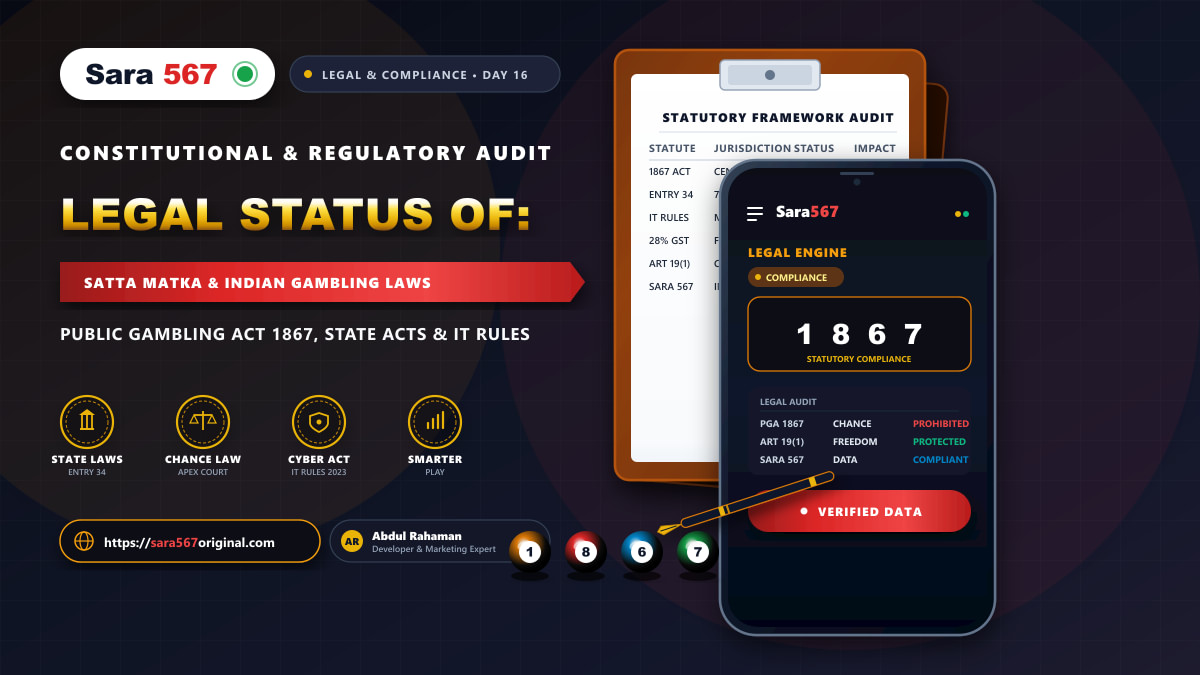
Legal Status of Satta Matka in India: Comprehensive Guide to Laws, State Regulations & Digital Compliance
In the complex and multifaceted legal jurisprudence of India, few topics evoke as much debate, regulatory nuance, and widespread public misunderstanding as the legal status of betting, lotteries, and historical numerical games like Satta Matka.
While millions of citizens interact daily with numerical records, historical charts, and live result feeds across the country, the underlying legal statutes governing wagering are fragmented across century-old colonial legislation, sovereign state-level enactments, constitutional separation of powers, and rapidly evolving cyberspace regulations enacted by the central government.
Is Satta Matka legal in India? Can states regulate or ban specific numerical activities? How does the Supreme Court of India distinguish between a "Game of Skill" and a "Game of Pure Chance"? And what is the crucial legal distinction between active monetary gambling and independent mathematical or historical reporting on platforms like Sara 567?
In this definitive legal guide, we provide an exhaustive, authoritative audit of the statutory and constitutional framework governing Satta Matka in India, examining historical enactments, judicial precedents, state-by-state variations, and modern digital compliance standards.
Table of Contents
- Constitutional Architecture: Seventh Schedule & State Powers
- The Central Foundation: The Public Gambling Act of 1867
- Game of Skill vs. Game of Chance: Landmark Supreme Court Jurisprudence
- State-by-State Regulatory Landscape
- The Digital Era: IT Intermediary Rules (2023) & The 28% GST Framework
- Active Wagering vs. Educational & Historical Journalism
- Legal Hazards of Unregulated Offshore Betting Syndicates
- Sara 567’s Architectural Compliance & User Protection Standards
- Frequently Asked Questions (FAQs)
- Legal Disclaimer & Responsible Analytical Ethics
Constitutional Architecture: Seventh Schedule & State Powers
To understand why gambling laws in India appear fragmented and contradictory from one region to another, one must examine the Constitution of India.
Under the Seventh Schedule of the Constitution, legislative powers are partitioned between the Union Government and State Governments across three legislative lists:
- List I (Union List): Matters of national importance (e.g., defense, foreign affairs, telecommunications).
- List II (State List): Matters where individual State Legislatures possess exclusive lawmaking authority.
- List III (Concurrent List): Matters shared by both central and state legislatures.
Crucially, Entry 34 of List II (State List) explicitly designates:
"Betting and gambling."
Because betting and gambling reside exclusively within the State List, the Parliament of India does not possess the constitutional mandate to enact a single, uniform national gaming code that supersedes state sovereignty. Consequently, each Indian State possesses the sovereign authority to permit, license, tax, heavily restrict, or completely criminalize gambling activities within its territorial borders.
| Constitutional & Statutory Pillar | Governing Authority | Legal Scope & Application | Primary Significance |
|---|---|---|---|
| Seventh Schedule, List II, Entry 34 | Sovereign State Legislatures | Exclusive power to legislate betting, gaming, and lotteries | Prevents a single centralized federal gambling law; creates state-by-state variation |
| Seventh Schedule, List I, Entry 31 | Union Parliament | Exclusive power over posts, telegraphs, telephones, wireless, and internet | Grants Central Government jurisdiction over cyberspace, ISP blocking, and IT rules |
| The Public Gambling Act, 1867 | Central Baseline (Adoptable by States) | Prohibits physical common gaming houses in non-excepted states | Serves as default benchmark for states that haven’t enacted independent acts |
| Information Technology Act, 2000 & 2023 Rules | Ministry of Electronics & IT (MeitY) | Regulates online intermediaries, online gaming intermediaries, and cyber safety | Enforces national blocking orders against unauthorized offshore gambling websites |
| Central Goods & Services Tax (CGST) Act | GST Council & Ministry of Finance | Imposes 28% GST on actionable claims in online money gaming | Standardizes tax compliance across legal, permitted real-money platforms |
The Central Foundation: The Public Gambling Act of 1867
The historical backbone of Indian gambling prohibition is The Public Gambling Act of 1867 (Act No. 3 of 1867). Enacted during the British colonial era following the Indian Rebellion of 1857, the statute was designed to suppress public gambling and the keeping of common gaming houses across the British territories.
Core Tenets of the 1867 Act
- The Concept of a "Common Gaming House" ($CGH$): Section 1 defines a common gaming house as any house, walled enclosure, room, or place in which cards, dice, tables, or other gaming instruments are kept or used for the profit or gain of the person owning or occupying the premises.
- Penalties for Operating a Gaming House: Section 3 prescribes fines and imprisonment (up to three months) for anyone owning, keeping, or managing a common gaming house.
- Penalties for Being Found in a Gaming House: Section 4 penalizes individuals found present inside a common gaming house, even if they are not actively participating in the wager at the moment of entry.
- Presumption of Guilt: Section 6 establishes that the discovery of instruments of gaming (such as dice, numbered charts, cards, or slips) on the premises serves as prima facie evidence that the location is an illegal gaming house.
Key Provisions & Penalties Under the 1867 Central Act
| Section of 1867 Act | Legal Prohibition | Prescribed Penalty | Application to Modern Environments |
|---|---|---|---|
| Section 3 | Owning, occupying, or managing a Common Gaming House | Fine up to ₹200 or imprisonment up to 3 months | Directed at physical premises; historically applied to local bookmaker dens |
| Section 4 | Being found inside a Common Gaming House | Fine up to ₹100 or imprisonment up to 1 month | Applies to players physically caught on prohibited gambling premises |
| Section 12 | Exemption for Games of Mere Skill | Complete Legal Immunity | The constitutional foundation for skill-based gaming in India |
| Section 13 | Gaming in public streets or public thoroughfares | Fine up to ₹50 or imprisonment up to 1 month | Applied to street matka runners drawing slips in public bazars |
The Technological Blind Spot of 1867
Drafted in the nineteenth century, the 1867 Act contemplated only physical rooms, wooden tables, and clay pots. It contains zero provisions addressing cyberspace, domain names, cloud servers, mobile applications, or electronic fund transfers. As a result, courts across India have repeatedly struggled to apply nineteenth-century statutory definitions to twenty-first-century internet infrastructure.
Game of Skill vs. Game of Chance: Landmark Supreme Court Jurisprudence
The most pivotal doctrine in Indian gaming law is the judicial distinction between a Game of Skill and a Game of Pure Chance.
Under Section 12 of the Public Gambling Act, 1867 (and equivalent clauses in virtually all state gambling enactments), games of "mere skill" are explicitly exempt from the penal provisions of the Act:
"Nothing in the foregoing provisions of this Act contained shall be held to apply to any game of mere skill wherever played."
Over six decades of jurisprudence, the Supreme Court of India has established the Dominant Factor Test to determine whether an activity is protected or prohibited.
The Three Landmark Supreme Court Rulings
1. State of Bombay v. R.M.D. Chamarbaugwala (AIR 1957 SC 699)
The Supreme Court ruled that competitions involving substantial skill, intellectual effort, and analytical capability do not constitute gambling under the law. The Court held that gambling activities (res extra commercium) are not entitled to constitutional protection as a fundamental trade or business under Article 19(1)(g) of the Constitution.
2. State of Andhra Pradesh v. K. Satyanarayana (AIR 1968 SC 825)
The Apex Court held that the card game of Rummy is predominantly a game of skill rather than chance. While the distribution of cards involves an element of luck, the player’s ability to memorize cards, calculate odds, hold or discard sequences, and execute strategy represents the dominant factor determining the outcome.
3. Dr. K.R. Lakshmanan v. State of Tamil Nadu (1996 2 SCC 226)
In this landmark ruling concerning horse racing, the Supreme Court formally crystallized the Dominant Factor Test:
- A game of skill is one where success depends predominantly on superior knowledge, training, attention, experience, and adroitness of the player.
- The mere presence of an element of chance does not convert a game of skill into gambling, provided skill remains the substantial or predominant factor.
Where Does Satta Matka Stand Under the Law?
Unlike chess, rummy, or horse-race handicapping, Indian courts have uniformly held that Satta Matka is a Game of Pure Chance.
In Satta Matka, an individual wagers on a single digit ($0\text{--}9$), a pair ($00\text{--}99$), or a three-digit combination ($220\text{ Panas}$) drawn from a randomized pool. Because the participant possesses zero physical or strategic control over the outcome of the draw itself, no amount of chart study, mathematical acumen, or historical analysis can alter the underlying combinatoric probability of an independent draw trial. Consequently, the commercial offering and facilitation of real-money wagering on Satta Matka is classified as gambling under state penal statutes.
| Legal Criterion | Game of Mere Skill (e.g., Chess, Rummy) | Game of Pure Chance (e.g., Satta Matka, Roulette) |
|---|---|---|
| Dominant Factor | Player intellect, strategy, training, memory | Completely random number generation or physical draw |
| Outcome Control | Player actions directly influence the final score | Player has zero influence over the drawn number |
| Constitutional Protection | Protected trade/profession under Article 19(1)(g) | Unprotected (res extra commercium); no trade immunity |
| Section 12 PGA Exemption | Exempt from gambling prohibitions | Subject to standard anti-gambling penal provisions |
State-by-State Regulatory Landscape
Because the Seventh Schedule delegates gambling exclusively to individual states, the legal status of gaming in India resembles a patchwork quilt. While physical betting on Matka is prohibited across most traditional jurisdictions, regulatory regimes range from complete digital prohibition to regulated state-run lotteries and licensed casino operations.
1. States with Strict Total Prohibitions
- Telangana & Andhra Pradesh: Both states enacted sweeping amendments (Telangana Gaming Act 2017 and AP Gaming Amendment Act 2020) that eliminated the traditional skill-versus-chance exemption for online games played for monetary stakes. All forms of real-money online wagering are cognizable, non-bailable offenses.
- Tamil Nadu: Tamil Nadu passed the Tamil Nadu Prohibition of Online Gambling and Regulation of Online Games Act, 2022, establishing an Online Gaming Authority to strictly ban real-money games of chance.
2. States with Regulated / Licensed Frameworks
- Goa: Governed by the Goa, Daman and Diu Public Gambling Act, 1976. Goa permits authorized land-based and offshore cruise-ship casinos operating under five-star resort licenses, alongside state-regulated paper and electronic lotteries.
- Sikkim: A pioneer in statutory modernization, Sikkim enacted the Sikkim Online Gaming (Regulation) Act, 2008, granting state licenses to authorized operators offering sports betting, casino games, and lotteries within physical intranet kiosks across the state.
- Meghalaya: Enacted the Meghalaya Regulation of Gaming Act, 2021, creating a dedicated gaming commission to issue licenses for both physical and online gaming operations within the state.
- Nagaland: Passed the Nagaland Prohibition of Gambling and Promotion and Regulation of Online Games of Skill Act, 2016, establishing a formal licensing regime specifically for online skill games operating across Indian states where skill gaming is permitted.
3. States Operating Under Dedicated Regional Penal Acts
- Maharashtra: Governed by the Maharashtra Prevention of Gambling Act, 1887 (Bombay Act IV of 1887). Section 4 and Section 12 rigorously penalize operating or betting in Matka dens, with enhanced punishments for recidivism.
- West Bengal: Governed by the West Bengal Gambling and Prize Competitions Act, 1957, which exempts horse racing and licensed card rooms under specific club charters.
| Indian State / Territory | Governing Statute | Satta Matka Wagering Status | Online Real-Money Gaming Status |
|---|---|---|---|
| Maharashtra | Maharashtra Prevention of Gambling Act, 1887 | Prohibited (Physical & Bookmaking) | Regulated under general penal code; no state license |
| Delhi (NCR) | Public Gambling Act, 1867 (Delhi Amendment) | Prohibited | Central 1867 provisions strictly enforced |
| Telangana | Telangana Gaming Act, 1974 (Amended 2017) | Strictly Prohibited (Cognizable) | Banned completely (even games of skill with stakes) |
| Andhra Pradesh | AP Gaming Act, 1974 (Amended 2020) | Strictly Prohibited (Non-bailable) | Banned completely |
| Goa | Goa Public Gambling Act, 1976 | Prohibited outside licensed casinos | Licensed physical & cruise casinos permitted |
| Sikkim | Sikkim Online Gaming Regulation Act, 2008 | Prohibited outside licensed networks | Regulated & licensed via government kiosks |
| Meghalaya | Meghalaya Regulation of Gaming Act, 2021 | Prohibited outside licensed venues | State licensing commission active |
The Digital Era: IT Intermediary Rules (2023) & The 28% GST Framework
In recent years, the Central Government has exercised its sovereign jurisdiction over telecommunications and cyberspace under List I to establish sweeping new digital compliance mandates.
1. The Information Technology (Intermediary Guidelines) Amendment Rules, 2023
Notified by the Ministry of Electronics and Information Technology (MeitY) in April 2023, the amended rules introduced a formal regulatory framework for "Online Gaming Intermediaries" (OGIs):
- Permissible vs Impermissible Online Games: An online real-money game is permissible only if it does not involve wagering on the outcome of an event and has been formally verified by a government-approved Self-Regulatory Body (SRB).
- Prohibition on Unverified Wagering: Intermediaries (including hosting providers, web browsers, and app stores) are prohibited from hosting, advertising, or enabling access to online real-money games that involve betting on chance outcomes without SRB verification.
- Nationwide Blocking Orders: MeitY routinely issues takedown and blocking directives under Section 69A of the IT Act against hundreds of offshore, illegal betting portals operating without domestic compliance.
2. The 28% Goods and Services Tax (GST) Regime
In October 2023, the GST Council and the Parliament of India amended the Central Goods and Services Tax (CGST) Act to resolve years of tax ambiguity regarding online real-money gaming:
- All actionable claims in online money gaming, casinos, and horse racing are subject to a uniform 28% GST on the full nominal value of the entry bet, rather than merely the platform’s commission (Gross Gaming Revenue or GGR).
- Offshore gaming operators serving Indian residents are legally mandated to register under the Indian GST system; failure to comply triggers immediate URL blocking under Section 69A of the IT Act.
| Regulatory Entity | Governing Rule / Statute | Operational Mandate | Legal Consequence of Violation |
|---|---|---|---|
| MeitY | IT Intermediary Rules, 2023 (under IT Act 2000) | Prohibits intermediaries from hosting illegal betting platforms | Nationwide ISP domain blocking under Section 69A |
| Ministry of Information & Broadcasting (MIB) | Consumer Protection Act & MIB Advisories (2022–2024) | Strictly bans surrogate advertising of offshore betting apps on TV and digital media | Penal action by Central Consumer Protection Authority (CCPA) |
| GST Council / CBIC | CGST (Amendment) Act, 2023 | Mandates 28% GST on actionable entry claims for money gaming | Asset freezes, tax liens, and director prosecution |
| Enforcement Directorate (ED) | Prevention of Money Laundering Act (PMLA), 2002 | Probes cross-border hawala networks and illegal betting syndicates | Attachment of bank accounts, properties, and criminal arrest |
Active Wagering vs. Educational & Historical Journalism
One of the most vital distinctions in Indian jurisprudence—and one frequently misunderstood by the public—is the boundary between active gambling facilitation and independent mathematical, educational, or historical reporting.
Constitutional Protection of Informational Expression
Under Article 19(1)(a) of the Constitution of India, all citizens possess the fundamental right to freedom of speech and expression. This right encompasses:
- The right to publish, disseminate, and analyze factual news, market declarations, and historical archives.
- The right to author mathematical, statistical, and combinatoric studies on probability theory, variance, and sample distributions.
- The right to educate the public on consumer safety, fraud prevention, and the risks of illegal syndicates.
The Legal Demarcation: Operators vs. Informational Portals
Publishing historical result data, calculating mathematical modulos, or reporting market timings does not constitute operating a common gaming house or violating anti-gambling statutes, provided the platform:
- Never accepts or deposits monetary funds from users.
- Never facilitates, routes, or matches monetary bets between participants.
- Never operates or promotes an illegal offshore wagering exchange.
- Maintains clear, prominent disclaimers educating users on the legal, financial, and psychological risks of gambling.
| Operational Dimension | Prohibited Gambling / Wagering Platform | Sara 567 Informational & Analytical Portal |
|---|---|---|
| Financial Transactions | Accepts UPI, Net Banking, Crypto, or Cash deposits | Zero financial transactions; completely free access |
| Wagering Engine | Places, calculates, and pays out real-money stakes | Zero wagering engine; pure data & chart visualization |
| Data Architecture | Private, closed betting slips with commercial interest | Public, transparent historical archives (Jodi & Pana) |
| Content Philosophy | Promotes deceptive "100% fix leaks" to extract money | Educates users on combinatoric odds, risk, and variance |
| Compliance Posture | Violates state penal acts; subject to MeitY blocking | Fully compliant with IT Intermediary Guidelines & free speech |
To review our strict non-wagering platform governance, consult our Terms of Service and Privacy Policy.
Legal Hazards of Unregulated Offshore Betting Syndicates
In recent years, unregulated offshore betting operators registered in foreign jurisdictions (such as Curacao, Cyprus, or Malta) have aggressively targeted Indian internet users through aggressive social media ads, surrogate branding, and Telegram networks.
Participating in these unregulated offshore platforms exposes citizens to grave legal, financial, and cybersecurity risks:
1. Total Lack of Consumer Redressal
Offshore operators exist outside Indian civil and criminal court jurisdiction. If an offshore operator arbitrarily freezes your account, refuses to process withdrawals, or disappears overnight, Indian law enforcement and consumer courts cannot compel the foreign entity to return your capital.
2. PMLA & Hawala Investigations
To bypass domestic banking blocks, offshore betting platforms frequently route deposits through unauthorized third-party UPI accounts ("mule accounts") and illegal hawala networks. Under the Prevention of Money Laundering Act (PMLA), the Enforcement Directorate (ED) routinely freezes bank accounts that have interacted with suspected money-laundering mule accounts, leaving innocent users entangled in protracted criminal investigations.
3. Identity Theft & Cyber Extortion
Registering on shady betting portals requires submitting personal KYC documents (Aadhaar cards, PAN cards, phone numbers, and bank details). These unregulated databases are routinely sold on dark web forums or utilized by cybercriminals to open fraudulent bank accounts and execute extortion schemes.
| Warning Sign / Red Flag | Real-World Consequence | What Legitimate Portals Do |
|---|---|---|
| Requests UPI / Crypto Deposits | Funds routed to illegal hawala mule accounts; risk of PMLA bank freezes | Never requests deposits; strictly informational |
| Guarantees "100% Leaked Results" | Advance-fee extortion scheme; mathematical impossibility | Explains uniform random distribution and house margin |
| Demands Third-Party APK Download | Trojan malware, keyloggers, and SMS reading spyware | Accessible through standard, secure web browsers |
| No Clear Physical Contact / Terms | Zero legal accountability if funds or private data are stolen | Transparent terms, audited editorial governance, and SSL/TLS |
Sara 567’s Architectural Compliance & User Protection Standards
Sara 567 was purposefully engineered to set the highest benchmark for legal transparency, user privacy, and data integrity in the Indian numerical market space.
We operate under strict compliance with Indian digital laws:
- Strictly Informational & Non-Commercial: Sara 567 does not offer real-money wagering, betting accounts, payment gateways, or financial transactions of any kind. Access to our historical records and charts is 100% free and educational.
- Full Compliance with IT Intermediary Rules, 2023: We do not host, promote, or link to unverified offshore gambling services or predatory schemes.
- Enterprise-Grade Cybersecurity: All data transmissions are encrypted using the modern TLS 1.3 cryptographic protocol over HTTPS, safeguarding your network privacy and preventing unauthorized eavesdropping.
- Commitment to Responsible Gaming: We actively publish educational masterclasses on Bankroll Management, Mathematical Probability, and Common Mistakes to Avoid, arming our readers with scientific knowledge rather than predatory illusions.
Frequently Asked Questions (FAQs)
1. Is Satta Matka legal in India?
The commercial offering, facilitation, and physical wagering on Satta Matka is prohibited across most Indian states under the Public Gambling Act of 1867 and state-specific anti-gambling enactments (such as the Maharashtra Prevention of Gambling Act, 1887). Because the game is classified by the Supreme Court as a Game of Pure Chance, it does not qualify for the legal protections granted to games of skill.
2. Can states make their own laws regarding gambling?
Yes. Under Entry 34, List II (State List) of the Seventh Schedule of the Indian Constitution, individual State Legislatures possess exclusive constitutional jurisdiction over betting and gambling. This is why states like Goa, Sikkim, and Meghalaya have established legalized, licensed gaming frameworks, while states like Telangana and Andhra Pradesh enforce total bans.
3. Is viewing Satta Matka charts and results online illegal?
No. Viewing, studying, or publishing historical market charts, numerical statistics, and educational probability analyses is fully protected under Article 19(1)(a) of the Constitution (Freedom of Speech and Expression). Merely accessing educational or historical information on platforms like Sara 567 does not constitute an offense.
4. Why is Satta Matka considered a Game of Chance rather than a Game of Skill?
In landmark decisions such as State of Andhra Pradesh v. K. Satyanarayana and Dr. K.R. Lakshmanan v. State of Tamil Nadu, the Supreme Court established the "Dominant Factor Test." Because a player in Satta Matka has zero control over which number is physically or digitally drawn from the randomized pool, chance—not human skill—is the exclusive determinant of the outcome.
5. What should I do if an online site promises "100% Guaranteed Leaks"?
Avoid them immediately and do not transfer any funds. Anyone claiming to possess "fix numbers," "insider leaks," or guaranteed winning results is engaging in fraudulent advance-fee deception. Every market draw is an independent random event, and genuine industry platforms strictly educate rather than make deceptive promises.
Legal Disclaimer & Responsible Analytical Ethics
The information presented in this article is provided strictly for general educational, historical, and informational purposes. It does not constitute formal legal advice, financial consultation, or an invitation to participate in any prohibited activity.
Key Principles to Remember:
- Laws and regulations vary significantly by jurisdiction; readers are advised to consult a qualified legal professional regarding the specific statutes applicable in their home state or territory.
- Sara 567 does not operate, host, promote, or facilitate betting or real-money gaming of any kind.
- Numerical wagering carries substantial financial and psychological risk. If you or someone you know is experiencing difficulties with compulsive gambling or financial distress, seek immediate assistance from professional counseling organizations such as Gamblers Anonymous.
Stay informed, respect statutory boundaries, and explore verified mathematical records with complete objectivity on Sara 567.
Full stack developer and marketing expert specializing in scalable web architecture, SEO optimization, and data-driven analytics for digital platforms.