
Bankroll Management for Satta Matka: The Complete Capital Protection & Risk Guide
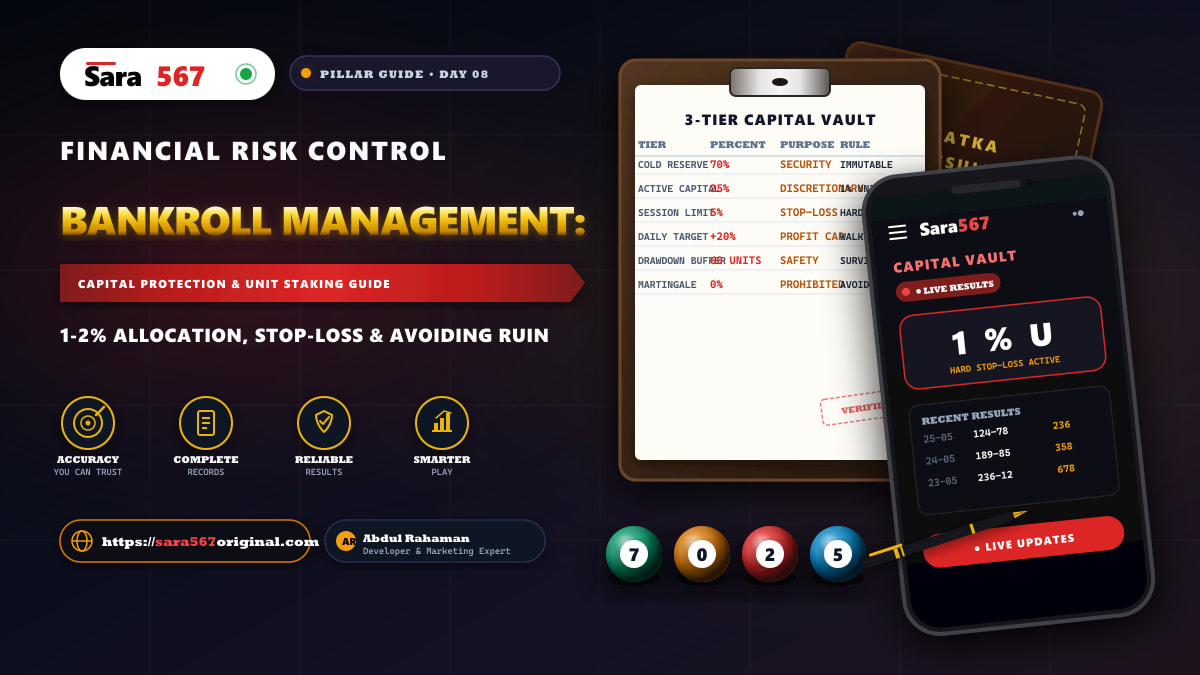
Bankroll Management for Satta Matka: The Complete Capital Protection & Risk Guide
In the world of numerical tracking, card games, and historical chart study, beginners invariably spend ninety percent of their energy searching for patterns, examining Jodi archives, and decoding Pana matrices. Yet, among seasoned analysts and financial mathematicians, a universal consensus reigns supreme: your numerical strategy means nothing if your bankroll management is flawed.
A disciplined approach to satta matka bankroll preservation and structured gambling money management is the single decisive boundary between analytical, responsible engagement and catastrophic financial distress. Without strict mathematical limits, even the most meticulous chart research will be completely wiped out by natural statistical variance and emotional decision-making.
At Sara 567 (sara567original.com), our commitment goes far beyond publishing real-time market updates for Kalyan Matka, Milan Day, and Time Bazar. We believe in absolute transparency, mathematical realism, and player protection. In this definitive pillar guide, we break down the science of bankroll management, explain unit allocation ratios, expose the mathematical ruin of the Martingale system, and deliver an actionable framework to protect your financial health.
Table of Contents
- The Primacy of Capital Preservation in Numerical Markets
- What Exactly Is a Satta Matka Bankroll?
- The 3-Tier Capital Allocation Architecture
- Unit Staking Mechanics: The 1% to 2% Golden Ratio
- Setting Hard Stop-Loss Thresholds (Daily & Weekly)
- Profit Target Ceilings: The Discipline of Stepping Away
- The Martingale Fallacy: Why Doubling Down Guarantees Ruin
- Mathematical Expectation and Statistical Variance Explained
- Psychological Biases: Tilt, Sunk Cost & The Gambler's Fallacy
- Practical Scenario Matrix: Disciplined vs. Erratic Bankroll
- Frequently Asked Questions (FAQs)
- Responsible Gaming & Analytical Ethics
The Primacy of Capital Preservation in Numerical Markets
Every commercial game of chance, lottery, or numerical market carries an inherent mathematical property known as the House Edge (or negative expected value, $-EV$). Over hundreds or thousands of draws, the mathematical law of large numbers guarantees that aggregate house advantage asserts itself over all individual participants.
Because the underlying mathematics inherently favors long-term capital attrition, capital preservation must always be your primary objective.
| Pyramid Tier | Capital Allocation | Primary Purpose | Management Rule |
|---|---|---|---|
| Tier 1: Capital Protection | 70% (Untouchable Reserve Buffer) | Absolute solvency shield | Never exposed to daily gaming under any circumstances |
| Tier 2: Active Bankroll | 25% (Operating Capital) | Monthly analytical entries | Subdivided across 30 equal trading/entertainment units |
| Tier 3: Profit Realization | 5% (Voluntary Exit Pool) | Session profit harvesting | Systematically withdrawn when session targets are hit |
When you approach market tracking through the lens of capital defense, your decision-making completely transforms:
- You no longer make arbitrary decisions based on emotional impulses.
- You never risk funds required for basic human needs (rent, groceries, utilities, savings, medical expenses).
- You insulate yourself from the destructive psychological spiral known as "tilt."
What Exactly Is a Satta Matka Bankroll?
A common mistake among newcomers is conflating their daily bank balance with their "bankroll."
A true bankroll is defined strictly as:
A finite, dedicated sum of discretionary leisure capital, completely separated from living expenses, whose total loss would cause zero material impact on your lifestyle, emotional health, or family obligations.
If losing your allocated funds would cause stress, delay bill payments, or require borrowing, you do not have a bankroll—you are risking essential survival capital.
| Fund Category | Eligible for Bankroll? | Purpose & Characteristics | Action Protocol |
|---|---|---|---|
| Living Essentials | NEVER | Rent, mortgage, groceries, utilities, debt service | 100% Locked; completely quarantined |
| Emergency Fund | NEVER | 3 to 6 months of living expenses for crises | Untouchable; held in liquid savings |
| Future Investments | NEVER | Retirement funds, stocks, education, insurance | Dedicated to long-term compound growth |
| Discretionary Entertainment | YES | Surplus leisure budget (movies, dining, gaming) | Permissible pool for bankroll allocation |
The 3-Tier Capital Allocation Architecture
Professional risk managers in financial trading separate total capital into distinct operational buckets. In numerical market tracking, we recommend implementing the 3-Tier Capital Allocation Architecture:
| Capital Tier | Share of Total Pool | Operational Role | Strict Safety Parameters |
|---|---|---|---|
| Tier 1: Cold Reserve | 70% | Untouchable Emergency Buffer | Kept strictly outside gaming accounts in liquid savings |
| Tier 2: Active Bankroll | 25% | Monthly Working Capital | Divided equally into 30 daily units (~0.83% of pool per day) |
| Tier 3: Single Session Cap | 5% | Maximum Daily Stop-Loss | Single bet unit strictly restricted to 1%–2% of Tier 2 |
1. Tier 1: The Cold Capital Reserve (70%)
Seventy percent of your total entertainment allocation remains in a secure, non-operational holding account. This reserve is completely off-limits during day-to-day tracking. It exists solely as an emotional buffer to ensure you never experience capital distress.
2. Tier 2: The Active Monthly Bankroll (25%)
Twenty-five percent of your total pool forms your operational working bankroll for the calendar month. This capital is partitioned evenly across the month’s scheduled sessions.
3. Tier 3: The Daily Session Ceiling (5% Max)
On any given operational day, your maximum allowable exposure across all markets combined (e.g., Kalyan, Milan, Rajdhani) must never exceed 5% of your active bankroll. This hard ceiling ensures that even a catastrophic string of unfavorable outcomes cannot deplete more than a small fraction of your capital.
| Allocation Tier | Recommended Share | Operational Function | Strict Protocol |
|---|---|---|---|
| Tier 1: Cold Reserve | 70% | Structural wealth insulation | Strictly non-operational; zero withdrawals |
| Tier 2: Active Bankroll | 25% | Monthly working capital pool | Divided into 25-30 daily operational units |
| Tier 3: Session Ceiling | 5% | Maximum daily risk threshold | Immediate shutdown when reached; zero reload |
Unit Staking Mechanics: The 1% to 2% Golden Ratio
Once your monthly bankroll is established, how should individual entries be sized?
The mathematical foundation of sustainable bankroll management is the Unit Staking System. Rather than wagering arbitrary rupee amounts based on intuition or "hunches," every single entry is calibrated as a fractional percentage—a Unit—of your active bankroll:
$$\text{1 Unit} = 1% \text{ of Active Monthly Bankroll}$$ $$\text{Conservative Entry} = 1 \text{ Unit } (1.0%)$$ $$\text{Maximum Permissible Entry} = 2 \text{ Units } (2.0%)$$
Worked Example of Unit Allocation:
Assume an analyst allocates a monthly discretionary bankroll of ₹10,000:
- 1 Unit (1.0%) = ₹100
- Standard Entry: 1 Unit = ₹100
- Maximum High-Confidence Entry: 2 Units = ₹200
- Maximum Daily Drawdown (5.0%): 5 Units = ₹500
| Active Monthly Bankroll | 1 Unit (1.0% Stake) | 2 Units (2.0% Max Stake) | Daily Stop-Loss (5.0% Limit) | Minimum Survival Capacity |
|---|---|---|---|---|
| ₹5,000 | ₹50 | ₹100 | ₹250 | 50 consecutive entries |
| ₹10,000 | ₹100 | ₹200 | ₹500 | 50 consecutive entries |
| ₹25,000 | ₹250 | ₹500 | ₹1,250 | 50 consecutive entries |
| ₹50,000 | ₹500 | ₹1,000 | ₹2,500 | 50 consecutive entries |
By capping individual entries at 1% to 2%, you ensure that your bankroll can absorb 50 to 100 consecutive unfavorable trials before capital depletion. This provides complete statistical resilience against short-term variance.
Setting Hard Stop-Loss Thresholds (Daily & Weekly)
A Stop-Loss is a pre-committed financial ceiling that triggers an immediate, non-negotiable shutdown of all activity the moment it is breached.
In numerical markets, the human psyche experiences acute distress during a losing streak. The amygdala activates, cognitive reasoning degrades, and players become susceptible to the irrational impulse to "win back" lost funds. A hard stop-loss removes human emotion from the equation by enforcing an automated exit rule.
The Three-Tier Stop-Loss Framework:
| Time Horizon | Drawdown Trigger Level | Mandatory Safety Action | Cool-Down Period |
|---|---|---|---|
| Session Trigger | 5% Bankroll Drawdown | Immediate app closure; no re-entry under any conditions | Rest of calendar day |
| Weekly Trigger | 15% Bankroll Drawdown | Total market freeze; zero tracking or participation | 72-Hour cooldown until Monday |
| Monthly Trigger | 35% Bankroll Drawdown | Complete platform hiatus and comprehensive financial review | 30-Day mandatory break |
- Daily Session Stop-Loss (5% of Bankroll): If your daily allocation experiences a 5% aggregate drawdown, you must close all charting apps, log out of all portals, and cease tracking immediately. No exceptions. No "one final try."
- Weekly Stop-Loss (15% of Bankroll): If cumulative weekly losses reach 15% of your bankroll, enforce an immediate 72-hour cooling-off period. Step away completely until the following Monday.
- Monthly Drawdown Circuit Breaker (35% of Bankroll): If cumulative monthly losses reach 35%, shut down all tracking for the remainder of the calendar month. Re-evaluate your strategy, review personal discipline, and replenish zero funds until the next scheduled budget cycle.
Profit Target Ceilings: The Discipline of Stepping Away
While every player understands the concept of a loss limit, very few recognize the equal importance of a Win Goal (Profit Ceiling).
Greed is just as lethal to a bankroll as panic. When participants experience a favorable run—such as hitting an Open Ank or a Jodi early in the day—the brain releases dopamine, creating a false sensation of invulnerability. Participants begin elevating their unit stakes, tracking additional markets, and ultimately give back all profits plus their original capital before the night concludes.
The 1.5x Rule for Profit Realization:
- Set a daily profit target equal to 1.5x to 2.0x of your daily session risk (e.g., if your daily risk is ₹500, your daily profit ceiling is ₹750 to ₹1,000).
- The moment your net profit reaches this ceiling, close the session immediately.
- Transfer a minimum of 50% of the day’s net profit into your untouchable Cold Reserve or bank savings account. Never leave surplus profits in your active working wallet where they can be impulsively recycled.
| Daily Risk Allocation | Conservative Profit Target (1.5x) | Target Action Protocol | Profit Sweep to Cold Savings |
|---|---|---|---|
| ₹250 | ₹375 | Session complete; log off immediately | ₹187 transferred to savings |
| ₹500 | ₹750 | Session complete; log off immediately | ₹375 transferred to savings |
| ₹1,000 | ₹1,500 | Session complete; log off immediately | ₹750 transferred to savings |
| ₹2,500 | ₹3,750 | Session complete; log off immediately | ₹1,875 transferred to savings |
The Martingale Fallacy: Why Doubling Down Guarantees Ruin
Among beginner gambling communities, the most pervasive and dangerous myth is the Martingale Strategy (often advertised deceptively as the "Double-Up Recovery System").
The Martingale premise states: “Whenever you lose an entry, double your stake on the next trial. When you eventually win, you will recover all past losses plus a 1-unit profit.”
Mathematically, the Martingale system is an absolute guarantee of financial ruin. While it appears intuitively appealing over 2 or 3 trials, it suffers from exponential progression:
$$\text{Stake on Trial } n = \text{Base Unit} \times 2^{n-1}$$
| Consecutive Trial | Base Unit Stake | Cumulative Capital Invested | Required Capital at Risk to Win ₹100 | Risk vs. Reward Ratio |
|---|---|---|---|---|
| Trial 1 | ₹100 | ₹100 | ₹100 | $1 : 1$ |
| Trial 2 | ₹200 | ₹300 | ₹300 | $3 : 1$ |
| Trial 3 | ₹400 | ₹700 | ₹700 | $7 : 1$ |
| Trial 4 | ₹800 | ₹1,500 | ₹1,500 | $15 : 1$ |
| Trial 5 | ₹1,600 | ₹3,100 | ₹3,100 | $31 : 1$ |
| Trial 6 | ₹3,200 | ₹6,300 | ₹6,300 | $63 : 1$ |
| Trial 7 | ₹6,400 | ₹12,700 | ₹12,700 | $127 : 1$ |
| Trial 8 | ₹12,800 | ₹25,500 | ₹25,500 | $255 : 1$ |
| Trial 9 | ₹25,600 | ₹51,100 | ₹51,100 | $511 : 1$ |
| Trial 10 | ₹51,200 | ₹1,02,300 | ₹1,02,300 | $1,023 : 1$ |
The Catastrophic Math:
By the 10th consecutive unfavorable trial, a player who started with a modest ₹100 entry must risk ₹51,200 on a single trial—and has already committed ₹1,02,300 in total capital—simply to win back a solitary ₹100 profit!
Because all real-world players operate with finite bankrolls and markets have table limits, a losing streak of 7 to 10 trials is a statistical certainty over any multi-month period. When that streak occurs, the Martingale user experiences total bankruptcy in a single afternoon.
Golden Rule: Never increase your stake to chase losses. Always keep stakes flat at 1% to 2% of your bankroll.
Mathematical Expectation and Statistical Variance Explained
To maintain emotional poise, an analyst must differentiate between Statistical Variance and Expected Value:
1. Negative Expected Value ($-EV$)
Because payouts in numerical markets incorporate an operational margin, every bet has a slightly negative mathematical expectation over thousands of trials:
$$\mathbb{E}[X] = \sum (x_i \cdot P(x_i)) < 0$$
Over infinite trials, the house edge is mathematically undefeated. Accepting this reality prevents players from believing they have "hacked" the market through secret formulas.
2. Statistical Variance (Short-Term Swings)
In the short term, random probability does not distribute itself smoothly. A coin flipped 100 times will frequently produce streaks of 6 or 7 consecutive heads. In Satta Matka:
- You may experience 15 consecutive sessions without hitting a target number.
- You may experience 3 winning sessions in 4 days.
- Both streaks are completely normal statistical variance.
Proper bankroll management is the shock absorber that allows you to survive prolonged variance downswings without depleting your capital.
Psychological Biases: Tilt, Sunk Cost & The Gambler's Fallacy
Bankroll discipline is 80% psychology and 20% mathematics. To protect your capital, you must identify and neutralize three primary cognitive distortions:
| Cognitive Bias | Common Internal Rationalization | Objective Reality | Antidote Protocol |
|---|---|---|---|
| The Gambler's Fallacy | "This digit hasn't hit in 20 days, so it is due today!" | Past independent trials have zero mechanical memory. | Stick to empirical frequency distributions, not "due" numbers. |
| The Sunk Cost Fallacy | "I have already lost ₹2,000 today; I must keep playing to recover it!" | Past losses are gone; each new wager carries independent negative expectation. | Respect the hard 5% daily stop-loss cap without exception. |
| Emotional "Tilt" | Recklessly increasing stake sizes after a frustrating loss. | High emotional arousal degrades rational statistical decision-making. | Step away from all devices for a minimum of 60 minutes. |
1. The Gambler's Fallacy
Believing that past independent trials influence future probabilities. In a properly randomized draw, the numbers from yesterday have zero mathematical memory. A Single Ank has an exact 1-in-10 probability today, regardless of whether it appeared 5 times last week or zero times last month.
2. The Sunk Cost Fallacy
Treating money already lost as an investment that must be reclaimed. Capital lost in a previous draw is gone forever. Sacrificing fresh capital to "chase" sunk capital violates basic economic logic.
3. Emotional "Tilt"
An emotional state of agitation triggered by bad beats or unexpected outcomes. When a player is on tilt, rational risk parameters are abandoned.
Antidote: Implement an involuntary 24-hour mandatory pause whenever you experience anger or urge to chase.
Practical Scenario Matrix: Disciplined vs. Erratic Bankroll
Let us compare two hypothetical market observers, both starting with an identical ₹10,000 monthly leisure budget:
| Operational Dimension | Trader A (Disciplined Method) | Trader B (Erratic / Intuitive) |
|---|---|---|
| Capital Allocation | ₹7,000 cold reserve; ₹3,000 active bankroll | Full ₹10,000 deposited in active wallet |
| Unit Sizing | 1 Unit = ₹100 (1% of ₹10,000) | Arbitrary stakes: ₹500, ₹1,000, ₹2,000 based on "feeling" |
| Reaction to a Loss | Maintains ₹100 unit; stops when daily ₹500 limit hit | Increases stake to ₹1,500 to recover previous loss (Martingale) |
| Reaction to a Win | Locks 50% profit into savings; closes session | Doubles stake on next market to "ride the lucky wave" |
| Stop-Loss Enforcement | Automated hard ceiling at ₹500/day | No stop-loss; plays until entire balance hits zero |
| End of Month Result | Bankroll intact; capital preserved; zero stress | Total capital wiped out; borrowing to fund next deposit |
| Long-Term Sustainability | High (Multi-year longevity) | Zero (Rapid bankruptcy within weeks) |
Frequently Asked Questions (FAQs)
Q1: What percentage of my income should go toward a Satta Matka bankroll?
No more than 1% to 3% of your monthly disposable net income (after all taxes, rent, food, debt service, and savings have been funded). If your monthly disposable income is ₹30,000, your total entertainment bankroll should never exceed ₹300 to ₹900.
Q2: Why is the Martingale strategy dangerous in Satta Matka?
The Martingale strategy doubles your stake after every loss. Because losing streaks of 6 to 10 trials occur regularly in random games, doubling leads to exponential stake escalation. Within just 8 to 10 trials, you are forced to risk hundreds of times your original base unit just to win back a tiny profit, leading to inevitable bankroll ruin.
Q3: What should I do when I hit my daily stop-loss?
Immediately close all market charts, log out of all portals, and cease tracking for the remainder of the day. Do not monitor results or participate in social groups until the following morning.
Q4: How should I handle winnings?
Follow the 50% Profit Sweep Rule: whenever you achieve a profitable session that meets your daily target, immediately withdraw or transfer at least 50% of the net profit directly into your personal savings account. Never leave surplus winnings in your active betting wallet.
Q5: Can disciplined bankroll management guarantee long-term profits?
No. Bankroll management cannot alter the underlying mathematical probabilities or house edge of random games. Its purpose is to prevent catastrophic losses, eliminate emotional ruin, protect essential lifestyle capital, and ensure disciplined participation.
Responsible Gaming & Analytical Ethics
At Sara 567, we reiterate our unwavering commitment to player welfare and responsible engagement:
- Strictly Educational & Analytical: All charts, timing tables, and historical archives provided on Sara 567 are designed solely for educational, cultural, and statistical study.
- Never Gamble Under Stress: Never track or participate in numerical markets when feeling depressed, anxious, under the influence of alcohol, or in financial distress.
- Zero Borrowing Tolerance: Never borrow money from family, friends, credit cards, or moneylenders to fund a bankroll.
- Recognize Problem Gambling: If gaming interferes with your job, personal relationships, or peace of mind, seek immediate professional assistance from recognized gambling counseling organizations.
Related Market & Strategy Guides on Sara 567
Continue your research across our educational guides:
- Kalyan Matka Complete Guide: Timings, Charts & Strategies
- Reading Jodi Charts Like a Pro: Step-by-Step Analysis
- Pana Chart Mastery: 3-Digit Combinations Explained
- Milan Day & Night Analysis: Pattern Recognition
- Rajdhani Day vs Night Comparison Guide
- Time Bazar Strategy Guide: Timings & Patterns
- Regional Satta Matka Variants: Gali & Disawar Overview
- Official Satta Matka Charts Directory
Full stack developer and marketing expert specializing in scalable web architecture, SEO optimization, and data-driven analytics for digital platforms.