The Future of Satta Matka: Predictions, Trends & Emerging Technologies (2026–2030)
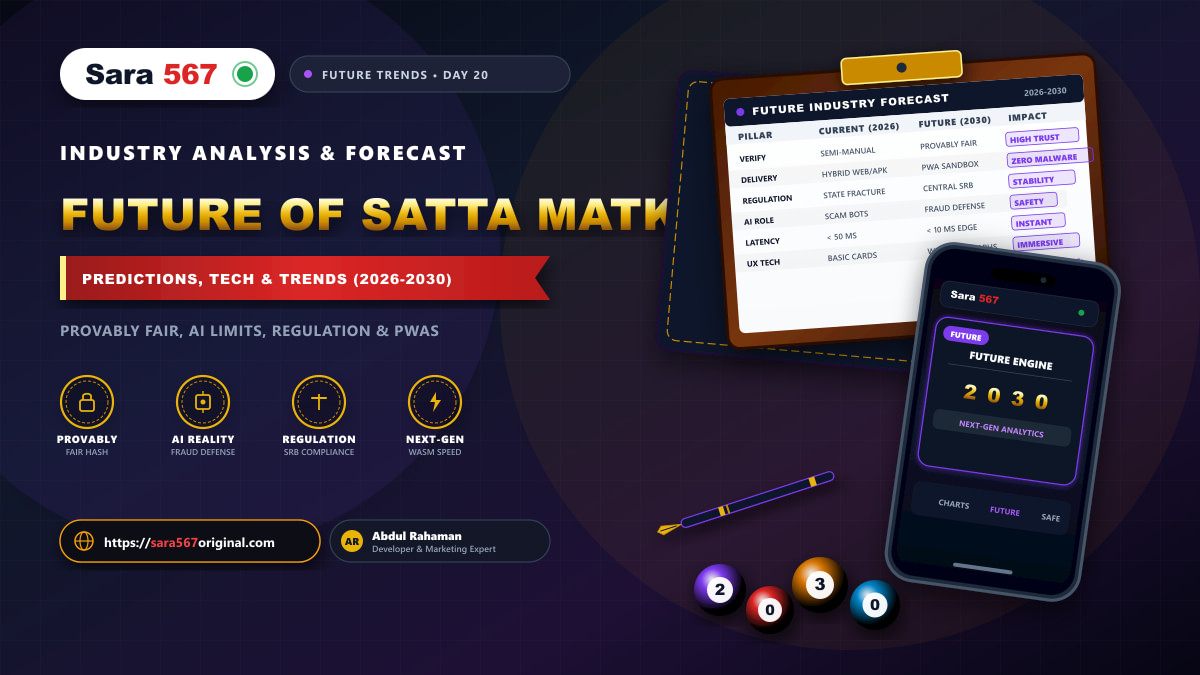
The Future of Satta Matka: Predictions, Trends & Emerging Technologies (2026–2030)
For over six decades, Satta Matka has demonstrated an extraordinary, chameleon-like resilience. Originating in the bustling trading hubs of 1960s Bombay as cotton rate betting, the market survived the closure of the New York Cotton Exchange, navigated the transition from physical earthen pots (matkas) to telephone distribution networks, and evolved into today's cloud-powered digital ecosystem.
Yet, the pace of technological, cultural, and legal change between 2026 and 2030 will dwarf the preceding sixty years. The convergence of cryptographic data validation, machine learning, decentralized cloud networks, shifting consumer demographics, and evolving Indian digital governance is rapidly rewriting the rules of numerical gaming.
What will Satta Matka look like by 2030? Will opaque, centralized draws be replaced by "Provably Fair" cryptographic algorithms? Can artificial intelligence predict number outcomes, or will it instead become a defensive shield against fraud? How will changing judicial frameworks and Progressive Web Apps (PWAs) reshape consumer accessibility on platforms like Sara 567?
In this forward-looking strategic analysis, we examine the five macro trends defining the future of Satta Matka. We separate technological reality from speculative marketing hype, explore the mechanics of cryptographic verification, evaluate regulatory trajectories, and outline how the next generation of data platforms will safeguard transparency and user trust.
Table of Contents
- The 5 Macro Trends Shaping Satta Matka (2026–2030)
- Trend 1: Cryptographic Verification & "Provably Fair" Number Generation
- Trend 2: Artificial Intelligence & Machine Learning: Hype vs. Reality
- Trend 3: Regulatory & Statutory Evolution: The Shift Toward Formalization
- Trend 4: Demographic Transformation: Gen-Z & The Death of the Local Bookie
- Trend 5: Next-Generation Mobile Platforms: PWAs, WebAssembly & Edge CDNs
- Sara 567’s Strategic Vision for the Next Decade
- The 5-Year Industry Readiness Matrix: 2026 vs. 2030
- Frequently Asked Questions (FAQs)
- Responsible Gaming Ethics in a Hyper-Digital Future
The 5 Macro Trends Shaping Satta Matka (2026–2030)
The traditional model of numbers wagering—relying on unverified intermediaries, opaque draw procedures, and delayed result tickers—is entering terminal decline. Over the next five years, five powerful structural forces will dictate the industry's landscape.
The 5 Macro Drivers:
- Cryptographic Transparency: Transition from private, unverified physical/digital draws to public, mathematically verifiable "Provably Fair" seed hashing.
- Algorithmic Analytics & AI: AI deployed for real-time anomaly detection, bot elimination, and responsible gaming limits rather than mythical predictions.
- Judicial & Statutory Formalization: Progressive evolution from nineteenth-century prohibition to federal Self-Regulatory Bodies (SRBs) and tax rationalization.
- Demographic Modernization: Mobile-native users rejecting suspicious sideloaded APKs in favor of lightweight, secure web platforms.
- Sub-10ms Edge Architecture: Decentralized content delivery networks (CDNs) and WebAssembly interfaces providing instant chart calculations directly in the browser.
Trend 1: Cryptographic Verification & "Provably Fair" Number Generation
The single greatest structural vulnerability of historical Satta Matka has always been the black-box problem. When a traditional market declares an Open Pana like 124-7 for Kalyan Matka, participants have no independent mechanism to verify that the selection was genuinely random and not selected retrospectively based on operator exposure.
Between 2026 and 2030, the adoption of Provably Fair Cryptography—pioneered in modern digital gaming—will fundamentally disrupt this opacity.
How Provably Fair Verification Works
A Provably Fair system relies on cryptographic hashing functions (such as SHA-256) to prove to players that the draw was predetermined and untampered with before the betting window closed.
- Server Seed Generation: Before the market session opens, the server generates a secret random string (Server Seed) and publishes its cryptographic hash (e.g.,
e3b0c44298fc1c149afbf4c8996fb92427ae41e4649b934ca495991b7852b855). Because a hash function is a one-way mathematical operation, players cannot reverse-engineer the original seed. - Client Seed Contribution: When the market closes, a decentralized, unpredictable public seed is generated (such as the hash of a specific public blockchain block or financial index closing value).
- Outcome Calculation: The server seed and client seed are combined mathematically:
$$\text{Result} = \text{HMAC_SHA256}(\text{Server Seed}, \text{Client Seed}) \pmod{220}$$
- Public Verification: Once the result is declared, the unhashed Server Seed is revealed. Any participant can paste the seeds into an open-source validator to confirm mathematically that the operator could not have altered the numbers without invalidating the original hash.
| Era / Verification Model | Draw Mechanism | Auditability | Tamper Resistance | Trust Foundation |
|---|---|---|---|---|
| Traditional Historic (1960–1990) | Physical earthen pot (matka) with chits | Zero public audit; witnessed by local syndicate insiders | Low; susceptibility to sleight of hand | Blind trust in syndicate figures |
| Early Digital (2000–2020) | Centralized database script / private RNG | Opaque server-side logs hidden behind firewalls | Moderate; susceptible to administrative manipulation | Reputation of the website operator |
| Emerging Cloud (2020–2026) | Encrypted API ingestion with immutable timestamps | Publicly timestamped archives on platforms like Sara 567 | High; append-only distributed databases prevent edits | Third-party cryptographic audit trails |
| Next-Gen Provably Fair (2026–2030) | SHA-256 dual-seed cryptographic hashing | 100% Client-Side Verifiable; open-source algorithms | Absolute; mathematically impossible to tamper | Zero-trust cryptographic proof |
This transition will render predatory operators obsolete. Platforms that refuse to provide verifiable cryptographic proofs will lose market share to transparent, data-first architectures.
Trend 2: Artificial Intelligence & Machine Learning: Hype vs. Reality
Artificial Intelligence (AI) is the most heavily hyped—and aggressively misunderstood—technology in modern consumer computing. Across social media platforms, rogue vendors routinely market "AI Matka Predictor Apps" claiming 99.8% win rates on Single Anks and Jodis.
To understand the future of AI in numbers markets, one must strictly differentiate between mathematical reality and technological fiction.
What AI CANNOT Do: The Stochastic Barrier
As demonstrated in our Mathematical Aspects of Satta Matka Guide, physical lottery draws and true Random Number Generators produce independent, identically distributed (i.i.d.) random variables.
No neural network, transformer model, or deep learning algorithm can predict the next draw from past historical data because past results do not contain hidden causal patterns. An AI model trained on twenty years of Time Bazar charts will output probability distributions identical to basic combinatorics:
$$P(\text{Single Ank}) = 10.0% \quad \text{and} \quad P(\text{Jodi}) = 1.0%$$
Any vendor claiming their AI software "cracks" Kalyan or Milan results is peddling an advance-fee confidence scam.
What AI CAN Do: Enterprise Infrastructure & Protection
While AI cannot forecast random outcomes, machine learning will revolutionize platform infrastructure between 2026 and 2030 in four critical domains:
- Syndicate & Bot Detection: Machine learning models analyze real-time WebSocket traffic to identify automated scraping rings, credential-stuffing attacks, and DDoS networks.
- Behavioral Responsible Gaming Monitoring: Natural Language Processing (NLP) and pattern recognition engines identify early behavioral markers of Tilt and loss chasing. Platforms can automatically trigger mandatory cooling-off periods when a user displays erratic, high-velocity refreshing patterns.
- Automated Multi-Language Voice Search: Real-time voice query recognition enabling users across India to search historical archives in Hindi, Marathi, Gujarati, Bengali, and Tamil natively.
- Data Anomaly Auditing: Machine learning algorithms cross-referencing multi-market declaration feeds to instantly flag discrepancies or typos before they pollute historical databases.
| Technology Domain | Deceptive Marketing Claim (Myth) | Legitimate Engineering Application (Reality) |
|---|---|---|
| Predictive Modeling | "Our deep neural network predicts Kalyan Open with 95% accuracy" | Predictive modeling is mathematically impossible on independent stochastic draws |
| Chart Pattern Recognition | "AI detects secret repeating geometry in weekly Jodi charts" | AI confirms that chart clusters are statistical noise consistent with Poisson distributions |
| Fraud Prevention | "Bypasses bookie algorithms to guarantee insider wins" | Identifies credential stuffing, malicious scraping bots, and spoofed data feeds |
| Responsible Gaming | Not mentioned by predatory vendors | Flags compulsive rapid-fire clicking and automatically suggests cooling-off breaks |
| Natural Language Search | "Ask AI for today's lucky VIP number" | Allows users to query complex historical archives via natural conversational voice queries |
Trend 3: Regulatory & Statutory Evolution: The Shift Toward Formalization
The legal architecture governing Satta Matka in India has remained fundamentally anchored to the archaic Public Gambling Act of 1867—a pre-independence statute enacted during the era of steam locomotives and physical gambling houses.
As analyzed in our comprehensive Legal Status of Satta Matka in India Guide, the intersection of state constitutional sovereignty (Seventh Schedule, Entry 34) and federal digital oversight (Information Technology Rules 2023) has created a complex regulatory patchwork. Between 2026 and 2030, this status quo will face unprecedented legislative pressure.
Three Regulatory Trajectories (2026–2030)
- Centralized Self-Regulatory Bodies (SRBs): Under the Ministry of Electronics and Information Technology (MeitY), the framework for Self-Regulatory Bodies will mature. Informational and analytical portals that adhere to strict age verification (18+), display responsible gaming safeguards, and provide zero real-money wagering interfaces will receive explicit safe-harbor protections under Section 79 of the IT Act.
- The 28% GST & Taxation Paradigm: Following the landmark amendments to the Central Goods and Services Tax (CGST) Act imposing a flat 28% GST on full contest values in online gaming, the Indian government has established a clear precedent: financial flows in digital gaming will be heavily audited and taxed. By 2030, underground operators using unregulated hawala rails will face aggressive enforcement from the Directorate General of GST Intelligence (DGGI) and the Enforcement Directorate (ED).
- State-Level Regulated Licensing Models: States like Goa, Sikkim, and Meghalaya have already demonstrated the fiscal viability of state-regulated, licensed gaming regimes. As state governments seek non-tax revenue to finance infrastructure and social programs, more states are projected to explore licensed, state-monitored lottery frameworks with mandatory consumer protection standards.
| Statutory Framework | Current Status (2026) | Projected Evolution (2028–2030) | User Impact |
|---|---|---|---|
| Public Gambling Act 1867 | Pre-colonial central law; widely interpreted as obsolete | Likely replaced by modern federal Model Gaming & Betting Bill | Clear legal distinction between illegal syndicates and data analytics |
| MeitY IT Rules (2023 Amendment) | SRB framework established but implementation delayed | Full operational rollout of accredited Self-Regulatory Bodies | Rogue offshore websites blocked; compliant platforms verified |
| 28% Unified GST Regime | Enforced on domestic online skill & chance platforms | Tightened enforcement on offshore gateways and crypto rails | Complete financial isolation of illegal, unregulated operators |
| Consumer Data Protection (DPDP Act) | Initial compliance frameworks taking effect | Full enforcement of stringent data minimization and consent rules | Platforms barred from harvesting user contacts or device telemetry |
Trend 4: Demographic Transformation: Gen-Z & The Death of the Local Bookie
The cultural ecosystem surrounding Satta Matka is undergoing an irreversible generational transition. For decades, market participation was anchored in physical social networks: corner tea stalls (chai tapris), pan shops, and local bookie dens (khaiwals).
That physical ecosystem is vanishing. As veteran operators retire, younger demographics are fundamentally altering how numerical markets are researched and consumed.
| Dimension | Traditional Historic Cohort | Gen-Z & Modern Digital Cohort |
|---|---|---|
| Access Channel | Physical bookie shops, tea stalls (chai tapris) | Instant mobile browser access via Progressive Web Apps |
| Transaction Rails | Physical paper slips and cash settlements | Digital-first orientation; cashless financial observation |
| Analytical Approach | Mystical dream interpretations and numerology | Data-driven chart analysis, variance studies, and odds evaluation |
| Declaration Speed | Tolerates 30-minute delayed word-of-mouth news | Demands sub-50ms live WebSocket push synchronization |
| Interface Tolerance | Tolerates ad-heavy portals, pop-ups, and spam | Rejects intrusive ads; demands sleek, responsive dark-mode UI |
| Device Security | Casual acceptance of unverified third-party APKs | High security consciousness; insists on sandboxed browser safety |
1. Digital-Native Expectations
Modern users raised on high-speed consumer applications (such as Zerodha, Swiggy, and UPI payment apps) bring uncompromising expectations to informational platforms:
- Zero Friction: If a page takes longer than two seconds to load, bounce rates exceed 60%.
- Zero Intrusive Ads: Modern users actively reject flashing banner ads, auto-playing video overlays, and deceptive "Download APK" popups.
- Data-First Minimalism: Younger enthusiasts treat numbers markets less as a mystical lottery and more as a study in probability, variance, and data visualization.
2. The Collapse of Cash-Based Intermediaries
With India’s Unified Payments Interface (UPI) processing billions of transactions monthly, physical cash circulation in urban centers has plummeted. Local bookies who relied on physical currency collection cannot compete with instantaneous, borderless digital networks. By 2030, physical Matka bookmaking will be a historical relic, completely eclipsed by digital informational architectures.
Trend 5: Next-Generation Mobile Platforms: PWAs, WebAssembly & Edge CDNs
As detailed in our Satta Matka & Technology Review, native sideloaded .apk files represent an unacceptable security hazard for modern smartphone users. The future of mobile delivery belongs entirely to Progressive Web Apps (PWAs) and WebAssembly (Wasm).
1. WebAssembly (Wasm) for In-Browser Analytics
Currently, calculating historical frequency distributions or filtering ten years of Rajdhani Day Panel Charts requires either heavy server processing or slow JavaScript execution on low-end mobile devices.
By compiling high-performance C++ or Rust algorithms into WebAssembly (Wasm), future platforms will execute complex statistical calculations directly in the user’s mobile browser at near-native hardware speed. Users will be able to run instant standard-deviation scans across 50,000 historical records in under 10 milliseconds without consuming mobile data or straining server resources.
2. Decentralized Edge Caching & Anti-Censorship Resilience
Traditional websites hosted on single centralized servers are vulnerable to domain name system (DNS) tampering, DDoS attacks, and network outages during high-concurrency peak windows (such as 4:10 PM Kalyan Open).
Next-generation platforms are shifting toward Decentralized Edge Networks:
- Static site assets (HTML, CSS, historical chart JSON) are replicated across thousands of edge data centers globally.
- Dynamic result declarations are broadcast via multi-region Anycast networks.
- If an individual data center suffers an ISP fiber cut, traffic routes instantaneously to the nearest operational node with zero user interruption.
| Technical Metric | Legacy Web 1.0 (2015) | Modern Cloud (2026) | Future WebAssembly Edge (2030) |
|---|---|---|---|
| Client Execution Engine | Client-side JavaScript (Slow) | Optimized React / Virtual DOM | WebAssembly (Wasm) Binary Execution |
| Chart Filtering Latency | 1,500ms to 4,000ms | 150ms to 350ms | < 10ms (Instantaneous Hardware Speed) |
| Server Architecture | Monolithic Single-Server VPS | Cloud Edge CDN + Redis Pub/Sub | Decentralized Multi-Region Mesh Network |
| Mobile Footprint | Heavy ad scripts (15–25 MB) | Lean PWA assets (< 2 MB) | Sub-500 KB Micro-App Shell |
| Offline Capability | Non-functional (Dinosaur error) | Service Worker basic page cache | Full Offline Multi-Year Database via IndexedDB |
Sara 567’s Strategic Vision for the Next Decade
As the industry stands on the precipice of this technological transformation, Sara 567 is built around four foundational architectural commitments:
- Absolute Immutability: All published market records are cryptographically timestamped and committed to permanent, append-only archives. We guarantee that historical results will never be altered, doctored, or deleted.
- Zero-Permission Security: Sara 567 will never distribute intrusive, sideloaded
.apkfiles that compromise mobile security. Our platform will remain 100% web-native, secure, and sandboxed within standard modern browsers. - Sub-50ms Global Synchronization: By investing in enterprise WebSocket infrastructure and edge caching, we ensure that every user receives verified results simultaneously, eliminating informational asymmetry.
- Educational & Ethical Leadership: We believe that transparency is the ultimate antidote to predatory exploitation. We will continue expanding our open-access curriculum covering Bankroll Management, Mathematical Probability, and Gaming Psychology.
The 5-Year Industry Readiness Matrix: 2026 vs. 2030
Review this five-year forecast matrix to understand how operational standards across the industry will transform by 2030:
| Operational Dimension | Industry Standard (2026) | Projected Industry Standard (2030) | Transformation Driver |
|---|---|---|---|
| Draw Verification | Private operator declaration with timestamp audit | Cryptographically signed, Provably Fair SHA-256 seed hashing | Demand for mathematical proof over blind trust |
| Mobile Delivery | Fragmented between risky sideloaded APKs and mobile websites | Universal adoption of Progressive Web Apps (PWAs) with zero APK risk | Operating system security hardening by Google and Apple |
| Data Calculation | Server-side rendering or heavy client JavaScript | WebAssembly (Wasm) running native statistical models in browser | Demand for zero-latency chart filtering on mobile devices |
| Legal Framework | Fragmented state laws with high judicial ambiguity | Federal Self-Regulatory Bodies (SRBs) with clear statutory boundaries | Modernization of digital commerce and gaming legislation |
| Consumer Mindset | Vulnerability to "VIP leak" scams and superstition | Analytical, data-driven observation of historical distributions | Maturation of digital literacy and widespread anti-scam education |
| Monetary Rails | Informal networks facing aggressive enforcement | Audited digital transactions subject to formal statutory taxation | Financial intelligence tracing and GST compliance enforcement |
Frequently Asked Questions (FAQs)
1. Will Satta Matka ever be officially legalized across all of India?
Under the Constitution of India (Seventh Schedule, List II, Entry 34), betting and gambling are state subjects, meaning the central government cannot unilaterally legalize gambling nationwide. However, the legal trajectory between 2026 and 2030 points toward increased formalization: more states are expected to adopt licensed, highly regulated, and heavily taxed frameworks (similar to Goa, Sikkim, and Meghalaya) to capture tax revenues and eliminate underground syndicates.
2. How will "Provably Fair" algorithms prevent operators from fixing numbers?
A Provably Fair algorithm uses cryptographic hashing (such as SHA-256). Before betting closes, the operator must publish the encrypted hash of the winning seed. Because the hash cannot be changed without detection, the operator cannot adjust the number after observing player wagers. When the seed is revealed after the draw, players can independently verify that the outcome matches the original pre-committed hash.
3. Can AI technology help a player consistently win at Satta Matka?
No. This is a mathematical impossibility. AI is exceptionally powerful at identifying real patterns in non-random data (such as medical imaging or financial market sentiment). However, in an independent stochastic process where each draw has zero memory of past events, there are no patterns to find. Any software or "bot" claiming to use AI to predict future draws is a fraudulent scheme.
4. Why are Progressive Web Apps (PWAs) considered the future over mobile apps?
Native mobile apps in the numbers space cannot be distributed through the official Google Play Store and must be downloaded as raw .apk files, which often contain malware. PWAs run directly in your mobile browser with zero installation risk, cannot access your private contacts or storage, update automatically without re-downloading, and consume a fraction of your device's memory.
5. How will 5G and mobile edge computing impact live Matka results?
5G networks and edge computing reduce network latency from 150–300 milliseconds down to sub-10 milliseconds. This means that declaration updates on platforms like Sara 567 will appear on handheld devices virtually instantaneously, providing real-time data synchronization identical to financial stock ticker terminals.
6. What is the difference between an informational data platform and an illegal gambling app?
An informational platform (like Sara 567) is an educational, analytical resource that publishes historical archives, market schedules, mathematical probability analyses, and live verified results. It does not accept wagers, handle monetary deposits, facilitate payouts, or operate a gaming book. Illegal gambling apps, conversely, handle real-money transactions outside statutory licensing frameworks.
Responsible Gaming Ethics in a Hyper-Digital Future
As technology makes information faster, more accessible, and seamless, the psychological temptation to over-engage increases exponentially. In an era where live market declarations are delivered to your pocket in milliseconds, personal boundary setting becomes the ultimate skill.
Principles for Navigating the Digital Future Responsibly:
- Recognize Technology as an Analytical Tool, Not a Shortcut: Modern charts and data feeds exist to help you understand variance and probability—not to manufacture false certainty.
- Never Surrender Financial Sovereignty to Software: No app, bot, algorithm, or "AI tool" can conquer the house edge or guarantee financial return.
- Implement Rigid Device Boundaries: Utilize screen-time monitoring tools, schedule mandatory "dark days" each week, and disconnect from all market tracking feeds during family, professional, and rest hours.
True sophistication in the digital age is not about finding secret predictive algorithms; it is about cultivating emotional discipline, honoring mathematical reality, and protecting your financial well-being above all else.
Educational disclaimer: This publication provides strategic analysis, technology forecasting, and industry commentary for educational and informational purposes only. Sara 567 does not promote, facilitate, or operate real-money wagering. Always adhere to applicable local regulations and practice strict digital security.
Full stack developer and marketing expert specializing in scalable web architecture, SEO optimization, and data-driven analytics for digital platforms.