
Regional Satta Matka Variants: Gali, Disawar & Emerging Markets Overview
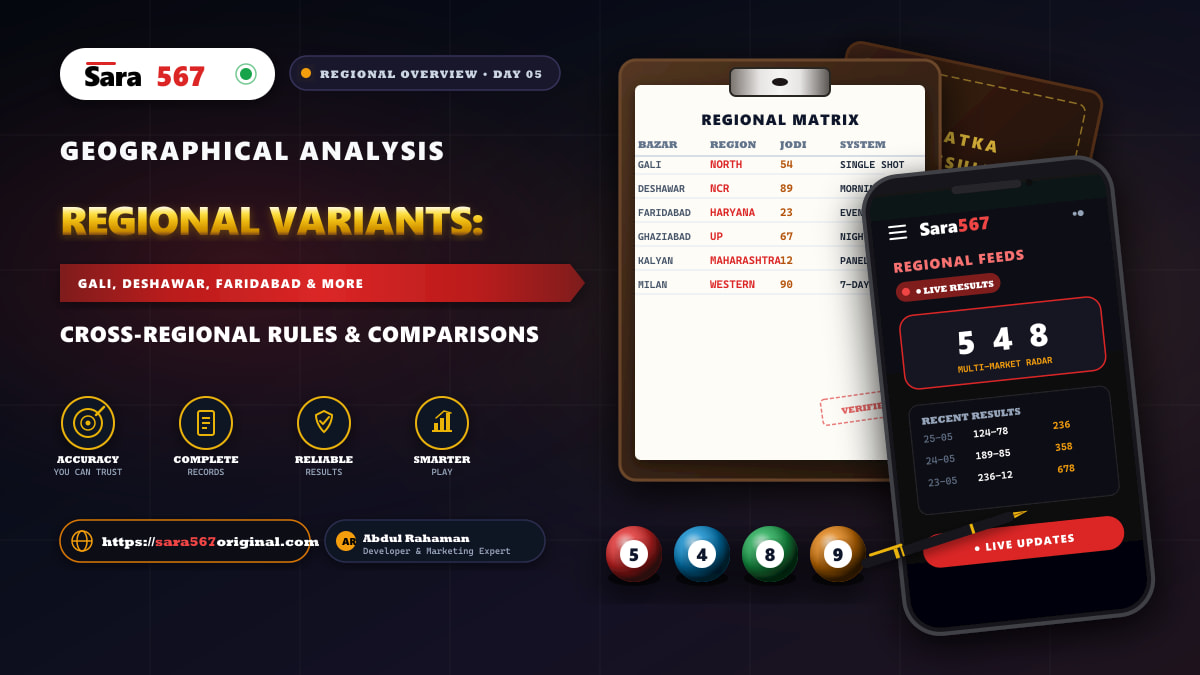
Regional Satta Matka Variants: Gali, Disawar & Emerging Markets Overview
While mainstream discussions around Indian numerical games frequently spotlight heritage hubs like Kalyan, Milan, and Rajdhani, an equally expansive, distinct ecosystem thrives across India's regional territories. Known collectively as regional satta markets or the Northern draw circuit, names like gali deshawar matka, Faridabad, and Ghaziabad command immense historical followings.
Understanding these regional variants requires shedding standard Western-matka preconceptions. The Northern circuit diverges dramatically in mathematical architecture, draw mechanics, terminology, and session schedules. Where traditional Mumbai markets operate on a dual-session Open and Close framework with 3-digit Pana sequences, regional markets generally function on direct two-digit outcomes and single-digit "Haruf" distributions.
At Sara 567 (sara567original.com), our analytical infrastructure tracks historical data across both regular and regional markets with zero lag. In this comprehensive guide, we map the entire regional landscape, detail the differences between Northern variants and Mumbai classics, examine canonical timing structures, and provide a disciplined, transparent blueprint for tracking regional records.
Table of Contents
- The Evolution of Regional Satta Matka in India
- The Core Northern Quartet: Disawar, Faridabad, Ghaziabad & Gali
- Architectural Breakdown: Regional vs. Mumbai Regular Markets
- Northern Number Mechanics: The Haruf and Two-Digit System
- Canonical Regional Timings and Daily Draw Cadence
- How Regional Markets Compare to Kalyan, Milan & Rajdhani
- Tracking Regional Records Responsibly on Sara 567
- Bankroll Management for High-Frequency Regional Markets
- Frequently Asked Questions (FAQs)
- Responsible Gaming & Analytical Ethics
The Evolution of Regional Satta Matka in India
To understand how regional satta markets emerged, one must revisit the early 1960s. When Kalyanji Bhagat launched Worli Matka and Ratan Khatri established the New Worli Bazar in Bombay, the game's mathematical basis was tied to the opening and closing cotton rates transmitted from the New York Cotton Exchange. As the format matured, the mechanics shifted toward drawing numbered playing cards from an earthen pot (matka).
However, as enthusiasm spread northward into Delhi, Uttar Pradesh, Haryana, and Rajasthan, local operators adapted the format to match regional preferences, local commercial hours, and informal telegraph networks. Rather than adopting the multi-phase three-card draw (Pana) prevalent in Maharashtra and Gujarat, Northern organizers formulated a stripped-down, two-digit format centered on immediate community settlement.
Over the decades, these independent games coalesced into established syndicates. The four pillars—Disawar, Faridabad, Ghaziabad, and Gali—established canonical drawing schedules that still govern Northern market activity today.
The Core Northern Quartet: Disawar, Faridabad, Ghaziabad & Gali
The Northern regional circuit operates as a chronological relay. Each market occupies a distinct window of the 24-hour cycle, ensuring that participants and market watchers transition sequentially from early dawn to late night:
| Time Slot (IST) | Regional Market | Market Character | Strategic Operational Role |
|---|---|---|---|
| 05:00 AM | Disawar | Dawn Anchor | Oldest northern market; opens early morning sentiment |
| 06:00 PM | Faridabad | Evening Bell | Bridges daylight industrial trading and evening tracking |
| 08:30 PM | Ghaziabad | Prime Night | Peak evening volume leading into dinner-hour analysis |
| 11:00 PM | Gali | Midnight Climax | Largest northern turnover; day's final result declaration |
1. Disawar (The Dawn Anchor)
Disawar stands as the oldest, most recognized regional market in North India. Historically rooted in Delhi and surrounding agricultural trading towns, Disawar’s most defining feature is its early-morning draw time (typically between 05:00 AM and 05:30 AM IST). It serves as the opening benchmark for the regional day.
2. Faridabad (The Evening Opener)
Anchored in the industrial manufacturing corridors of Haryana, Faridabad represents the early evening trigger for the regional sequence. Declaring its result around 06:00 PM IST, it bridges the gap between daytime commerce and nighttime recreational tracking.
3. Ghaziabad (The Mid-Evening Pivot)
Associated with the western Uttar Pradesh commercial belt, Ghaziabad follows at approximately 08:30 PM IST. Because it sits directly between Faridabad and Gali, statistical enthusiasts frequently monitor Ghaziabad results for short-term digit clustering.
4. Gali (The Midnight Headliner)
Gali is universally regarded as the premier title within the Northern syndicate. Drawing close to 11:00 PM to 11:30 PM IST, Gali concludes the evening sequence with massive historical archives and intensive daily interest.
Architectural Breakdown: Regional vs. Mumbai Regular Markets
The fundamental difference between regional Northern variants and Western regular markets (such as Kalyan, Milan, and Rajdhani) lies in how the numbers are structured, drawn, and recorded.
| Structural Feature | Regional Northern Circuit (Gali, Disawar) | Western Regular Markets (Kalyan, Milan, Rajdhani) |
|---|---|---|
| Primary Number Format | Single 2-digit outcome (00 to 99) | Dual 3-digit Pana (128) + Single Ank (1) + Jodi (14) |
| Draw Stages | Single instantaneous draw per cycle | Two separate stages: Open Session & Close Session |
| Draw Time Gap | None (Immediate final number) | 1 to 2.5 hours between Open and Close |
| Sub-Market Types | Haruf (Andar / Bahar), Single Jodi | Single Ank, Jodi, Single Pana, Double Pana, Triple Pana |
| Historical Records | Flat monthly grid of 2-digit numbers | Rich tabular matrix showing Panel and Jodi side-by-side |
| Geographic Core | Delhi, UP, Haryana, Punjab, Rajasthan | Maharashtra, Gujarat, Madhya Pradesh, Pan-India |
| Platform Integration | Independent daily registries | Full live API charts on Sara 567 |
As shown above, while a player observing Kalyan Matka must navigate Open Panas, Open Anks, Close Panas, and the combined Jodi, an observer tracking gali deshawar matka focuses entirely on a solitary two-digit result and its single-digit Haruf components.
Northern Number Mechanics: The Haruf and Two-Digit System
For enthusiasts accustomed to Mumbai terminology, regional vocabulary can initially seem unfamiliar. The Northern circuit uses specific mathematical concepts:
1. The Jodi (Pair)
In regional markets, the Jodi is simply the complete two-digit result drawn for that session, spanning anywhere from 00 through 99. There are exactly 100 possible combinations in any given draw.
2. Haruf: Andar (Inside) and Bahar (Outside)
Instead of three-digit Pana calculations, regional markets isolate the two digits of the Jodi into Haruf (characters):
- Andar Haruf (Inside Digit / Tens place): The first digit of the two-digit pair. For example, if Gali draws
74, the Andar Haruf is7. - Bahar Haruf (Outside Digit / Units place): The second digit of the two-digit pair. For
74, the Bahar Haruf is4.
Each Haruf spans values from 0 to 9, providing a 1-in-10 mathematical probability distribution for single-digit tracking.
| Format Variant | Result Example | Andar Haruf (Tens) | Bahar Haruf (Units) | Full Jodi |
|---|---|---|---|---|
| Disawar Morning | 58 | 5 | 8 | 58 |
| Faridabad Evening | 12 | 1 | 2 | 12 |
| Ghaziabad Night | 90 | 9 | 0 | 90 |
| Gali Midnight | 37 | 3 | 7 | 37 |
This structural simplicity explains why regional games gained rapid traction across areas where calculating complex Pana sum rules (1+2+8 = 11 -> 1) was considered cumbersome.
Canonical Regional Timings and Daily Draw Cadence
Precision is paramount when monitoring regional updates. Because regional markets are declared sequentially throughout the evening, tracking official timestamps prevents reliance on outdated or fabricated data circulated on unverified social channels.
| Market Name | Geographic Hub | Official Result Window | Session Window | Key Distinguishing Factor |
|---|---|---|---|---|
| Disawar | Delhi / North NCR | 05:00 AM – 05:30 AM IST | Early Dawn | Oldest regional market; sets tone for day |
| Faridabad | Haryana Industrial Hub | 06:00 PM – 06:15 PM IST | Early Dusk | Starts the evening regional cycle |
| Ghaziabad | Western UP Commercial Belt | 08:30 PM – 08:45 PM IST | Mid Evening | High-volume pivot between dusk and midnight |
| Gali | Delhi / Old Bazaar Syndicate | 11:00 PM – 11:30 PM IST | Late Night | Highest volume regional draw of the night |
| Delhi Bazar | Regional Metro Alternate | 03:00 PM – 03:15 PM IST | Afternoon | Daytime counterweight to evening draws |
| Shri Ganesh | Regional NCR Extension | 04:30 PM – 04:45 PM IST | Late Afternoon | Feeder market leading into Faridabad |
Note: While established markets maintain fixed timings, regional declarations can experience operational variances of 5 to 15 minutes. Always verify results against verified archival records on Sara 567.
How Regional Markets Compare to Kalyan, Milan & Rajdhani
To provide actionable perspective for players familiar with our existing guides on Kalyan Matka, Milan Day & Night, and Rajdhani Day vs Night, let us evaluate how regional markets contrast against regular flagship titles.
| Analytical Dimension | Regional Markets (Gali / Disawar) | Regular Flagships (Kalyan / Milan / Rajdhani) |
|---|---|---|
| Mathematical Transparency | Direct 2-digit random selection | Card-derived sum modulo arithmetic |
| Chart Granularity | Monthly Jodi grids | Comprehensive Panel + Jodi chronological archives |
| Turnaround Time | Immediate single outcome | Extended suspense between Open and Close |
| Platform Tools | Basic number verification | Interactive Jodi, Pana, and Live charts on Sara 567 |
| Analytical Depth | Frequency clustering, cut-digit trends | Harmonic sequences, family Jodis, cyclic Pana analysis |
| Regulatory Risk | Highly fragmented, unorganized syndicates | Established market protocols with widespread standard rules |
While regular flagships like Kalyan offer rich mathematical depth through 3-digit panel variations, regional variants appeal to observers who prefer clean, rapid, binary two-digit clarity without waiting for dual session declarations.
Tracking Regional Records Responsibly on Sara 567
Because regional markets originated in unorganized local settings, the digital information sphere surrounding them is plagued by misleading claims, deceptive "leak" promises, and falsified historical records.
At Sara 567, we counter misinformation by applying strict digital verification protocols to all data feeds:
| Pipeline Stage | Processing Engine | Verification Action | Quality Standard |
|---|---|---|---|
| Stage 1 | Result Ingestion | Captures decentralized declarations from primary regional feeds | Multi-source capture |
| Stage 2 | Cross-Feed Validation | Compares figures across multiple reporting nodes | Discrepancy detection |
| Stage 3 | Timestamping & Hashing | Computes cryptographic checksum and logs publish time | Tamper-proof logging |
| Stage 4 | Live Chart Publication | Broadcasts verified result to Sara 567 interactive tables | Instantaneous sync |
The 4-Step Verification Workflow:
- Multi-Source Ingestion: Sara 567 cross-references multiple independent syndication nodes before acknowledging any regional result.
- Timestamp Authentication: Every incoming number is tagged with precise server-received timestamps to detect delayed postings.
- Historical Archive Immutability: Once confirmed, historical outcomes are written into immutable database logs, ensuring that back-testing records reflect true historical outcomes.
- Clean Presentation: Results are presented in readable, high-contrast tables designed for seamless display on both desktop and mobile screens.
Bankroll Management for High-Frequency Regional Markets
The condensed spacing of the evening regional circuit—Faridabad at 6:00 PM, Ghaziabad at 8:30 PM, and Gali at 11:00 PM—creates a psychological trap known as sequential chasing.
When participants experience an unfavorable outcome in Faridabad, the immediate proximity of Ghaziabad often tempts them into doubling their exposure to recover losses. This behavior violates fundamental risk controls and rapidly exhausts financial resources.
The Golden Rules for Regional Market Observers:
| Rule | Principle | Operational Application |
|---|---|---|
| Fixed Session Limits | Never treat the four regional draws as one single session | Allocate independent, non-transferable budgets for each market |
| No Martingale Escalation | Doubling after losses is mathematically flawed | Keep stake sizes flat regardless of preceding draw outcomes |
| Hard Daily Stop-Loss | Define maximum permissible loss prior to 06:00 PM | Stop tracking for the night the moment the ceiling is hit |
| The 1% Capital Rule | Never risk substantial portions of total disposable income | Single entries should never exceed 1% to 2% of total allocated entertainment capital |
| Zero Emotional Trading | Avoid tracking when fatigued or stressed | Log off following the Gali result; never chase overnight |
Frequently Asked Questions (FAQs)
Q1: What is the main difference between Gali and Disawar?
The primary operational distinction between Gali and Disawar is their draw timing. Disawar is an early-morning dawn draw (05:00 AM IST), while Gali is a late-night headline draw (11:00 PM IST). Both utilize the identical two-digit Jodi and Haruf scoring system, but Disawar represents the start of the regional cycle, and Gali represents its culmination.
Q2: What does "Haruf" mean in regional satta markets?
"Haruf" refers to a single digit (0 through 9) extracted from the two-digit Jodi outcome. The first digit is designated as Andar Haruf (Inside / Tens place), and the second digit is designated as Bahar Haruf (Outside / Units place). For example, if Faridabad produces 49, the Andar Haruf is 4 and the Bahar Haruf is 9.
Q3: Are regional markets like Gali and Disawar connected to Kalyan Matka?
No. Regional Northern markets and Kalyan Matka are structurally, historically, and operationally independent. Kalyan Matka originated in Mumbai, follows a dual-stage Open/Close schedule with 3-digit Pana formulas, and operates under Western matka conventions. Gali and Disawar belong to the Northern two-digit circuit and have separate organizers, draw mechanics, and timing schedules.
Q4: Can historical chart patterns predict future regional results?
No. Every draw in a properly randomized numerical game is an independent statistical event. While historical charts on Sara 567 allow researchers to visualize past frequency distributions, repeating pairs, and cold digits, they cannot forecast upcoming draws with mathematical certainty. Any claims of "guaranteed leak numbers" are fraudulent.
Q5: How does Sara 567 ensure the accuracy of regional results?
Sara 567 employs automated multi-source ingestion algorithms that cross-verify regional outcomes across multiple trusted channels before publishing. Our records are updated in real time with server timestamps, guaranteeing that users receive authenticated historical data.
Responsible Gaming & Analytical Ethics
Numerical market tracking should strictly be approached as a matter of cultural, historical, and mathematical inquiry. The mathematics of all random number draws heavily favor house edges and aggregate variance over extended time horizons.
- Treat Content as Informational: All charts, timing tables, and historical archives provided on Sara 567 are designed solely for educational, research, and tracking purposes.
- Strict Budgetary Boundaries: Never allocate funds earmarked for essential living expenses, savings, healthcare, or family needs.
- Seek Help When Needed: If monitoring numerical markets interferes with your emotional well-being, work, or relationships, step away immediately and contact responsible gaming counseling resources.
Related Guides on Sara 567
Explore our deep-dive analysis of other premier Indian markets:
- Kalyan Matka Complete Guide: Market History, Timings, Charts & Strategies
- Milan Day & Night Analysis: Pattern Recognition & Historical Charts
- Rajdhani Day vs Night: Timings, Market Differences & Chart Comparison
- Time Bazar Strategy Guide: Timings, Panel Patterns & Playing Techniques
- Official Market Jodi Charts Directory
Full stack developer and marketing expert specializing in scalable web architecture, SEO optimization, and data-driven analytics for digital platforms.