Satta Matka Terminology Guide: The Complete A to Z Matka Dictionary
Satta Matka Terminology Guide: The Complete A to Z Matka Dictionary
For researchers, numerical data analysts, and newcomers exploring the historical records of Indian numbers markets, navigating the terminology can feel like deciphering an entirely foreign dialect. Terms like Single Ank, Family Jodi, Cut Number, Half Sangam, and Double Pana are universally referenced across charts and result boards, yet rarely defined with mathematical clarity or rigorous precision.
Without a thorough grasp of this specialized lexicon, interpreting historical panel charts on platforms like Sara 567 becomes unnecessarily confusing. Crucially, a lack of vocabulary makes beginners vulnerable to opportunistic social media fraudsters who exploit confusing jargon like "VIP Fix Leaks" or "Direct Company Results" to orchestrate advance-fee scams.
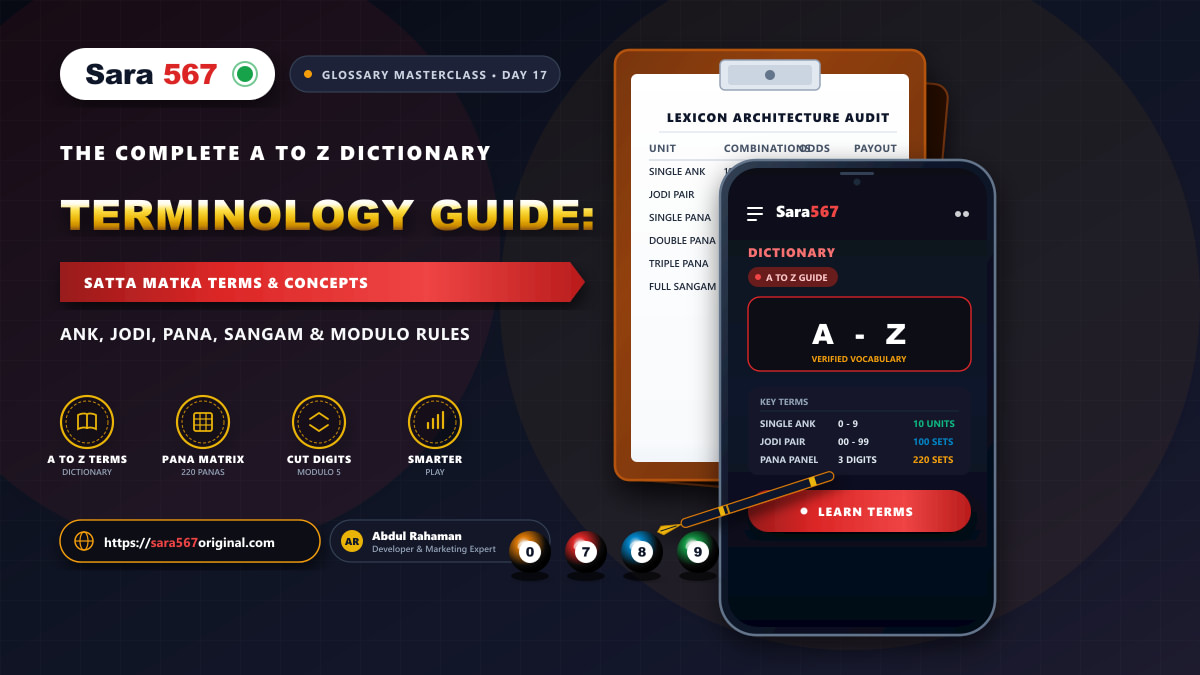
In this masterclass, we present the definitive A to Z dictionary of Satta Matka terminology. We deconstruct the vocabulary into five logical architectural categories, provide exact mathematical formulas for every number combination, clarify the difference between legitimate statistical concepts and deceptive scam jargon, and provide an exhaustive alphabetical reference guide.
Table of Contents
- Core Architectural Taxonomy of Matka Terminology
- Category 1: Fundamental Numerical Units (Ank, Jodi, Pana)
- Category 2: Advanced Synthesis Combinations (Sangam & Modulo)
- Category 3: Market Schedules & Operational Jargon
- Category 4: Chart Auditing & Analytical Concepts (Cuts & Brackets)
- The Master A to Z Satta Matka Dictionary Table
- Deceptive Slang & Fraudulent Jargon to Avoid
- How Sara 567 Standardizes Data Presentation
- Frequently Asked Questions (FAQs)
- Responsible Gaming & Analytical Ethics
Core Architectural Taxonomy of Matka Terminology
To master the language of numerical markets, it is helpful to organize terms into five distinct structural layers. The table below outlines the core taxonomy:
| Taxonomy Layer | Functional Focus | Key Example Terms | Analytical Application |
|---|---|---|---|
| 1. Primary Numbers | Fundamental building blocks of outcomes | Single Ank, Open, Close, Jodi, Pana, Patti | Basic unit selection and board tracking |
| 2. Complex Synthesis | Multi-variable combinations and formulas | Half Sangam, Full Sangam, Berij, Faraq | Advanced mathematical odds and high-multiplier analysis |
| 3. Market Operations | Timing, session phases, and schedules | Bazar, Open Time, Close Time, Run, Hiatus | Aligning study routines with live market declarations |
| 4. Chart Analytics | Historical patterns, trends, and symmetry | Cut Ank, Family Jodi, Red Jodi, Bracket, Latency | Conducting empirical audits on Sara 567 Charts |
| 5. Integrity & Safety | Technical verification vs scam prevention | WebSocket, Edge CDN, Fix Leak (Scam), P&L | Protecting personal capital and verifying data sources |
Category 1: Fundamental Numerical Units (Ank, Jodi, Pana)
Every market declaration consists of an interconnected progression of single digits, two-digit pairs, and three-digit triplets.
1. Ank (Single Digit)
- Definition: The Hindi word Ank (अंक) translates directly to "numeral" or "digit." In Satta Matka, an Ank refers strictly to any single integer between 0 and 9 ($S = {0, 1, 2, 3, 4, 5, 6, 7, 8, 9}$).
- Open Ank: The primary single digit declared during the first session of a market draw.
- Close Ank: The concluding single digit declared during the second session of a market draw.
- Final Ank: A specialized single digit historically calculated by syndicate analysts prior to the Close session (derived from specific modulo calculations). To learn how it works, see our guide on Final Ank Explained.
2. Jodi (Two-Digit Pair)
- Definition: The Hindi word Jodi (जोड़ी) means "pair." A Jodi is formed by combining the Open Ank and the Close Ank in sequential order.
- Combinatorial Space: Exactly 100 possible pairs, ranging from
00to99. - Mathematical Formula: $$\text{Jodi} = (10 \times \text{Open Ank}) + \text{Close Ank}$$ Example: If Open Ank is $4$ and Close Ank is $8$, the resulting Jodi is $48$.
- Red Jodi (Lal Jodi): A Jodi where both digits are identical (
00,11,22, ...,99) or where the two digits represent exact modulo 5 cut numbers (05,16,27,38,49,50,61,72,83,94). These are highlighted in red font on standard charts. Learn more in Reading Jodi Charts Like a Pro.
3. Pana / Patti (Three-Digit Panel Triplet)
- Definition: The three individual numbers drawn during a session, written in strictly ascending order ($d_1 \le d_2 \le d_3$). The sum of these three digits, modulo 10, yields the Single Ank.
- Combinatorial Space: Exactly 220 ascending three-digit combinations.
- Single Pana (SP): All three digits are distinct ($d_1 < d_2 < d_3$). Exactly 120 unique Single Panas exist (e.g.,
1-3-7,2-4-8,1-4-9). - Double Pana (DP): Two of the three digits are identical ($d_1 = d_2 < d_3$ or $d_1 < d_2 = d_3$). Exactly 90 unique Double Panas exist (e.g.,
1-1-5,2-4-4,7-7-9). - Triple Pana (TP / Motor): All three digits are identical ($d_1 = d_2 = d_3$). Exactly 10 unique Triple Panas exist:
000,111,222,333,444,555,666,777,888,999.
| Numerical Unit | Component Digits | Combinatorial Universe ($N$) | Theoretical Probability | Standard Multiplier |
|---|---|---|---|---|
| Single Ank | 1 Digit ($0\text{--}9$) | 10 | $1 / 10 = 10.0%$ | $1 : 9$ |
| Jodi (Pair) | 2 Digits ($00\text{--}99$) | 100 | $1 / 100 = 1.0%$ | $1 : 90$ |
| Single Pana (SP) | 3 Distinct Ascending Digits | 120 | $1 / 220 \approx 0.45%$ | $1 : 140$ |
| Double Pana (DP) | 2 Identical + 1 Distinct Digit | 90 | $1 / 220 \approx 0.45%$ | $1 : 280$ |
| Triple Pana (TP) | 3 Identical Digits | 10 | $1 / 1,000 = 0.1%$ | $1 : 600\text{ to }1 : 900$ |
Category 2: Advanced Synthesis Combinations (Sangam & Modulo)
Beyond basic single-session picks, traditional markets feature complex multi-session synthesis wagers connecting both the Open and Close panels.
1. Half Sangam
A synthesis wager combining a three-digit Pana from one session with the Single Ank from the opposing session. There are two distinct variations:
- Type A: Open Pana + Close Ank (e.g.,
124Open Pana and8Close Ank). - Type B: Open Ank + Close Pana (e.g.,
7Open Ank and350Close Pana). - Combinatorial Space: $220 \times 10 = 2,200$ possible combinations.
- Standard Payout Ratio: $1:1,000$ to $1:1,400$.
2. Full Sangam
The ultimate combinatoric challenge in Indian numbers markets: correctly selecting both the three-digit Open Pana and the three-digit Close Pana simultaneously.
- Structure:
[Open Pana] × [Close Pana](e.g.,148 × 235). - Combinatorial Space: $220 \times 220 = 48,400$ possible combinations.
- Theoretical Probability: $1 / 48,400 \approx 0.00206%$.
- Standard Payout Ratio: $1:10,000$ to $1:15,000$.
3. Berij (Total Sum Modulo)
In Hindi/Marathi market culture, Berij (बेरीज) translates to "addition" or "sum." It refers to the digital root sum of a Jodi.
- Example: For Jodi
39, the sum is $3 + 9 = 12$. Dropping the tens digit yields a Berij of $2$.
4. Faraq (Difference Metric)
The absolute difference between the Close Ank and Open Ank ($|\text{Close} - \text{Open}|$). Analysts utilize Faraq tables to assess whether historical results are clustering around narrow differences (e.g., Faraq 1: 23, 45, 78) or wide divergences (e.g., Faraq 8: 19, 08).
| Advanced Combination | Input Parameters | Formula / Construction | Sample Space | Typical Payout Multiplier |
|---|---|---|---|---|
| Half Sangam (A) | Open Pana + Close Ank | $\text{Pana}{\text{open}} + \text{Ank}{\text{close}}$ | 2,200 | $1 : 1,000\text{ to }1 : 1,400$ |
| Half Sangam (B) | Open Ank + Close Pana | $\text{Ank}{\text{open}} + \text{Pana}{\text{close}}$ | 2,200 | $1 : 1,000\text{ to }1 : 1,400$ |
| Full Sangam | Open Pana + Close Pana | $\text{Pana}{\text{open}} + \text{Pana}{\text{close}}$ | 48,400 | $1 : 10,000\text{ to }1 : 15,000$ |
| Berij (Sum Total) | Jodi Digits Sum | $(\text{Open} + \text{Close}) \pmod{10}$ | 10 | $1 : 9$ |
| Faraq (Difference) | Absolute Ank Divergence | $ | \text{Close} - \text{Open} | $ |
For deep insights into the mathematical probabilities behind these formats, read our Mathematical Aspects of Satta Matka.
Category 3: Market Schedules & Operational Jargon
Understanding the operational tempo and schedule terminology prevents timing confusion during active declaration windows:
- Bazar (Market): A distinct, branded numerical game entity operating under fixed, scheduled declaration windows (e.g., Kalyan Bazar, Milan Night, Rajdhani Day).
- Open Time: The exact scheduled moment when the three-digit Open Pana and Open Ank are declared.
- Close Time: The scheduled moment when the concluding Close Pana and Close Ank are declared, completing the daily Jodi.
- Draw Interval: The duration of time elapsing between Open Time and Close Time (typically 1 to 2 hours in standard markets).
- Regular Market: Flagship long-standing markets operating on the two-session (Open/Close) format with 220 Panas and 100 Jodis.
- Regional Market: Localized single-session variants (e.g., Disawar, Gali, Faridabad, Ghaziabad) where an entire two-digit result is declared in a single event without separate Open/Close Panas. Learn more in our Regional Satta Matka Variants Guide.
- Hiatus / Off-Day: Days when a market ceases operations (e.g., Kalyan and Time Bazar do not operate on Sundays; Rajdhani Day/Night pauses on Saturdays and Sundays).
| Market Classification | Operational Windows | Weekly Operating Days | Declaration Format | Landmark Benchmark |
|---|---|---|---|---|
| Benchmark 6-Day | 04:10 PM / 06:10 PM | Monday – Saturday (6 Days) | Dual Session (Open Pana + Close Pana) | Kalyan Matka |
| Unbroken 7-Day | Day: 03:00 PM / 05:00 PM<br />Night: 09:00 PM / 11:00 PM | Monday – Sunday (7 Days) | Continuous Daily Dual Sessions | Milan Day & Night |
| Business Week 5-Day | Day: 03:15 PM / 05:15 PM<br />Night: 09:35 PM / 11:35 PM | Monday – Friday (5 Days) | Weekday Dual Sessions (Weekend Break) | Rajdhani Day & Night |
| Midday Speed 1-Hour | 01:00 PM / 02:00 PM | Monday – Saturday (6 Days) | Rapid 1-Hour Resolution Window | Time Bazar |
Category 4: Chart Auditing & Analytical Concepts (Cuts & Brackets)
Professional chart analysts rely on a specialized set of structural terms when mapping historical trends across Sara 567 Jodi and Pana Charts:
1. Cut Ank / Opposite Number (Cut Number)
In Indian market arithmetic, every digit from $0$ through $9$ has an intrinsic mirror counterpart separated by a distance of modulo 5 ($|d_1 - d_2| = 5$).
When an analyst says "the Cut of 2 appeared," they mean the digit $7$ was declared. Cut numbers form the basis for Family Jodis and cross-hedging strategies:
| Primary Digit | Mathematical Modulo | Cut / Opposite Digit | Arithmetic Proof |
|---|---|---|---|
| 0 | $(0 + 5) \pmod{10}$ | 5 | $5 - 0 = 5$ |
| 1 | $(1 + 5) \pmod{10}$ | 6 | $6 - 1 = 5$ |
| 2 | $(2 + 5) \pmod{10}$ | 7 | $7 - 2 = 5$ |
| 3 | $(3 + 5) \pmod{10}$ | 8 | $8 - 3 = 5$ |
| 4 | $(4 + 5) \pmod{10}$ | 9 | $9 - 4 = 5$ |
| 5 | $(5 + 5) \pmod{10}$ | 0 | $5 - 0 = 5$ |
| 6 | $(6 + 5) \pmod{10}$ | 1 | $6 - 1 = 5$ |
| 7 | $(7 + 5) \pmod{10}$ | 2 | $7 - 2 = 5$ |
| 8 | $(8 + 5) \pmod{10}$ | 3 | $8 - 3 = 5$ |
| 9 | $(9 + 5) \pmod{10}$ | 4 | $9 - 4 = 5$ |
2. Family Jodi (Kutumb Jodi)
A cluster of eight mathematically interrelated Jodis formed by substituting digits with their respective Cut numbers and reversing their order.
- Example: For Jodi
14, its complete 8-member Family consists of:- Base Jodi:
14 - Inverted Jodi:
41 - Half Cuts:
19,64,46,91 - Full Cuts:
69,96
- Base Jodi:
3. Bracket
The complete historical weekly row displayed on a Jodi Chart. A standard bracket displays 5 to 7 consecutive daily Jodis side by side (Monday through Sunday), allowing researchers to observe horizontal weekly momentum.
4. Statistical Latency (Cold Number)
The measure of how many consecutive draws have elapsed since a specific digit or Pana last appeared. If digit $8$ has not appeared in 35 consecutive sessions, its latency metric is $L = 35$.
The Master A to Z Satta Matka Dictionary Table
Use this alphabetical reference table to look up any standard industry term instantly:
| Term | Category | Plain-Language Definition |
|---|---|---|
| Ank | Number | A single digit ranging from $0$ to $9$. |
| Bahi-Khata | History | The traditional hand-bound paper ledger books used by 20th-century bookmakers. |
| Bankroll | Risk | The strictly isolated pool of disposable entertainment funds allocated for gaming. |
| Bazar | Market | An organized numerical market entity (e.g., Kalyan, Milan, Rajdhani). |
| Berij | Formula | The single-digit modulo 10 sum of the two numbers in a Jodi ($[O + C] \pmod{10}$). |
| Bracket | Chart | A complete horizontal weekly row of daily Jodis on a chart. |
| Close Ank | Number | The final single digit declared during the concluding afternoon/evening session. |
| Close Pana | Number | The ascending three-digit combination that produces the Close Ank. |
| Cut Ank | Formula | The mirror digit separated by 5 units ($0\leftrightarrow 5, 1\leftrightarrow 6, 2\leftrightarrow 7, 3\leftrightarrow 8, 4\leftrightarrow 9$). |
| Double Pana (DP) | Number | A three-digit panel containing two identical digits and one distinct digit (e.g., 224). |
| Draw Interval | Operations | The elapsed time duration between Open declaration and Close declaration. |
| Family Jodi | Chart | The set of 4 or 8 mathematically correlated pairs formed by cut digits. |
| Faraq | Formula | The absolute numerical difference between the Close Ank and Open Ank. |
| Final Ank | Formula | A theoretical single digit calculated prior to Close declaration. |
| Full Sangam | Complex | The dual selection of both the Open Pana and Close Pana ($1 / 48,400$ odds). |
| Half Red | Chart | A Jodi where one digit is a cut number of the other (e.g., 16, 27, 38). |
| Half Sangam | Complex | A combination of an Open Pana + Close Ank, or Open Ank + Close Pana. |
| Jodi | Number | A two-digit pair from 00 to 99 created by combining Open and Close Anks. |
| Kalyanji Bhagat | History | The pioneering founder of Kalyan Matka who introduced the daily clay pot draw in 1962. |
| Latency | Analytics | The number of consecutive market draws a digit has remained unannounced. |
| Matka | History | The Hindi word for an earthen clay pot, historically used to hold paper number slips. |
| Open Ank | Number | The first single digit announced during a market's opening session. |
| Open Pana | Number | The ascending three-digit combination that produces the Open Ank. |
| Pana / Patti | Number | A three-digit panel triplet arranged in strictly ascending order ($220$ total). |
| Ratan Khatri | History | The pioneer known as the "Matka King" who founded Worli Matka using playing cards in 1964. |
| Red Jodi | Chart | A Jodi where digits are identical (33) or modulo 5 cuts (38), rendered in red ink. |
| Single Ank | Number | A single numeral from $0$ to $9$; foundational betting unit. |
| Single Pana (SP) | Number | A three-digit panel containing three completely distinct digits (e.g., 138). |
| Stop-Loss | Risk | A mandatory pre-set limit (e.g., 3 units) that terminates a session upon loss. |
| Tilt | Psychology | An emotional, irrational state causing players to chase losses and violate bankroll rules. |
| Triple Pana (TP) | Number | A panel where all three digits are identical (e.g., 777); 10 exist. |
| Unit Sizing | Risk | Sizing bets strictly to $1%\text{--}2%$ of total available bankroll. |
| WebSocket | Technology | The persistent cloud network protocol powering instant live declarations on Sara 567. |
Deceptive Slang & Fraudulent Jargon to Avoid
The dark side of unregulated social media channels involves the deliberate manufacture of pseudo-technical jargon designed to swindle unsuspecting beginners. Educating yourself on these fraudulent terms is your first line of defense:
| Fraudulent Term | What Scammers Claim It Means | The Objective Truth & Reality |
|---|---|---|
| "100% Fix Leak Game" | An insider leaked number obtained directly from market managers | 100% Advance-fee scam. Draws are random; no insider leaks exist. |
| "Direct Company Report" | Official paper report leaked from a central corporate office | There is no "central corporate company." Syndicates do not leak reports. |
| "VIP Paid Group / Membership" | Exclusive WhatsApp/Telegram channel providing guaranteed winning numbers | Scammers collect upfront subscription fees and disappear after losses. |
| "Sure Shot Jodi" | A number pair mathematically guaranteed to declare today | Pure mathematical impossibility. Every Jodi has an independent $1%$ probability. |
| "Loss Cover Package" | A custom betting plan guaranteed to recoup all past financial losses | Predatory scheme designed to extract remaining funds from vulnerable individuals. |
For a complete breakdown of predatory traps, consult our guide on Common Satta Matka Mistakes to Avoid.
How Sara 567 Standardizes Data Presentation
Navigating historical records should never be a chaotic or confusing experience. Sara 567 has pioneered the most modern, legible, and standardized user interface in the Indian market sector:
- Clear Typographic Visual Hierarchy: Our Jodi Charts and Pana Charts feature high-contrast, responsive grids that distinguish Open Anks, Close Anks, and Panas at a glance.
- Automated Color Coding: All Red Jodis and Cut pairs are highlighted automatically using compliant semantic CSS, eliminating the need for manual calculations.
- Sub-200ms WebSocket Pushes: Live results are streamed directly to your mobile screen without requiring constant manual page refreshing.
- Complete Non-Wagering Informational Environment: We strictly publish verified historical records, mathematical probability guides, and educational tutorials—we never host, promote, or accept monetary bets.
Frequently Asked Questions (FAQs)
1. What is the fundamental difference between an Ank, a Jodi, and a Pana?
An Ank is a single digit from $0$ to $9$. A Jodi is a two-digit pair from 00 to 99 created by joining the Open Ank and Close Ank. A Pana (or Patti) is a set of three ascending digits (e.g., 1-4-8) whose sum modulo 10 determines the Single Ank.
2. Why are certain Jodis highlighted in red on charts?
Red Jodis (Lal Jodi) represent pairs where both digits are identical (e.g., 44, 99) or where the digits represent exact modulo 5 cut numbers (e.g., 49, 16, 27). Historically, physical bookmakers marked these rare symmetrical outcomes in red ink to distinguish them on physical ledger sheets.
3. What does "Cut Number" mean in practice?
A Cut Number is the mirror digit separated by 5 units ($d \pm 5 \pmod{10}$). For example, the cut of $1$ is $6$, the cut of $3$ is $8$, and the cut of $0$ is $5$. Analysts use cut digits to create balanced 4-pair or 8-pair Family Jodi combinations.
4. How many total Pana combinations exist?
There are exactly 220 ascending Pana combinations in regular Indian numbers markets:
- 120 Single Panas (all three digits different)
- 90 Double Panas (two digits identical)
- 10 Triple Panas (all three digits identical)
5. Can mathematical knowledge of terminology guarantee wins?
No. Thorough knowledge of terminology and combinatorics allows you to read charts objectively, audit statistical frequencies, and manage risk through disciplined unit sizing. However, every draw remains an independent random trial governed by probability, and no system can guarantee future outcomes.
Responsible Gaming & Analytical Ethics
The definitions, mathematical relationships, and operational concepts in this glossary are published exclusively for educational, historical, and research purposes.
Always keep these safety guidelines in mind:
- Satta Matka involves real financial risk and can become psychologically addictive.
- Never wager money that is required for food, rent, education, healthcare, or family needs.
- Never trust anyone claiming to possess "fix numbers" or guaranteed leaks.
- If you or someone you know is struggling with compulsive gambling behaviors, seek immediate assistance from professional counseling services such as Gamblers Anonymous.
Stay informed, navigate charts with analytical discipline, and verify all records objectively on Sara 567.
Full stack developer and marketing expert specializing in scalable web architecture, SEO optimization, and data-driven analytics for digital platforms.