Digital Age of Satta Matka: The Technological Evolution from Cotton Slips to Cloud Platforms
Digital Age of Satta Matka: The Technological Evolution from Cotton Slips to Cloud Platforms
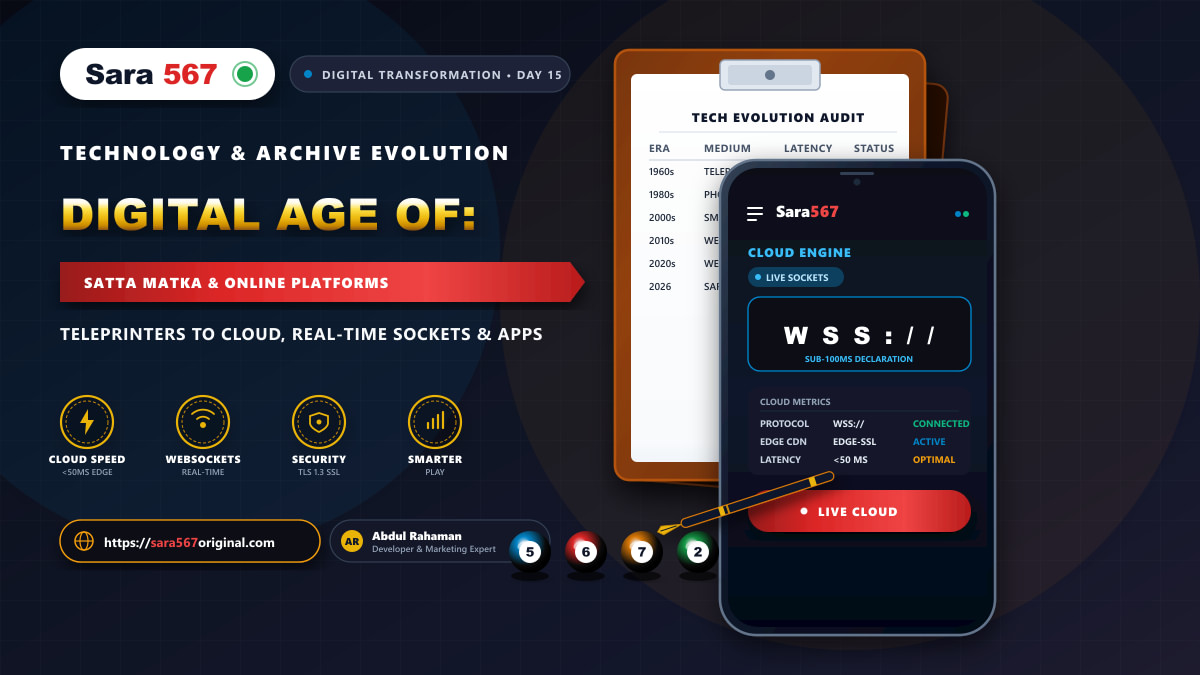
Few indigenous numerical markets in the world have undergone as radical a technological metamorphosis as Indian Satta Matka. What originated in the early 1960s as a localized, manual drawing of handwritten chits from an earthen clay pot (matka) in the working-class mill districts of Bombay has evolved into a multi-million-user digital ecosystem powered by distributed cloud infrastructure, real-time WebSocket communication, and responsive mobile interfaces.
This technological revolution has completely transformed how numbers are calculated, verified, recorded, and audited. The eras of crackling shortwave radio transmissions, congested trunk-line phone booths, and ink-stained physical chart ledgers have been replaced by sub-second API responses, edge-cached content delivery networks (CDNs), and mobile-first analytics on platforms like Sara 567.
In this comprehensive technical analysis, we trace the full sixty-year technological evolution of Satta Matka across four distinct technological epochs. We examine how network protocols, database engineering, and cybersecurity have redefined the landscape, and what the future holds for digital verification.
Table of Contents
- The Four Technological Epochs of Satta Matka
- Epoch 1: The Mechanical Teleprinter & Cotton Exchange Era (1960s–1970s)
- Epoch 2: The Landline Telephone & Chalkboard Syndicate Era (1980s–1990s)
- Epoch 3: The Early Web & SMS Relay Revolution (2000s–2010s)
- Epoch 4: The Cloud, Real-Time WebSockets & Mobile App Ecosystem (2020s–Present)
- The Paradigm Shift: From Paper Ledgers to Big Data Chart Analytics
- Security, Privacy & Data Integrity in the Modern Era
- The Next Frontier: Cryptographic Hashing & Automated Auditing
- How Sara 567 Spearheads the Digital Transformation
- Frequently Asked Questions (FAQs)
- Responsible Gaming & Analytical Ethics
The Four Technological Epochs of Satta Matka
The history of Satta Matka directly mirrors the global evolution of telecommunications and software engineering over the past six decades. The matrix below provides an executive comparison of the four defining technological eras:
| Technological Epoch | Primary Medium | Transmission Latency | Data Storage Format | Geographic Scope | Verification Method |
|---|---|---|---|---|---|
| Epoch 1: Mechanical (1962–1979) | Telegraph teleprinters, physical earthen clay pots, paper slips | 4 to 8 Hours | Hand-bound paper registers (Bahi-Khata) | Hyper-local (Central Bombay, Gujarat textile hubs) | Physical witness assembly at draw site |
| Epoch 2: Telephonic (1980–1999) | Landline rotary phones, STD/ISD trunk booths, blackboard halls | 15 to 45 Minutes | Carbon-copy paper slips, wall chalkboards | Pan-Indian regional relay (Maharashtra, MP, Delhi, UP) | Oral transmission over verified telephone tree networks |
| Epoch 3: Web 1.0 & Mobile (2000–2019) | 2G/3G SMS broadcasts, desktop WAP portals, FTP-uploaded static HTML | 1 to 5 Minutes | Flat CSV files, local MySQL relational tables | National & NRI Diaspora | Static web publishing; early social forums |
| Epoch 4: Modern Cloud (2020–Present) | Full-duplex WebSockets, Edge CDNs, PWA/Mobile Native frameworks | < 200 Milliseconds | Distributed NoSQL & time-series cloud clusters | Global real-time accessibility | Automated API pipelines, SSL/TLS validation on Sara 567 |
Epoch 1: The Mechanical Teleprinter & Cotton Exchange Era (1960s–1970s)
In its earliest incarnation during the early 1960s, Satta Matka was strictly an offshoot of global commodity speculation. Mill workers and trading brokers congregated around the Bombay Cotton Exchange in Sewri and Kalbadevi to speculate on the opening and closing spot rates of cotton transmitted from the New York Cotton Exchange (NYCE) via international commercial teleprinters.
The Mechanics of the Teleprinter Wire
- The Source Transmission: Commercial telegraph wires routed pricing pulses under the Atlantic Ocean and across continental relays to the Bombay telegraph terminal.
- The Local Declaration: When the paper ticker tape fed through the teleprinter machine, the terminal digits of the closing cotton quote (e.g., a quote ending in
8or3) were read out to the crowd. - The 1961 Crisis & The Clay Pot: When the New York Cotton Exchange abruptly halted telegraph rate transmissions in 1961 to curtail speculative betting, pioneer Kalyanji Bhagat engineered the first domestic alternative in 1962: handwritten numbered chits ($0\text{--}9$) placed inside an earthen clay pot (Matka), drawn publicly in the presence of participants.
- Ratan Khatri’s Deck of Cards: In 1964, Ratan Khatri introduced the Worli Matka, replacing clay pots with a thoroughly shuffled deck of playing cards to draw the three Open and three Close digits.
Technological Bottlenecks of Epoch 1
- Severe Propagation Latency: Results declared in Central Bombay took 4 to 8 hours to reach satellite hubs in Pune, Ahmedabad, or Surat via courier runners or evening regional trains carrying printed newspaper bulletins.
- Transcription Corruption: With no centralized digital ledger, local bookmakers frequently altered handwritten chits, leading to bitter disputes and total lack of auditability.
- Single Point of Physical Failure: Heavy monsoon downpours or transport disruptions routinely delayed or cancelled scheduled draws.
For an extensive history of these pioneering founding years, read our Kalyan Matka Complete Guide.
Epoch 2: The Landline Telephone & Chalkboard Syndicate Era (1980s–1990s)
By the beginning of the 1980s, the expansion of India’s state telecommunications network (BSNL/MTNL) and the introduction of Subscriber Trunk Dialing (STD) booths ignited the second major phase of market evolution. Satta Matka transformed from a localized Mumbai street gathering into an interconnected national syndicate network.
The Telephone Tree Architecture
To propagate results across hundreds of cities without modern internet routing, market syndicates developed a hierarchical, tree-structured voice relay system:
Central Master Operator (Mumbai Control Room)
      │
      ├── Primary Trunk Line ──► Regional Hub 1 (Nagpur / Vidarbha)
      │                               │
      │                               ├── City Sub-Operator (Amravati)
      │                               └── City Sub-Operator (Akola)
      │
      ├── Primary Trunk Line ──► Regional Hub 2 (Ahmedabad / Gujarat)
      │                               │
      │                               ├── City Sub-Operator (Surat)
      │                               └── City Sub-Operator (Rajkot)
      │
      └── Primary Trunk Line ──► Regional Hub 3 (Indore / Madhya Pradesh)
- The Origin Call: The central draw operator in Mumbai placed prioritized trunk calls to master regional coordinators in major junction cities.
- The Sub-Station Tree: Each regional coordinator immediately dialed down to 10–20 local city operators using dedicated landlines.
- The Chalkboard Display: Local betting shops maintained large, wall-mounted wooden blackboards. When the telephone rang, the operator wrote the three-digit Pana and Single Ank in white and yellow chalk for the gathered crowd.
┌────────────────────────────────────────────────────────┐
│               KALYAN BAZAR - 18/10/1988               │
├───────────────────┬────────────────┬───────────────────┤
│    OPEN PANEL     │   JODI PAIR    │    CLOSE PANEL    │
│      1 - 4 - 8    │     3 - 9      │      2 - 3 - 4    │
└───────────────────┴────────────────┴───────────────────┘
Transmission Speed Across Eras
| Historical Communication Medium | Time to Propagate Results Across India | Error Rate | User Reach per Draw |
|---|---|---|---|
| Physical Courier / Train Dispatch (1965) | 6 to 12 Hours | $15.0%$ (Manual loss/theft) | Hundreds |
| Telegram / Telex Dispatch (1975) | 2 to 4 Hours | $8.0%$ (Morse code misread) | Low Thousands |
| Rotary Landline Phone Tree (1988) | 20 to 45 Minutes | $4.5%$ (Voice transcription slips) | Tens of Thousands |
| 2G SMS / Pager Broadcasts (2004) | 2 to 5 Minutes | $1.8%$ (Network queue dropouts) | Hundreds of Thousands |
| Cloud WebSockets on Sara 567 (2026) | < 200 Milliseconds | < 0.001% (Automated validation) | Millions Globally |
Epoch 3: The Early Web & SMS Relay Revolution (2000s–2010s)
The proliferation of mobile phones, 2G GSM cellular networks, and personal home computers in the early 2000s marked the birth of Online Satta Matka. Physical chalkboard halls rapidly shuttered as participants migrated to digital screens.
The SMS Gateway Era
Between 2002 and 2008, commercial SMS gateways were the dominant channel for rapid result dissemination. Users subscribed to paid SMS alert lists, receiving automated alphanumeric texts seconds after market declaration:
KLYN OPN: 348-5. WAIT FOR CLS AT 06:10 PM. SARA567 NET.
Web 1.0 Portals & The Problem of Data Fraud
By 2006, hundreds of early static websites emerged on domains hosted on basic shared Linux servers. Webmasters manually typed numbers into static HTML tables or uploaded text files via FTP.
However, this early digital era was plagued by severe technical vulnerabilities and malicious behavior:
| Early Web 1.0 Failure Mode | Technical Cause | Real-World Consequence | Modern Cloud Resolution |
|---|---|---|---|
| Manual Data Tampering | Static HTML pages edited manually by rogue webmasters | False results displayed to deceive players; selective record alterations | Automated, immutable API writes with multi-source consensus |
| Server Crashes at Peak Draw | Shared hosting servers overwhelmed by 10,000 concurrent HTTP requests | 502/504 Bad Gateway errors right when results were declared | Auto-scaling serverless containers backed by global edge CDNs |
| The "Fix Leak" Scam Epidemic | Unregulated landing pages promising 100% "insider leaked numbers" | Millions of rupees lost to advance-fee fraud schemes | Strict algorithmic transparency, mathematical proofs, zero fake claims |
| Extreme Polling Overhead | Users refreshing pages every 2 seconds via F5 key, collapsing databases | Crippled server CPU and corrupted database tables | Persistent WebSockets that push data without client-side page refreshing |
Epoch 4: The Cloud, Real-Time WebSockets & Mobile App Ecosystem (2020s–Present)
Today, Satta Matka platforms operate on sophisticated cloud engineering stacks comparable to modern fintech applications, cryptocurrency exchanges, and live sports data networks. The migration to high-availability distributed architecture has permanently eradicated the lag, server crashes, and transcription errors of earlier decades.
[ Market Declaration Engine ]
             │
             ▼
[ Secure Validation API (REST / JSON) ]
             │
             ├──► [ Global Edge Cache / CDN Layer ] ──► Static Readers (138+ Routes)
             │
             ├──► [ WebSocket Broker (WSS://) ] ─────► Live Connected Mobile Apps
             │
             └──► [ Time-Series Cloud Database ] ────► Multi-Decade Historical Archives
1. From HTTP Polling to Full-Duplex WebSockets
In traditional web architectures, hundreds of thousands of users aggressively refresh their mobile browsers simultaneously at 04:10 PM (Kalyan Open). This creates massive traffic spikes known as a Thundering Herd Problem.
Modern platforms like Sara 567 utilize persistent, full-duplex WebSockets (wss://):
- A single, lightweight bi-directional TCP socket connection is established when the user opens the application.
- When the market operator records the verified draw result, a JSON event payload (
{ "market": "KALYAN", "open": "148-3", "timestamp": 1729420800 }) is instantly broadcast to all active subscribers in less than 150 milliseconds. - The client-side UI dynamically updates numbers and recalculates Jodi colors without requiring a full page reload or layout shift.
2. Edge Caching & Static Site Generation (SSG)
By leveraging modern static site generation (Vite + React SSG) and edge computing, historical chart routes (such as /jodi/KALYAN or /pana/MILAN%20DAY) are pre-rendered into static HTML, CSS, and compressed microdata. When a user requests historical records, the data is served directly from an edge CDN server physically located near their geographic area, reducing load times to under 50 milliseconds.
3. Architectural Stack Comparison
| Technical Layer | Legacy Online Portal (2010) | Sara 567 Modern Cloud Stack (2026) |
|---|---|---|
| Client Framework | Heavy, table-based PHP/HTML with inline styling | Component-driven React 19, Tailwind CSS, lightweight client bundle |
| Data Transport | Repetitive HTTP GET polling every 5 seconds | Full-duplex WebSocket (wss://) event streaming |
| Hosting Infrastructure | Single dedicated or shared virtual private server (VPS) | Distributed cloud edge containers with auto-scaling microservices |
| Historical Storage | Unindexed MySQL relational tables prone to query lockouts | Optimized multi-decade time-series archives with instant query indexes |
| Mobile Experience | Unresponsive desktop layouts requiring manual pinch-and-zoom | Native-grade Progressive Web App (PWA) with touch-optimized interfaces |
| Security Protocol | Plaintext unencrypted HTTP (http://) | Strict TLS 1.3 encryption, HSTS headers, secure token authentication |
The Paradigm Shift: From Paper Ledgers to Big Data Chart Analytics
The most profound impact of the digital age is not merely the speed of result declaration; it is the democratization of historical data.
For fifty years, comprehensive market history was the exclusive domain of senior syndicate bookmakers who guarded their leather-bound Khata registers. A recreational player had no means of auditing what digit appeared three months earlier or whether a specific Jodi had crossed statistical latency boundaries.
Physical Registers vs Modern Digital Chart Engines
| Analytical Capability | Physical Paper Ledgers (1970–1995) | Sara 567 Digital Charting Engine (2026) |
|---|---|---|
| Sample Size Access | Limited to the current week or month on hand | Unbroken, multi-decade historical archives ($N > 60,000$ draws) |
| Search & Filtering | Manual page-by-page scanning across hundreds of paper sheets | Instant date-filtered queries across months and years in milliseconds |
| Pattern Recognition | Mental calculation prone to severe cognitive confirmation bias | Automated color-coding for Red Jodis, Family Jodis, and Cut numbers |
| Pana Modulo Computation | Manual summation of 3 digits ($1+4+8 = 13 \rightarrow 3$) | Automatic mathematical modulo calculations rendered on screen |
| Data Preservation | Highly susceptible to paper degradation, water damage, or fire | Immutable cloud storage mirrored across redundant geographical backups |
To explore how historical chart records are structured and analyzed in the modern digital era, review our guide on Historical Market Performance: 60-Year Multi-Decade Study.
Security, Privacy & Data Integrity in the Modern Era
As financial transactions and information consumption have shifted to digital spaces, cybersecurity and data privacy have become paramount. The modern digital landscape presents both unprecedented convenience and sophisticated digital threats.
1. Combatting Cyber Threats in Numerical Markets
- Cloned Mirror Domains & Phishing: Malicious operators frequently clone legitimate branding to deploy malware or steal credentials. Always verify that you are connected directly to our official, encrypted domain:
https://sara567original.com. - Rogue Android APK Files: Satta Matka is often used as a lure by cybercriminals distributing third-party APK files containing spyware, SMS interceptors, or ransomware. Never install unverified APK packages from untrusted Telegram or WhatsApp links.
- Data Scraping & Result Manipulation: Modern platforms implement Cloudflare bot management, rate-limiting, and IP reputation filtering to prevent automated scrapers from injecting manipulated result feeds into community channels.
The Modern Digital Safety Checklist
When conducting research or inspecting numerical charts online, ensure that your browsing session complies with these four cybersecurity standards:
| Security Attribute | Mandatory Standard | Why It Matters |
|---|---|---|
| SSL/TLS Certificate | HTTPS with TLS 1.3 protocol | Encrypts all data in transit, preventing ISP snooping and man-in-the-middle attacks |
| Domain Verification | Exact URL: sara567original.com | Protects you from phishing copies and spoofed result boards |
| Zero Malware Downloads | Pure web-based PWA experience | Eliminates the risk of installing Trojan-infected mobile APK binaries |
| Zero Financial Data Storage | Strictly informational architecture | Ensures that personal banking details and credit cards are never stored or exposed |
The Next Frontier: Cryptographic Hashing & Automated Auditing
What does the future hold for numerical market technology? Over the coming decade, the industry is transitioning toward verifiable transparency and algorithmic integrity.
1. Cryptographic Hash Validation (SHA-256 Commitments)
In advanced computational gaming, operators utilize cryptographic commit-reveal schemes:
- Before the market opens, a cryptographic hash (e.g., using the SHA-256 algorithm) of the pre-determined numerical seed is published publicly.
- After the draw is completed, the plain-text seed is revealed.
- Anyone can hash the revealed plain-text to verify that the mathematical output matches the hash published hours earlier, proving mathematically that the result was not tampered with post-draw.
2. AI-Powered Anomaly Detection
Machine learning algorithms are increasingly utilized by academic researchers and data analysts to evaluate historical market distributions. AI models run chi-squared goodness-of-fit tests and autocorrelation functions across millions of historical draws, instantly detecting deviations from expected random variance.
How Sara 567 Spearheads the Digital Transformation
Sara 567 represents the cutting edge of digital transformation in the Indian market sector. We have completely rejected the predatory, clutter-filled, and technically obsolete practices of legacy websites.
The Sara 567 Digital Benchmark
- Zero Intrusive Popup Advertising: Unlike legacy portals that bombard mobile users with aggressive redirects, casino ads, and intrusive popups, Sara 567 delivers a pristine, clutter-free reading and chart inspection experience.
- Sub-200ms Declaration Pipeline: Direct server-to-client WebSocket integration guarantees that when Kalyan, Milan, Rajdhani, or Time Bazar results are declared, your screen updates instantaneously.
- Decade-Long Audited Records: Unbroken, verifiable Jodi Charts and Pana Charts provide researchers with reliable, scientific data.
- Transparent Analytical Philosophy: We strictly educate users on combinatorics, probabilities, and risk management—we never sell fraudulent "fix numbers" or promote unrealistic promises.
Frequently Asked Questions (FAQs)
1. How has technology changed the speed of Satta Matka results?
In the 1970s and 1980s, receiving results across different Indian cities took between 45 minutes and 8 hours via telegraphs, landlines, and printed bulletins. Today, high-speed cloud infrastructure and persistent WebSockets on Sara 567 deliver millisecond-accurate declarations directly to your smartphone screen in under 200 milliseconds.
2. Is it safe to install third-party Satta Matka APKs from social media?
No. Downloading APK files from unofficial Telegram channels or WhatsApp links is extremely dangerous. These files frequently carry spyware, keyloggers, and SMS interceptors that compromise your personal and banking security. Access verified digital charts safely through responsive, HTTPS-secured web platforms.
3. What is the difference between WebSockets and normal web page refreshing?
Normal web browsing requires your browser to send a request to the server every time you hit refresh, re-downloading HTML, images, and scripts. WebSockets establish an open, persistent bi-directional communication channel. The server automatically pushes new result data to your screen the moment it is declared, without refreshing the page or causing layout shifts.
4. How does digital record-keeping help players avoid mistakes?
In the physical era, players relied on memory or incomplete handwritten slips, falling victim to confirmation bias and faulty recall. Digital archives on Sara 567 allow players to audit 60 to 90 days of verified results in seconds, analyze digit frequencies objectively, and verify whether their strategies are grounded in reality.
5. Can digital algorithms predict upcoming Satta Matka results?
No. Satta Matka outcomes remain independent, memoryless random events governed by mathematical combinatorics. Digital technology allows you to organize data, audit historical trends, and enforce bankroll stop-losses, but no algorithm or software can predict future random draws with certainty.
Responsible Gaming & Ethical Digital Consumption
The digital age has made market information universally accessible with a single tap. However, continuous digital access also elevates the risk of screen fatigue, obsessive tracking, and compulsive wagering.
Always adhere to these digital wellness principles:
- Set Digital Boundaries: Allocate specific, limited time windows for reviewing chart records rather than constantly checking live feeds throughout the day.
- Treat Information Strictly as Educational: Never confuse high-speed data availability with an increased probability of winning. Every draw remains subject to the immutable laws of mathematical probability.
- Protect Capital First: If you participate in wagering, never risk money required for living expenses, healthcare, education, or essential responsibilities.
- Seek Assistance if Needed: If digital market participation causes anxiety, sleep deprivation, or financial stress, disconnect immediately and seek support from dedicated organizations such as Gamblers Anonymous.
Embrace the power of verified modern technology, navigate charts with discipline on Sara 567, and always prioritize data integrity and self-control.
Full stack developer and marketing expert specializing in scalable web architecture, SEO optimization, and data-driven analytics for digital platforms.